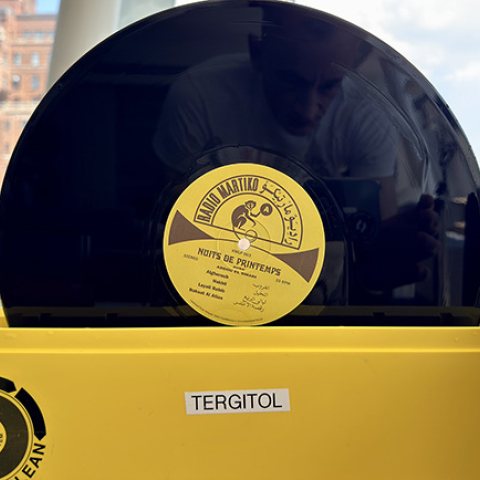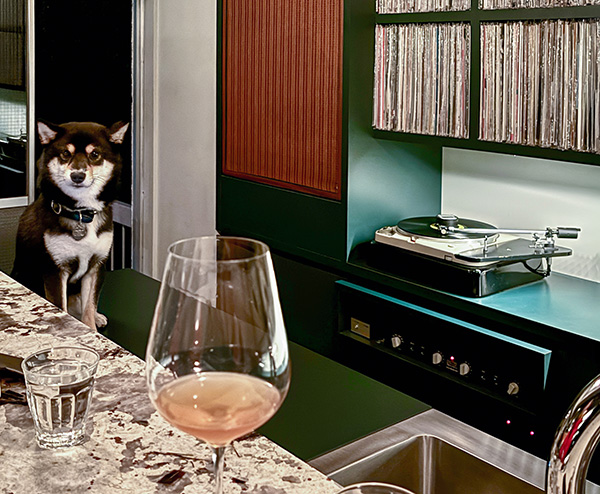
Studio Mule, Tokyo.
I was curious to see how jazz kissaten had inspired other kinds of listening spaces, and a few nights later, following a tip from a friend who had recently moved to Tokyo, I went to Studio Mule. Located on the fourth floor of a homely little building in Shibuya, the sleekly lit space is organized around a wraparound granite bar and a glass wall displaying thousands of bottles of natural wine, most from France and Italy. The interior, I learned, is the work of renowned designer Koichi Futatsumata, best known for his collaborations with Australian beauty brand Aesop.
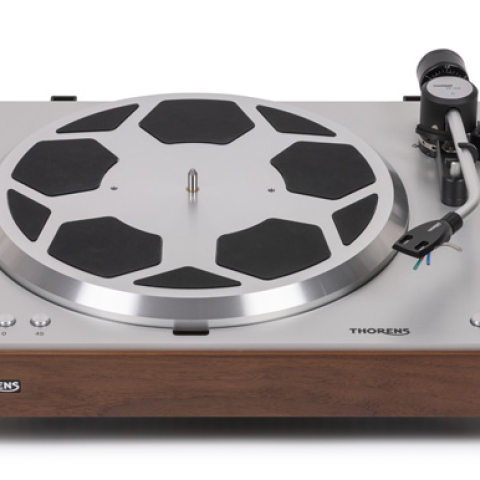
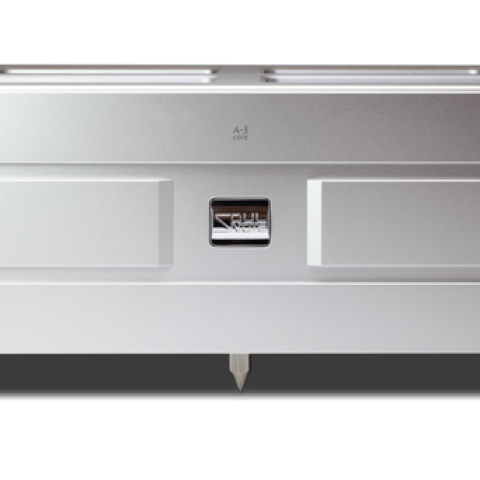
Studio Mule's proprietor, Toshiya Kawasaki, is a well-known deejay and owner of Mule Musiq, one of Japan's best electronic dance music labels; you can buy their records in a telephone booth–sized shop near the bar. Though I didn't ask, I doubt Kawasaki would call himself by the old-fashioned term masuta. Whereas everything inside the Eagle could have existed in the 1970s, there was nothing vintage about Studio Mule—except the hi-fi. The records were being played on a Thorens TD 124 turntable, a Mark Levinson amplifier, and decades-old Klipsch Cornwalls neatly set into the wall above the bar. There was no digital. The volume was moderate and the sound superb. Perhaps surprisingly, dance music isn't played at Studio Mule. And when I asked to hear some of the Brazilian records Kawasaki keeps above the bar, all the titles he chose were new to me. He played a delicately lilting track from Ricardo Bomba's sole long-player, Ultralight, followed it with a dancing cut from Airto Moreira's debut, Natural Feelings, and finally my favorite discovery of the night, the eponymous 1974 record by Jaime & Nair, a lovely melding of folk, bossa nova, and orchestral pop. (Thanks, Toshiya—I've since bought a reissue on vinyl.)
I sipped a glass of good champagne from Pierre Gerbais while McEnroe, Kawasaki's black-and-buff Shiba Inu, watched from the bar. It was around 10pm, and the place was packed with a mix of tourists and locals. Despite the jet lag, I was feeling fine and struck up a conversation with two women visiting from Seoul. They had polished off a bottle of orange wine and were in a bright, sociable mood, which made Kawasaki encourage them—graciously but firmly, and more than once—to keep it down. His determination to maintain a Japanese sense of decorum amid the presence of foreign visitors carried over to the bathroom. There, above the wonderful INAX, the Bentley of toilets, was a sign that read "Please sit while going to the bathroom."
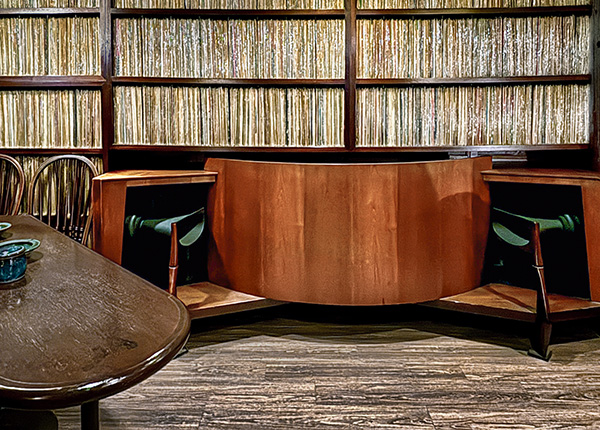
Modern Jazz Jamaica, Sapporo.
The most soulful kissa I visited was Modern Jazz Jamaica, in Sapporo. Located in a nondescript building in Susukino, the city's beehive-like nightlife district, it has been in continuous operation since it was founded by Shigemitsu and Mutsuko Higuchi in 1961. Shigemitsu passed 8 years ago, and now it's run mostly by the 79-year-old Mutsuko. On the night we visited, I hoped to meet her, but the woman behind the bar turned out to be her daughter.
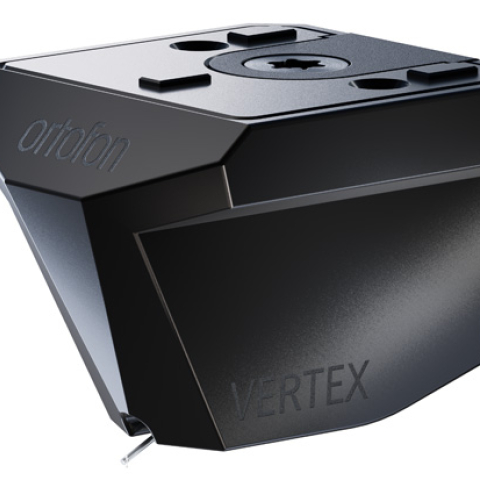
Jamaica, as everyone calls it, is a dim, wood-paneled room occupied almost entirely by records and a gorgeous JBL Paragon D44000 one-piece stereo speaker. The rest of the system consists of a Thorens Prestige turntable with an Ortofon SPU-GE cartridge mounted on an SME 3012 arm, a newer record player and CD rig from McIntosh, and amplification from Mark Levinson (yet again!). Amid the records are display cases of Japanese and American whiskeys, each bottle labeled with a regular customer's name. The jazz is classic and played loud.
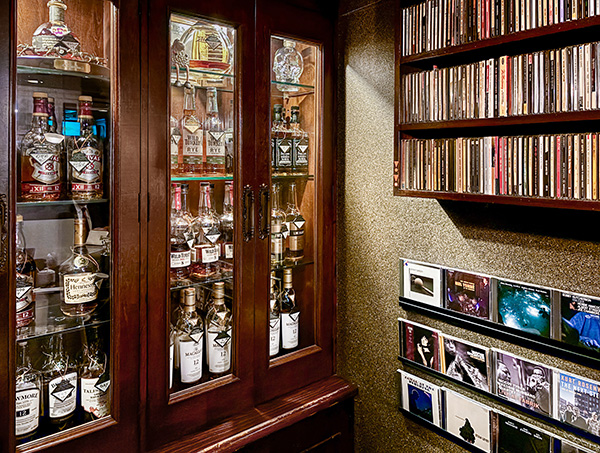
Modern Jazz Jamaica, Sapporo.
During that first visit, I was surprised to discover the bar occupied by American tourists, still an uncommon sight outside of skiing season in Hokkaido. Three middle-aged dudes were drinking large bottles of the city's famous beer and conversing at NASCAR volumes. One even took a phone call, which was somehow mercifully tolerated. A few Japanese regulars were reading at the sole table. After a while of this, one of the Americans said, "No one here is talking. I don't know what the custom is." Somehow, this insight passed unexplored, and the men carried on for a while longer until they finally paid and left, leaving us with only the John Coltrane record to listen to.
We came again the following day, at the strange hour of 4pm. Inside, Mutsuko (below) was alone, listening to a John Scofield CD with a look of deep pleasure. We sat down at the bar and, with the help of a local friend, asked some questions. Mutsuko talked for a while about the bar's early years, when high school students would cut classes to come listen to jazz and smoke, which made them feel grown up. She said that she and her late husband had named the club after their favorite Blue Mountain coffee beans from Jamaica, and that they had ordered the Paragon directly from California sometime in the 1960s. These days more visitors come to take photos of the bar for Instagram, Mutsuko related, but said that she didn't mind.
She put on an LP of the Bill Evans Trio's Waltz for Debby; in the small room, Evans and Scott LaFaro sounded nearly alive. Then she poured herself a coffee and sat on a stool behind the bar. "I think I'm happiest now," Mutsuko said with a grin. "All day I get to listen to music I like. And because of that, I think I've stopped aging."
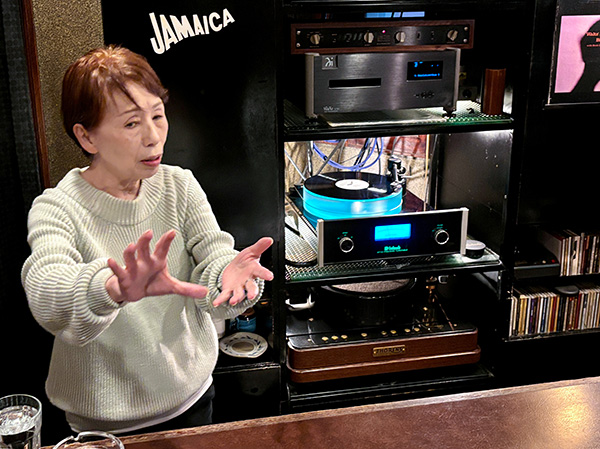
Mutsuko Higuchi at Modern Jazz Jamaica, Sapporo.