Sidebar 3: Measurements
I measured the Arvus H2-4D with my Audio Precision SYS2722 system. I connected the H2-4D's Ethernet port to my network and used the unit's GUI to set the processor's output configuration to "5.1.2," to make sure there was no DSP being used, and to set its volume control to the maximum. Initially, the data source was the HDMI output of my Roon Nucleus+, and playback was with the Roon 2.0 app, which recognized the Arvus as an ALSA device. However, concerned that I was getting anomalous results with data sampled at rates higher than 48kHz and bit depths greater than 16, I repeated the testing with the HDMI output of my 2017 MacBook Pro, using the VLC Player, Adobe Audition, and Pure Music apps. I used the Tascam–pin-out DB25-XLR snake that KR had used for his auditioning; although the Arvus has 8 AES3 digital outputs and 16 pairs of analog outputs, I performed all the measurements using the left front and right front channels.
Footnote 1: See arvus.com/atmos-h2-4d.html.
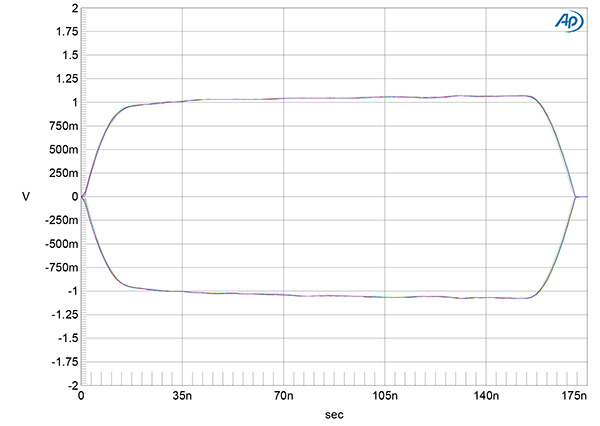
Fig.1 Arvus H2-4D, eye pattern of AES3 data output carrying 16-bit, 44.1kHz data (±2V vertical scale, 175ns horizontal scale).
I first examined the timing uncertainty in the Arvus H2-4D's AES3 output by looking at the datastream's "eye pattern." I overlaid successive snapshots of the H2-4D's AES3 output, taken over a 60s time window, with the Audio Precision's digital oscilloscope function, with data representing the 16-bit Miller/Dunn J-Test signal. With an ideal transmission system, the pulse transitions in the datastream will overlay one another precisely to produce an image of a wide-open "eye." Fig.1 was plotted over one "unit cycle." The eye is superbly open, with no blurring of the leading and trailing edges. The average jitter level, assessed with a 50Hz–100kHz bandwidth, was 681 picoseconds, which, though higher than that of the Jay's CD transport reviewed elsewhere in this issue, is still low.
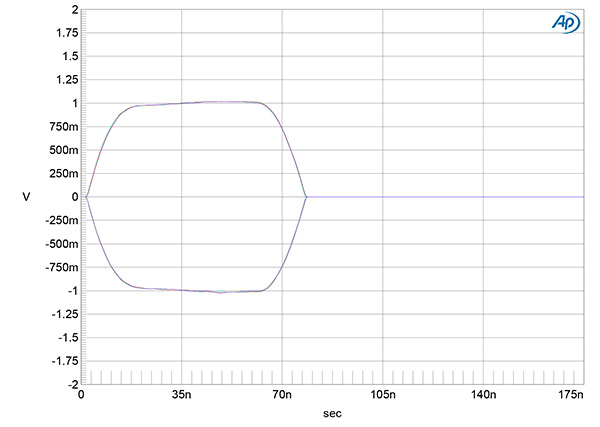
Fig.2 Arvus H2-4D, eye pattern of AES3 data output carrying 16-bit, 96kHz data (±2V vertical scale, 175ns horizontal scale).
Fig.2 shows the eye pattern with the Arvus outputting AES3 data sampled at 96kHz. The higher sample rate results in a significantly shorter eye, but there is still no blurring. The average jitter level with the 96kHz data was a little higher, at 827ps. Peculiarly, while the transmitted data had a 16-bit word length at both sample rates, the Audio Precision's Digital I/O panel indicated that all 24 bits in the AES3 stream were active. This might be due to the action of the Arvus's digital-domain volume control, even when set to do nothing.
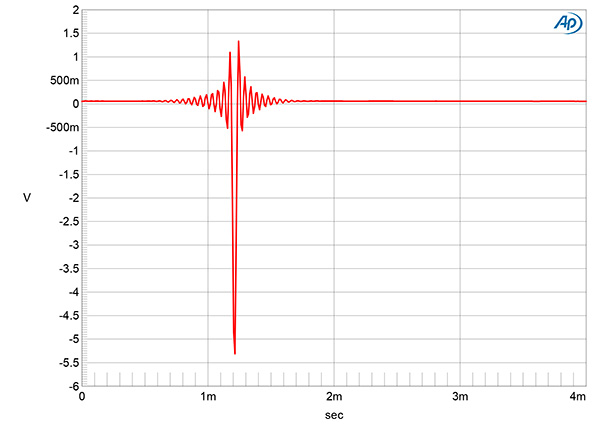
Fig.3 Arvus H2-4D, impulse response (one sample at 0dBFS, 44.1kHz sampling, 4ms time window).
Turning to the H2-4D's balanced analog outputs, the maximum level was 4.19V with the Roon server's HDMI output data but 6dB lower with all three apps on the MacBook Pro. The output impedance at 20Hz was a relatively high 1718 ohms, though the impedance dropped to 955 ohms at 1kHz and 950 ohms at 20kHz. The analog outputs inverted absolute polarity, as seen in fig.3, which shows the H2-4D's impulse response with 44.1kHz data. The response is typical of a linear-phase reconstruction filter, with equal amounts of ringing on either side of the single sample at 0dBFS.
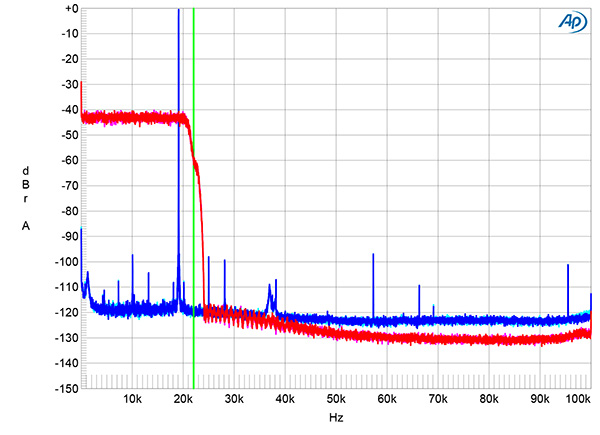
Fig.4 Arvus H2-4D, wideband spectrum of white noise at –4dBFS (left channel red, right magenta) and 19.1kHz tone at 0dBFS (left blue, right cyan) into 100k ohms with data sampled at 44.1kHz (20dB/vertical div.).
With 44.1kHz white-noise data (fig.4, magenta and red traces), the Arvus's output rolls off above half the sample rate (vertical green line), reaching full stopband attenuation at 24kHz. With a 19.1kHz tone at 0dBFS (cyan, blue), the aliased image at 25kHz is suppressed by 100dB, and the harmonics associated with the 19.1kHz tone are all very low in level.
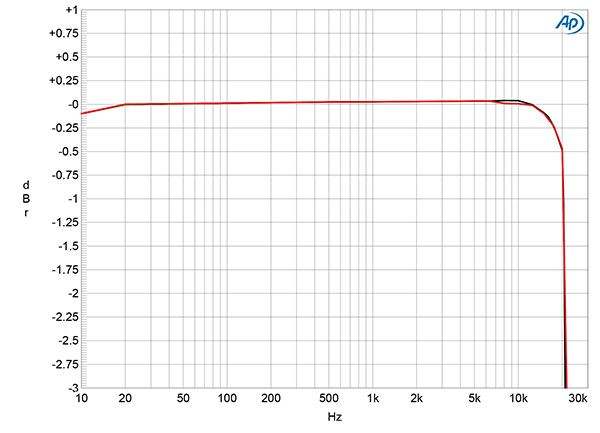
Fig.5 Arvus H2-4D, frequency response at –12dBFS into 100k ohms with data sampled at: 44.1kHz (left channel green, right gray) and 96kHz (left blue, right red) (1dB/vertical div.).
The Arvus's frequency response with data sampled at 44.1kHz and 96kHz is shown in fig.5. The responses at the two sample rates appear to be identical, which suggests that the higher-rate data were downsampled, perhaps to 48kHz. This graph was taken with the Roon server, so, wondering if Roon was responsible for the downsampling, this was the first test I repeated with the VLC Player and Adobe Audition apps on my laptop. I made sure that the HDMI output's sample rate had been correctly set with Apple's Audio MIDI control panel, but the results were identical.
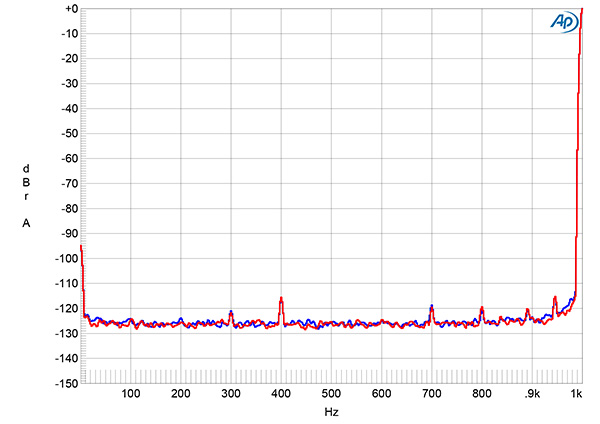
Fig.6 Arvus H2-4D, spectrum with noise and spuriae of dithered 1kHz tone at 0dBFS with 24-bit data (left blue, right red) (20dB/vertical div.).
Channel separation (not shown) was very good, at 87.5dB in both directions at all audio frequencies. The H2-4D's low-frequency noisefloor (fig.6), measured with a 24-bit 1kHz tone, was free from any power supply–related spuriae, though the level of random noise was higher than I expected with 24-bit data.
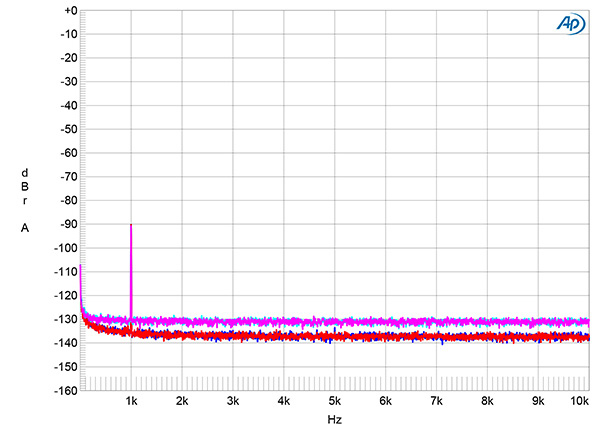
Fig.7 Arvus H2-4D, spectrum with noise and spuriae of dithered 1kHz tone at –90dBFS with: 16-bit data (left channel green, right gray), 24-bit data (left blue, right red) (20dB/vertical div.).
When I increased the word length from 16 bits to 24 bits with dithered data sourced from Roon representing a 1kHz tone at –90dBFS, the noisefloor was that of the LSB-level 16-bit dither with both 16- and 24-bit data. I repeated this test with the VLC Player, but the 24-bit noisefloor (fig.7, blue and red traces) was only 6dB below that with 16-bit data (green, gray traces). This suggests that the Arvus's analog outputs are limited to a resolution of at most 17 bits. (The Arvus website (footnote 1) says that the H2-4D is "16 & 24 bit compatible" but doesn't state the resolution limits.) Although the waveform of an undithered 16-bit tone at exactly –90.31dBFS (not shown) resolved the three discrete voltage levels, these were overlaid with high-frequency noise.
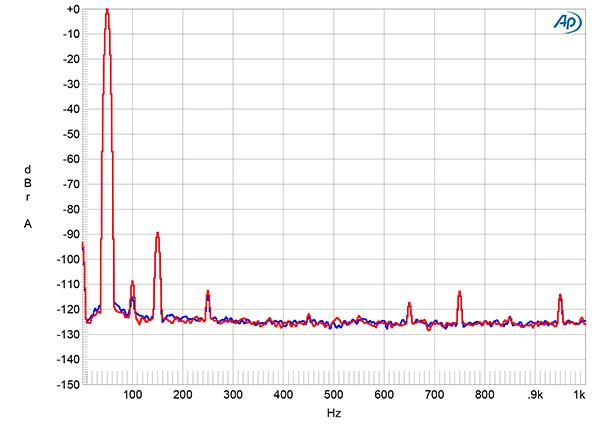
Fig.8 Arvus H2-4D, 24-bit data, spectrum of 50Hz sinewave, DC–1kHz, at 0dBFS into 600 ohms (left channel blue, right red; linear frequency scale).
The H2-4D offered very low levels of harmonic distortion. Even into the punishing 600 ohm load, with a full-scale 50Hz tone (fig.8), the third harmonic lay at just –90dB (0.003%) and the only other harmonics visible in this graph, the second and fifth, lie at or below –110dB (0.0003%). With a 1kHz tone at 0dBFS into 600 ohms, the third harmonic was even lower in level, at –100dB (0.001%).
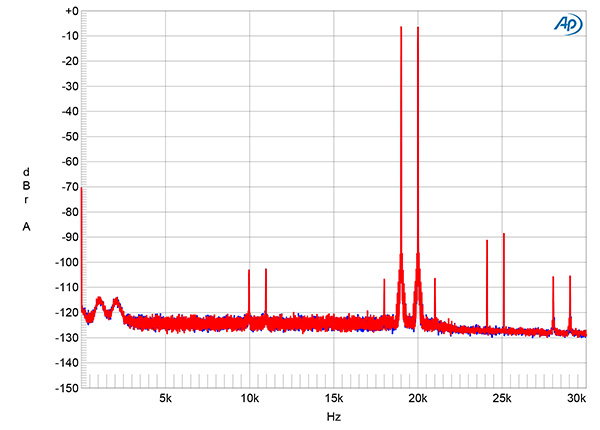
Fig.9 Arvus H2-4D, 24-bit data sampled at 44.1kHz, HF intermodulation spectrum, DC–30kHz, 19+20kHz at 0dBFS into 100k ohms (left channel blue, right red; linear frequency scale).
Intermodulation distortion products with an equal mix of 19kHz and 20kHz tones sampled at 44.1kHz, the signal peaking at 0dBFS, were all very low in level (fig.9). The aliased images of the primary tones were also low in level, though again the noisefloor was higher than I expected with 24-bit data.
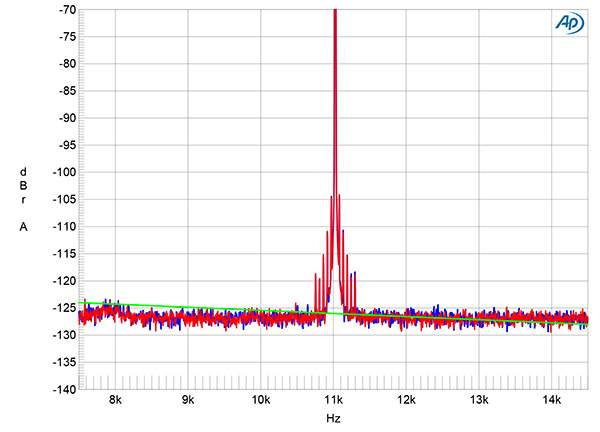
Fig.10 Arvus H2-4D, high-resolution jitter spectrum of analog output signal, 11.025kHz at –6dBFS, sampled at 44.1kHz with LSB toggled at 229Hz: 16-bit data (left channel blue, right red). Center frequency of trace, 11.025kHz; frequency range, ±3.5kHz.
Fig.10 shows the spectrum of the H2-4D's output when it was fed high-level, undithered, 16-bit J-Test data sampled at 44.1kHz with the VLC Player. (Again I used the Audio MIDI control panel to ensure that the laptop was outputting 24-bit data sampled at 44.1kHz.) The odd-order harmonics of the undithered low-frequency, LSB-level squarewave, which should all lie at the levels indicated by the sloping green line in this graph, are all obscured by random noise. In addition, sidebands are present at ±60Hz and its harmonics. The result was similar with the Roon Nucleus+, though the 60Hz-spaced sidebands were higher in level and a pair of sidebands was now present at ±1kHz. Repeating this spectral analysis with 24-bit J-Test data with all four sources of HDMI data gave identical results.
The Arvus H2-4D's measured performance was paradoxical in that while its digital outputs correctly followed the incoming data's sample rate, its analog outputs with hi-rez data appear to be downsampled to 48kHz, with not much better than 16 bits of resolution. I wonder if this is due to the need to apply DSP to 16 data channels simultaneously with minimal latency. This won't be an issue when playing movie soundtracks and Dolby Atmos–encoded data, as I understand that these are limited to a sample rate of 48kHz. But I feel that it does rule out the H2-4D for use in a system where the owner wants to play back hi-rez music files as well as movies, with just one processor.—John Atkinson
Footnote 1: See arvus.com/atmos-h2-4d.html.