Paradox Phono 70 Signature Measurements, from May 2022 (Vol.45 No.5):
Michael Fremer was impressed by the Paradox Phono 70 Signature phono preamplifier when he reviewed it in his March 2022 Analog Corner column (footnote 1). "If you want a neutral player that's quiet, super–well-organized, and can plumb the depths and scale the peaks without adding colorations, the Phono 70 Signature is well worth considering," he concluded. Mikey suggested it would be worth my taking a look at its measured performance, so I performed a complete set of measurements with my Audio Precision SYS2722 system.
The Phono 70 Signature is intended to be used with low-output moving coil cartridges and is powered by an outboard DC power supply. The display on the supply indicated that the output voltage was 18.3V, close to the specified 18V. The unloaded input impedance is specified as 100k ohms—I measured 90k ohms at low and middle frequencies, dropping inconsequentially to 55k ohms at the top of the audioband. This is too high to properly load moving coil cartridges, so the Phono 70 Signature uses a second pair of RCA jacks next to the input RCAs, into which RCA plugs with a resistor connected to screwdown terminals are inserted. I connected a resistor with a nominal value of 470 ohms to the RCA plug's terminals and remeasured the input impedance. It was now 468 ohms at 20Hz and 1kHz, 511 ohms at 20kHz.
The Phono 70 Signature inverted polarity. Its output impedance is specified as 3.3k ohms. I measured 2.6k ohms at 20Hz and 1kHz, rising to 8.3k ohms at 20kHz. The Phono 70 should be used with a line preamplifier having an input impedance of at least 20k ohms if the low frequencies are not to sound lightweight. (Mikey's darTZeel NHB-18NS preamplifier has an unbalanced input impedance of 22k ohms at 20Hz.)
Footnote 1: The Phono 70 Signature is sold direct and costs $3000. Web: paradoxpulse.com.
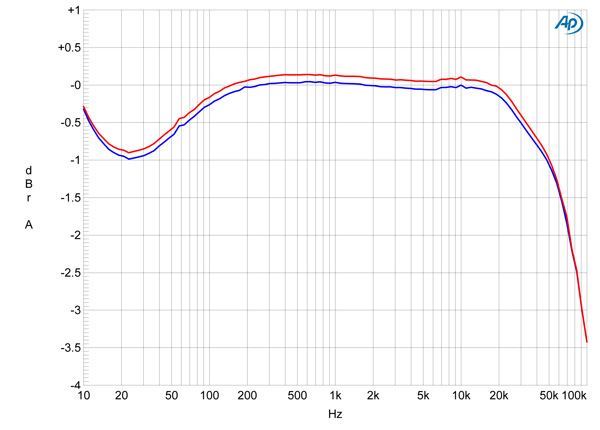
Fig.1 Paradox Phono 70 Signature, response with RIAA correction into 100k ohms (left channel blue, right red) (0.5dB/vertical div.).
The specified gain is 70dB. I measured 66.1dB at 1kHz, which is still appropriate for a low-output moving coil cartridge. Fig.1 shows the preamp's frequency response. The error in the RIAA deemphasis is superbly low from 100Hz to 20kHz, with excellent channel matching, though there is a 1dB drop in output in the low bass, centered on 23Hz. Although designer Terence Robinson had told MF that the Paradox Phono 70 Signature's RIAA correction included the so-called Neumann fourth-pole time constant of 3.18µs, the ultrasonic outputs rolls off smoothly above 20kHz, reaching –3dB at 90kHz, rather than rising above 50kHz.
Fig.2 Paradox Phono 70 Signature, spectrum of 1kHz sinewave, DC–1kHz, into 100k ohms for 500µV input (left channel blue, right red; linear frequency scale).
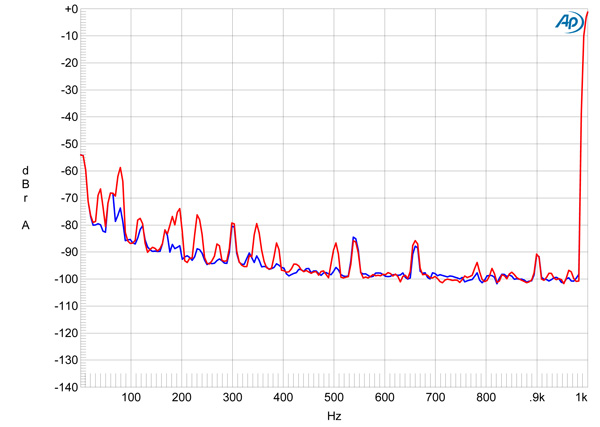
Channel separation was >70dB in both directions across the audioband, though this measurement was affected by the presence of low-frequency random noise (fig.2). The combination of high gain and passive RIAA correction will result in a higher noisefloor than usual. However, the Phono 70's unweighted, wideband S/N ratio, measured with the inputs shorted to ground, was a good 63.6dB in the left channel and 62dB in the right channel, referred to the standard MC input signal of 1kHz at 500µV. Restricting the measurement bandwidth to 22Hz–22kHz increased the ratio to 67dB in both channels, while switching an A-weighting filter into circuit further increased the ratio to 74.5dB.
Paradox doesn't specify overload margins, though Robinson told Mikey that he'd tried cartridges that output up to 450µV without any problems. MF did most of his auditioning with an Ortofon Verismo cartridge, which has a nominal output of 200µV, 8dB below the usual 500µV. The THD+noise in the Phono 70's output with a 1kHz signal reached 1% at 2V output, which is equivalent to an overload margin of 6.5dB referred to 500µV. This is lower than usual, but it does represent an acceptably high margin of 14.5dB ref. the Ortofon's 200µV output. The overload margin at the bottom of the audioband was the same, but at 20kHz it was just 0dB ref. 1kHz at 200µV.
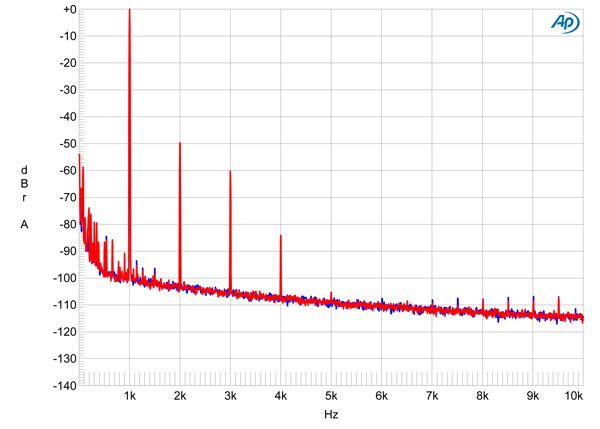
Fig.3 Paradox Phono 70 Signature, spectrum of 1kHz sinewave, DC–10kHz, into 100k ohms for 500µV input (left channel blue, right red; linear frequency scale).
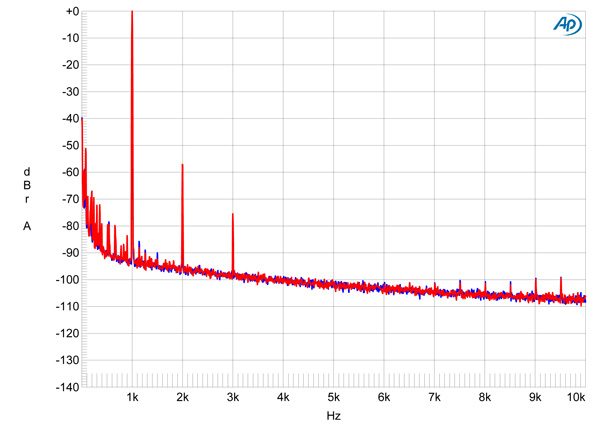
Fig.4 Paradox Phono 70 Signature, spectrum of 1kHz sinewave, DC–10kHz, into 100k ohms for 220µV input (left channel blue, right red; linear frequency scale).
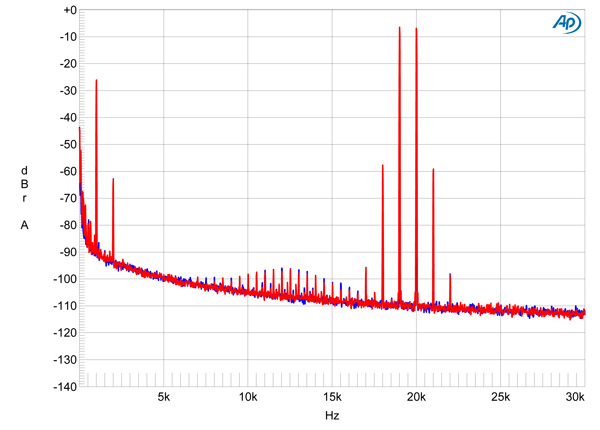
Fig.5 Paradox Phono 70 Signature, HF intermodulation spectrum, DC–30kHz, 19+20kHz into 100k ohms for 2mV peak input (left channel blue, right red; linear frequency scale)
With 1kHz at 500µV, the subjectively innocuous second harmonic was the highest in level, at –50dB (0.3%, fig.3) with the third harmonic 10dB lower. Reducing the input level to 220µV lowered the levels of both harmonics, with the second now lying close to –60dB (0.1%, fig.4). I examined intermodulation distortion with an equal mix of 19kHz and 20kHz tones, at a peak input level equivalent to 1kHz at 200µV. As expected from the poor overload margin at the top of the audioband, the second-order difference product at 1kHz was relatively high in level, at –27dB (4.5%, fig.5).
Its performance on the test bench indicates that the Paradox Phono 70 Signature must be used with low-output moving coil cartridges, the lower the output, the better.—John Atkinson
Footnote 1: The Phono 70 Signature is sold direct and costs $3000. Web: paradoxpulse.com.