I communicated with Franc via email, and at first, he was incredulous. He asked me to perform a few more diagnostics then agreed that the arm needed to be returned to his factory in Slovenia.
You can imagine the disappointment that registered on this 4Point owner's face when I gave him that news. He'd already had a few years' worth of this sort of thing. I also suggested that the cartridge be returned to Japan to deal with the slightly canted cantilever so that we could start "fresh" once he got the arm back. He grudgingly agreed and at that point told me, "You know, when the cartridge was first installed in the 4Point, the guy who did it said he was having trouble with the antiskating but that it would be okay." Clearly, it wasn't okay. Back it all went.
Months later, my now-friend returned with the repaired 4Point and the suspension-adjusted Lyra Etna. He was antsy, skeptical, and apprehensive—worried that history would repeat itself. Can you blame him?
I did a complete, not casual setup. I set the approximate vertical tracking force using a high-quality digital scale then set overhang to Löfgren A using the WallyTractor. I much prefer an "arc" type overhang gauge like the WallyTractor, where you can trace the stylus's actual path across the record. Second best is a two–null-point gauge. Least useful is a one–null-point gauge, where there's no corroboration. Please don't download a piece of paper off the internet: Get a real gauge.
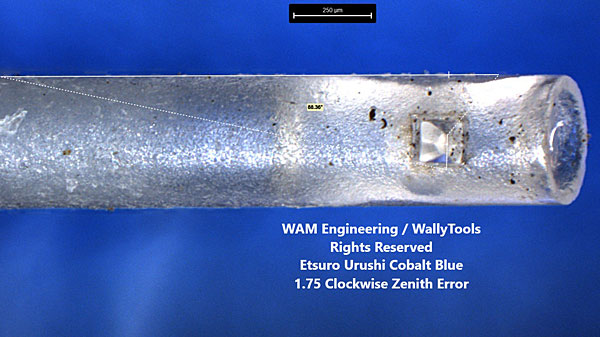 Stylus/cantilever manufacturer Namiki's zenith-angle tolerance is 5°, which is considerable, but Boisclair has found larger errors on some very costly cartridges; those should be returned and replaced. But right now, the only way I know of to address this problem is to send your cartridge to WAM Engineering for a Stylus/Cantilever Microscopic Analysis; with that information and a WallyZenith gauge, you can correct the issue in your setup. I set up this 4Point/Feickert/Etna combo before WAM offered this service.
According to Boisclair, at least one cartridge manufacturer in Japan has met with cantilever/stylus suppliers Namiki and Ogura to try to find a way to improve production. This is very good news!
With overhang and zenith precisely set, I used a digital stylus force gauge to set tracking force. I prefer—and use—a gauge that measures at record height (footnote 1), so for tonearms where the force may vary with height (including those loaded with springs and those that do not have horizontal and vertical centers of gravity in the same plane, footnote 2) I also prefer a gauge that's accurate to two decimal points.
Graham Engineering arms are neutrally balanced, but the SAT arm is not. In the case of the SAT arm, measuring 1.72gm at the height of the typical stylus pressure gauge means tracking force is about 1.68gm at record height. SAT's instructions explain how to compensate for this.
Stylus/cantilever manufacturer Namiki's zenith-angle tolerance is 5°, which is considerable, but Boisclair has found larger errors on some very costly cartridges; those should be returned and replaced. But right now, the only way I know of to address this problem is to send your cartridge to WAM Engineering for a Stylus/Cantilever Microscopic Analysis; with that information and a WallyZenith gauge, you can correct the issue in your setup. I set up this 4Point/Feickert/Etna combo before WAM offered this service.
According to Boisclair, at least one cartridge manufacturer in Japan has met with cantilever/stylus suppliers Namiki and Ogura to try to find a way to improve production. This is very good news!
With overhang and zenith precisely set, I used a digital stylus force gauge to set tracking force. I prefer—and use—a gauge that measures at record height (footnote 1), so for tonearms where the force may vary with height (including those loaded with springs and those that do not have horizontal and vertical centers of gravity in the same plane, footnote 2) I also prefer a gauge that's accurate to two decimal points.
Graham Engineering arms are neutrally balanced, but the SAT arm is not. In the case of the SAT arm, measuring 1.72gm at the height of the typical stylus pressure gauge means tracking force is about 1.68gm at record height. SAT's instructions explain how to compensate for this.
 Ironically, he didn't hear the problem until he upgraded the tonearm, because the far less costly arm on his previous turntable was forgiving—which is to say, lacking detail and resolution. He was not happy—until the new cartridge arrived and was installed. Then, finally, he got what he had paid for!
Fortunately for my friend, his Etna's stylus was well within tolerance, and 93° was achieved with the arm slightly lower than parallel to the record surface. (With medium- to low-compliance cartridges, 93° static produces approximately 92° when the record spins.) Which brings up another point: Contrary to what some have claimed online, I have never said, and do not believe, that there is anything magic about an SRA of 92°.
Cutting-stylus SRA measurements vary, as Risch and Maier discovered in their groundbreaking 1981 Audio magazine article, "More Than One Vertical Tracking Angle"; you can download it from the AnalogPlanet website. They settled on 92° as an acceptable average of the SRAs they measured at mastering houses throughout the United States.
If you wish to adjust SRA by ear for every record you own, knock yourself out! I'm happy to set SRA at 92°/93°, where all my excellent-sounding records sound at least outstanding.
But unless you at least start at 92°/93° degrees by measuring SRA, you're just guessing, and what's more, you know nothing about the manufacturing quality of the cartridge for which you paid mucho bucks.
Next comes azimuth—assuming your arm lets you adjust this parameter. Hopefully it does, because this is another critical setting, required to maximize channel separation. Tonearm instruction manuals say to adjust azimuth so that the cantilever is perpendicular to the record surface, or so that the headshell is parallel to the record surface, but, just as with setting SRA so that the armtube is parallel to the record surface, this approach is not accurate enough. Yes, you can attempt to do it by ear, but the best way is to use a voltmeter or oscilloscope to measure crosstalk. The Fozgometer is a reasonably good, easy-to-use alternative, but it's still a coarse approximation.
As Boisclair has pointed out, unless the azimuth setting rotates the headshell parallel to groove travel (as with "S" shaped arms), when you adjust azimuth, you will change SRA slightly. WAM provides a calculator on its website that makes it easy to compensate for that change.
Now you're finished—and without fiddling, you can be certain you've done a proper setup so that your system will sound great. Along the way, you have also examined the build quality of your cartridge and the basic performance of your tonearm. None of the frustrations encountered by that 4Point owner would have occurred had the arm been tested by the WallySkater.
Sure, you can tweak the vertical tracking force by ear within the cartridge manufacturer's recommended range, and you can further adjust the stylus rake angle, but once you've done that for one record, it's probably not going to be ideal for the next. That's why I'm happy—why I'm finished—once I've set the static SRA at 93°.
By now, you should get the point: You can't set up a defective cartridge so that it sounds good. Diagnostic checks are essential at every step, and doing setup properly serves this dual purpose: It also diagnoses cartridge issues. Following simplified instruction manuals by rote is a terrible way to set up a cartridge and optimize tonearm performance, unless you are setting up a cartridge with a spherical stylus like a Denon DL-103R, in which case the only parameters that matter are overhang and tracking force. Nor will you extract much detail from the grooves no matter what you do, though you are guaranteed pleasant, innocuous sonics. After finishing the Feickert/Kuzma/Etna setup, I played a few records for my friend. He was ecstatic about both how it sounded and how the arm behaved. The next day, he texted a photo of him and his wife sitting on their couch contentedly listening to records. "It's never sounded this good," he told me. "Thank you so much!"
Turntable setups are not my gig—I do enough of that at home—but recently, as a friendly favor, I set up Jay Jay "Twisted Sister" French's Ortofon A95–fitted VPI HW-40.7 I found that tracking force was off (1.7gm instead of 2.3gm), overhang was way off, SRA was off, antiskating was way off: The "Fatboy" arm's headshell was parallel to the record surface. When I was done, I measured channel separation with a digital oscilloscope and got 31dB L–R and 31dB R–L. In other words: perfection.
A few months ago, I visited Fred Kaplan and set up his SME 6/Ortofon Cadenza Black combo. With the M1 tonearm's headshell parallel to the record surface, I measured the same, perfect result. That's impressive.
If you don't want to mess with digital microscopes and oscilloscopes, or if you own an arm that doesn't allow these adjustments, like Rega's, for $500 you can send your cartridge to WAM and have it examined. They'll send it back with shims that compensate for the cartridge's SRA and azimuth errors. I know I've mentioned this before, but it's worth repeating, especially since no one else I know of offers this service.
Ironically, he didn't hear the problem until he upgraded the tonearm, because the far less costly arm on his previous turntable was forgiving—which is to say, lacking detail and resolution. He was not happy—until the new cartridge arrived and was installed. Then, finally, he got what he had paid for!
Fortunately for my friend, his Etna's stylus was well within tolerance, and 93° was achieved with the arm slightly lower than parallel to the record surface. (With medium- to low-compliance cartridges, 93° static produces approximately 92° when the record spins.) Which brings up another point: Contrary to what some have claimed online, I have never said, and do not believe, that there is anything magic about an SRA of 92°.
Cutting-stylus SRA measurements vary, as Risch and Maier discovered in their groundbreaking 1981 Audio magazine article, "More Than One Vertical Tracking Angle"; you can download it from the AnalogPlanet website. They settled on 92° as an acceptable average of the SRAs they measured at mastering houses throughout the United States.
If you wish to adjust SRA by ear for every record you own, knock yourself out! I'm happy to set SRA at 92°/93°, where all my excellent-sounding records sound at least outstanding.
But unless you at least start at 92°/93° degrees by measuring SRA, you're just guessing, and what's more, you know nothing about the manufacturing quality of the cartridge for which you paid mucho bucks.
Next comes azimuth—assuming your arm lets you adjust this parameter. Hopefully it does, because this is another critical setting, required to maximize channel separation. Tonearm instruction manuals say to adjust azimuth so that the cantilever is perpendicular to the record surface, or so that the headshell is parallel to the record surface, but, just as with setting SRA so that the armtube is parallel to the record surface, this approach is not accurate enough. Yes, you can attempt to do it by ear, but the best way is to use a voltmeter or oscilloscope to measure crosstalk. The Fozgometer is a reasonably good, easy-to-use alternative, but it's still a coarse approximation.
As Boisclair has pointed out, unless the azimuth setting rotates the headshell parallel to groove travel (as with "S" shaped arms), when you adjust azimuth, you will change SRA slightly. WAM provides a calculator on its website that makes it easy to compensate for that change.
Now you're finished—and without fiddling, you can be certain you've done a proper setup so that your system will sound great. Along the way, you have also examined the build quality of your cartridge and the basic performance of your tonearm. None of the frustrations encountered by that 4Point owner would have occurred had the arm been tested by the WallySkater.
Sure, you can tweak the vertical tracking force by ear within the cartridge manufacturer's recommended range, and you can further adjust the stylus rake angle, but once you've done that for one record, it's probably not going to be ideal for the next. That's why I'm happy—why I'm finished—once I've set the static SRA at 93°.
By now, you should get the point: You can't set up a defective cartridge so that it sounds good. Diagnostic checks are essential at every step, and doing setup properly serves this dual purpose: It also diagnoses cartridge issues. Following simplified instruction manuals by rote is a terrible way to set up a cartridge and optimize tonearm performance, unless you are setting up a cartridge with a spherical stylus like a Denon DL-103R, in which case the only parameters that matter are overhang and tracking force. Nor will you extract much detail from the grooves no matter what you do, though you are guaranteed pleasant, innocuous sonics. After finishing the Feickert/Kuzma/Etna setup, I played a few records for my friend. He was ecstatic about both how it sounded and how the arm behaved. The next day, he texted a photo of him and his wife sitting on their couch contentedly listening to records. "It's never sounded this good," he told me. "Thank you so much!"
Turntable setups are not my gig—I do enough of that at home—but recently, as a friendly favor, I set up Jay Jay "Twisted Sister" French's Ortofon A95–fitted VPI HW-40.7 I found that tracking force was off (1.7gm instead of 2.3gm), overhang was way off, SRA was off, antiskating was way off: The "Fatboy" arm's headshell was parallel to the record surface. When I was done, I measured channel separation with a digital oscilloscope and got 31dB L–R and 31dB R–L. In other words: perfection.
A few months ago, I visited Fred Kaplan and set up his SME 6/Ortofon Cadenza Black combo. With the M1 tonearm's headshell parallel to the record surface, I measured the same, perfect result. That's impressive.
If you don't want to mess with digital microscopes and oscilloscopes, or if you own an arm that doesn't allow these adjustments, like Rega's, for $500 you can send your cartridge to WAM and have it examined. They'll send it back with shims that compensate for the cartridge's SRA and azimuth errors. I know I've mentioned this before, but it's worth repeating, especially since no one else I know of offers this service.
Footnote 1: I use a Cartridge Man gauge, which is very good but also expensive and doesn't seem to be available right now in the United States. Rega and Clearaudio make similarly expensive alternatives, while Pro-Ject, Audio Additives, and Riverstone make significantly cheaper gauges that meet these criteria. Footnote 2: Another case where this is important is for 'tables with ferromagnetic platters, like the original Thorens TD-124. In that case, the magnetic attraction between cartridge and platter must be accounted for.—Jim Austin
Footnote 3: See Mikey's setup tutorial in the January 2021 issue of Stereophile here.—Jim Austin
A modest zenith-angle error.
Then, using one of the null points on the gauge, I set cantilever zenith angle with antiskating disabled—though, as WAM Engineering's J.R. Boisclair has discovered using a supercostly, high-magnification microscope, styluses (styli?) can be mounted incorrectly, producing gross zenith-angle errors, some small enough to be compensated for with tweaks and tools, others too far off to be salvaged.
This is the next setup frontier, and it means that setting the cantilever so that it's parallel to the null point hash marks isn't necessarily correct anymore. But, unless you have a full cartridge-inspection report from WAM Engineering so that you can compensate for manufacturing errors, using the cantilever to set zenith angle is the best we can do.
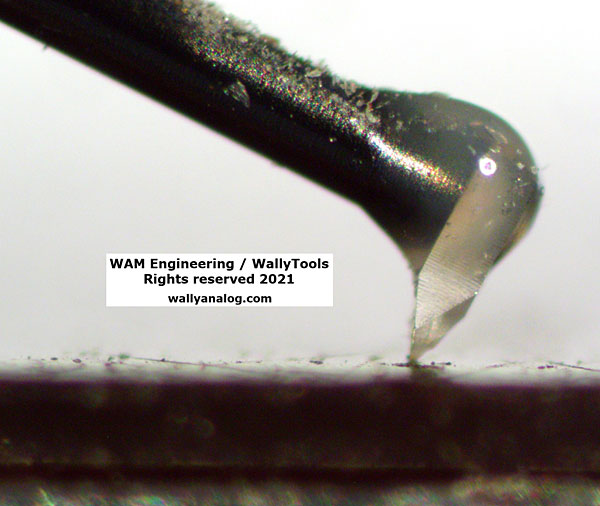
An Ortofon Replicant stylus at rest. (Photo: WAM Engineering/Wally Tools.)
Next, I set the Etna's stylus rake angle (SRA) using a digital microscope (footnote 3). Though instruction manuals that come with most SRA-adjustable tonearms say to set the arm parallel to the record surface and you're done—or to do that and then "play" until you like the sound—that approach is insufficient for severe stylus profiles such as line contact, Geiger, and Ortofon's Replicant 100.
The reason is obvious: Like zenith angle, SRA manufacturing tolerances are too loose, and that's proven true on some very costly cartridges. As a favor, I set up an Etna for a guy with an SAT arm. With the back of the arm just about touching the platter, I still measured 98 degrees. The sound was bright. With the arm parallel to the record surface, the sound was even brighter. Doing this install "by ear" would never produce great sound. That cartridge had to be replaced.
Footnote 1: I use a Cartridge Man gauge, which is very good but also expensive and doesn't seem to be available right now in the United States. Rega and Clearaudio make similarly expensive alternatives, while Pro-Ject, Audio Additives, and Riverstone make significantly cheaper gauges that meet these criteria. Footnote 2: Another case where this is important is for 'tables with ferromagnetic platters, like the original Thorens TD-124. In that case, the magnetic attraction between cartridge and platter must be accounted for.—Jim Austin