When Dr. Ted and his crew began experimenting in order to re-create the soothing, late-evening RF environment we all know and love, they found instead that extra-low-frequency (ELF) and super-low-frequency (SLF) generators, tuned to various frequencies and combinations thereof, could affect soundstage width, depth, and height, as well as shift the perceived frequency balance, especially in terms of low-frequency "stiffness."
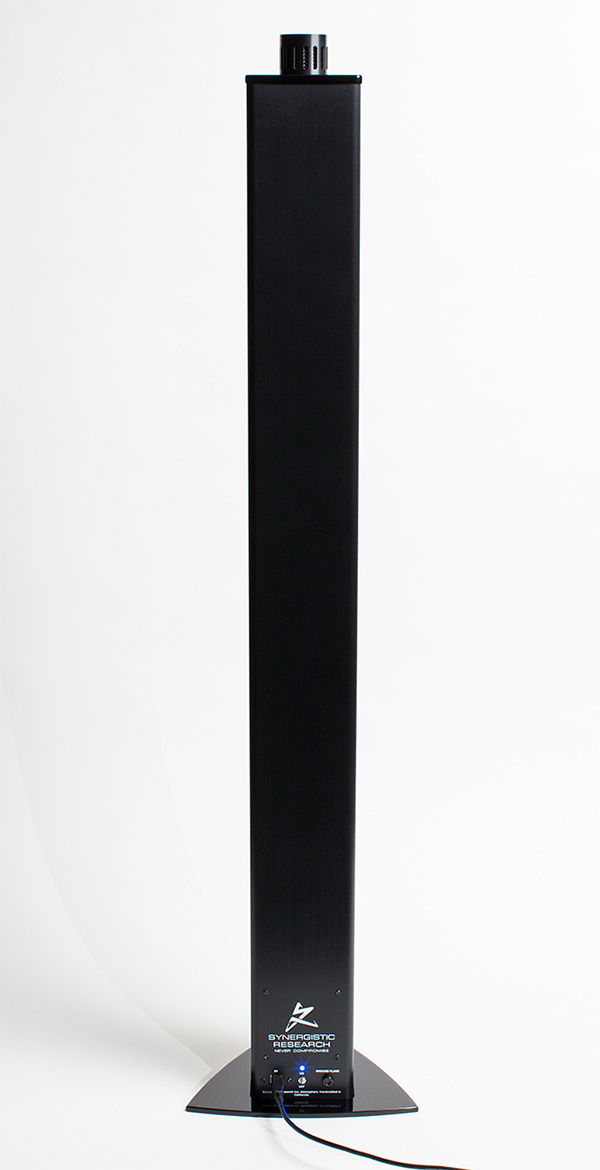
The product that resulted from this research is the Atmosphere: a black tower, 3' 3" tall, that plugs into the wall, is controlled via Bluetooth, and costs $2495. An iPad app downloadable from Synergistic controls the Atmosphere's output. Synergistic narrowed the ELF and SLF generators' output choices to two series of presets: Standard Scenes, which comprise Intimate Acoustic, Holographic, and Grand Canyon; and ATM Red Scenes: In My Listening Room, Expansive, Amplified, and Ethereal. The ATM Red Scenes (maybe you're thinking "an ATM where Ted withdraws the money deposited by the suckers who buy into this crap". . .?) are made possible by placing between the speakers a small, cylindrical "tuning module," included in the price. For each Scene (represented on the app with relevant color photos), you can choose between two Advanced Settings: Air and Stratosphere.
Each preset is claimed to change the sound in specific ways. Intimate Acoustic, for when you want the performer in your room, is best for small-scale recordings. For live recordings or those with an abundance of added reverb, you're better off with Holographic. Grand Canyon is for large-scale recordings, whether acoustic (symphonic) or electric (
eg, Roger Waters's
Amused to Death). Or, if you so react, when you want to feel like an ass descending into the Grand Canyon of audiophile stupidity for buying into any of this nonsense.
Does the Atmosphere work? Sorry to say, yes—but in subtle ways that I found hardly profound. If your system isn't doing well, adding one won't fix it—but as icing on the cake, yes. I invited my wife downstairs into the listening room, sat her down, and, without telling her what I was doing with my iPad or pointing out the Atmosphere, I played a record, beginning in Intimate Acoustic mode. After a short while I switched to Grand Canyon mode and asked, "Did anything change?"
"The voice pushed farther back, toward the wall," she said, gesturing with one hand toward the wall behind the Alexandria XLFs. Which was what I'd heard.
I demonstrated the Atmosphere for some visiting audio manufacturers. As loath as they were to admit it, they heard the differences, too.
The Atmosphere is no game changer for a system, and Synergistic Research's Ted Denney is not Capt. James Tiberius Kirk. But if, as the announcer for the original
Star Trek TV series intoned, space
is the final frontier, then Denney is exploring strange new worlds of sound that some of you may wish to visit.
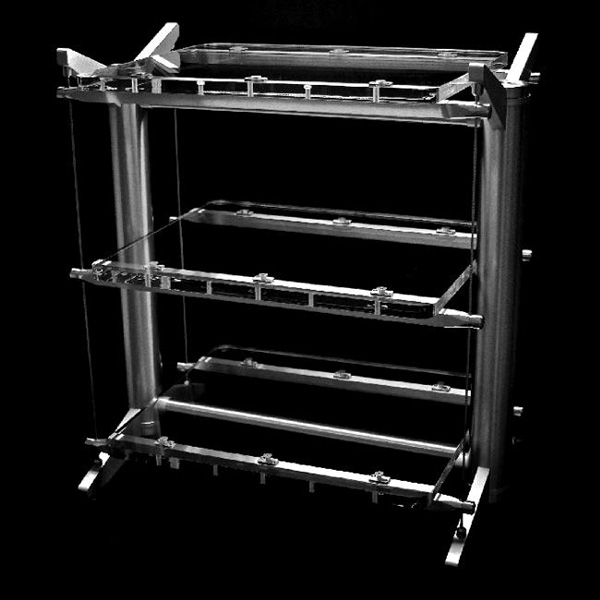 Stillpoints ESS Rack
The rack you set your equipment on can also make a difference in your system's sound, but this is another area in which skeptics run wild and audio enthusiasts dig in their heels.
"How can a
rack affect the sound?"
"Well, have you listened?"
"I don't have to—I
know it can't."
Isolating audio equipment from its environment is obviously beneficial, especially in the analog world, because it prevents outside vibrations from finding their way into the music signal. That's the premise behind Harmonic Resolution System's SXR racks, one of which I bought after reviewing them in my February 2009 column: The improvement in sound the SXR racks produced over my then-reference rack—a Pagode Master Reference from Finite Elemente—was obvious. The massive HRS bases sit on machined aluminum feet that contain rubber diaphragms to support the load; different diaphragm compliances are available, and the user selects the ones that are appropriate to the weight of the component being supported—thus tuning the base to an effectively low resonant frequency.
However, as we know, audio components—including electronics, whether solid-state or tubed—"chatter" with internally generated vibrational energy. The amounts of this chatter can be fairly gross (
eg, from transformers) or minute (
eg, when signals pass through even the smallest board-mounted components). But even microvibrations have been shown to affect, however minutely, the performance of passive electronic components. Which is why it's not enough to isolate components from only external vibrations.
The energy generated inside a component needs to be damped or drained away. Using aluminum plates and proprietary polymer discs, the products in HRS's Nimbus System—Nimbus Couplers, used with or without Nimbus Spacers, take the place of a component's feet, making direct contact between its bottom panel and the shelf below—combine mass, stiffness, and damping to transduce internal vibrational energy into heat.
The idea of dissipating energy from within audio components is also the basis for the Stillpoints company and their ceramic-ball technology (footnote 6). I've found Stillpoints' far-lower-mass solution to be more effective at draining internal vibrations, and more convenient to use.
Inside each of Stillpoints's various footers are layers of differently sized ceramic balls that are allowed a slight degree of movement horizontally, while being constrained within housings claimed to dissipate microvibrational energy by transducing it into heat. While Wilson Audio Specialties doesn't recommend the use of Stillpoints, I replaced the floor spikes supplied with my Alexandria XLF speakers with Stillpoints' massive Ultra 5 feet ($699 each). There were definite improvements in bass clarity and in soundstage focus and stability. I'm not going back to the spikes.
Likewise, placing Stillpoints' smaller Ultra SS feet ($249 each; the SS stands for "stainless steel") under electronic components produced equally salutary sonic effects. (Space limitations prevent me from going into placement and setup details.)
Stillpoints' ESS Rack attempts to both dissipate a component's own vibrational energy and isolate that component from external vibrations. It's available in three widths and three heights, with various shelf options. Each ESS Rack is built using two internally damped tubular columns and two threaded, internally tensioned, central tubular crossbars. The columns are fitted at both ends with pairs of wing-like metal arms. The arms at the bottom hold the footers that support the ESS Rack; stretched between the bottom and top arms are vertical steel cables, to which the hefty shelf-supporting crossbars are clamped: The pre-tensioned cables serve to isolate the shelves from each other. The spacing of the shelves is easily varied to fit components of almost any height, and though it might not look like it, each shelf can support thousands of pounds.
Stillpoints offers four types of shelf. I was sent an ESS Rack with four shelves that featured the company's Ç" solid stainless-steel shelf-support crossbars, to which a top shelf of 1"-thick acrylic (optional; a thickness of ¾" is standard) was attached via six Stillpoints resonance-control devices: three evenly spaced across each of the two solid crossbars.
The three other shelves weren't shelves at all, in any usual sense; instead, they were skeletal constructions comprising two Xes of stainless steel coupled to the crossbars with six Stillpoints devices: Two threaded holes in each arm of each X, for a total of 16 holes per shelf, accept the head of a Stillpoints Ultra-Mini coupler. Screw four of these into the grid arms, at whichever holes are best positioned for the component the Ultra Minis are to support. This low-mass design, intended to quickly and efficiently dissipate energy, is similar to the thinking embodied in Rega Research's current ultra-low-mass turntables.
The ESS Rack combines isolation from and control of vibrations in one ingenious and, I think, extremely attractive package. But it's expensive: Prices start at $8620 for the smallest ESS, with three basic acrylic shelves. It seems to me that solid acrylic shelves are at odds with the ESS Rack's skeletal design concept—but after all, if you have a turntable (and if you're reading this column, surely you do), a shelf-less top level won't always be practical—and where do you put such necessary accessories as record brushes, clamps, and stylus cleaners? And while the ESS's
X-shelves might not be ideal for every component you own or might someday buy, I'd still save up for them rather than opt for all acrylic shelves.
Unfortunately, I couldn't directly compare the ESS and HRS racks—there were too many variables, and moving one or both racks was impossible. However, tapping the plinth of the turntable placed on the ESS's acrylic top shelf while the stylus sat in the groove of an LP effectively demonstrated the complete isolation between the top and lower shelves.
I was, however, able to move a turntable (a Wilson Benesch Full Circle with ACT 0.5 tonearm) and phono preamplifier (Pure Audio Vinyl) from the ESS Rack to my
Finite Elemente Pagode rack ($6195 when new), which is my reference rack for the system in my utility room that I use for most of the record reviews I write for AnalogPlanet.com. The Pagode includes carefully tuned resonators fitted into the frame of each of its shelves. It's a good rack—and, with its maple shelves and brushed-aluminum risers, it's beautiful, stylish, and a shame to keep in a utility room. But it's sonically not in the league of the HRS or the ESS, both of which helped my system produce noticeably "blacker" backgrounds, more nimble bass, and more precise transients—and, thus, far greater transparency. I didn't have to strain to hear the differences between the same gear on the ESS and Pagode racks. As ISIS audio fanatics would say, "veils were lifted."
Footnote 6: Stillpoints, 573 County Road A, Suite 103, Hudson, WI 54016. Tel: (651) 204-0605. Web:
www.stillpoints.us