Stand Loudspeaker Reviews

Sort By:  Post Date TitlePublish Date

JMlab Micron & Micron Carat loudspeaker

Let me take you back some 40 years to the mono days of the early 1950s. It's unlikely that the minimonitor genus of loudspeakers, of which this French JMlab is a prime example, would have survived back then. There was the practical problem of available amplifier power. The average amp could squeeze out no more than 10 to 15W into an 8 ohm load—far less power than the typically insensitive minimonitor demands for adequate dynamic headroom. But that in itself would not have sufficed to displace the minimonitor from the marketplace. After all, "high-power" amps (50-watters) could be had at a price.

Celestion SL700 loudspeaker

"Who Stole The Bass?" asked Anthony H. Cordesman, writing about minimonitors in the April/May 1987 Stereophile (Vol.10 No.3). And for the designer of a box loudspeaker, the fundamental design decision, at any price level, is how much bass extension to aim for. It will always be possible to design a speaker with extension down to 20Hz, but will the result be musically and commercially successful? Will the designer end up with a speaker hypertrophied in that one area at the expense of every other? Will, indeed, the result be feasible technically? For example, for a given cabinet volume, gains in low-frequency extension have to be balanced against corresponding drops in sensitivity, and it is quite possible that to go for 20Hz extension will result in a 60dB/W/m sensitivity, equating with a speaker that only plays extremely quietly, and thus of no use to anyone.

Acoustic Energy AE1 loudspeaker

"Who">http://www.Stereophile.com//features/44/">Who Stole The Bass?" asked Anthony H. Cordesman, writing about minimonitors in the April/May 1987 Stereophile (Vol.10 No.3). And for the designer of a box loudspeaker, the fundamental design decision, at any price level, is how much bass extension to aim for. It will always be possible to design a speaker with extension down to 20Hz, but will the result be musically and commercially successful? Will the designer end up with a speaker hypertrophied in that one area at the expense of every other? Will, indeed, the result be feasible technically? For example, for a given cabinet volume, gains in low-frequency extension have to be balanced against corresponding drops in sensitivity, and it is quite possible that to go for 20Hz extension will result in a 60dB/W/m sensitivity, equating with a speaker that only plays extremely quietly, and thus of no use to anyone.

Epos ES 14 loudspeaker

Americans might be forgiven if they haven't heard of Epos. A small, British specialist loudspeaker manufacturer, it was founded in 1983 by its designer, Robin Marshall—an ex-BBC engineer and a onetime consultant to Monitor Audio, according to Roy Hall of Epos's US importer, Music Hall. Their first model, the ES 20, didn't make it to the US, and was apparently a bit too pricey in the UK to make much of a splash there (about £700, $1300 at the current rate of exchange—a mint in a country with the patent on sub-$500/pair (UK prices!) two-ways). In 1986 or thereabouts, the new, smaller ES 14 was introduced, using updated versions of the same drivers in a smaller, ported cabinet. Music Hall only recently began importing the Epos into the US.

Sonus Faber Extrema loudspeaker

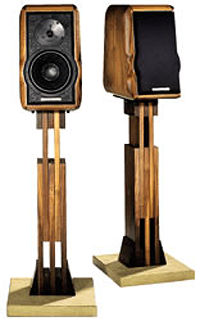
Sonus Faber was founded in 1981 by Franco">http://www.stereophile.com//loudspeakerreviews/870/index2.html">Franco Serblin. Real wood has always featured strongly in the construction of this company's evolving range of costly, compact loudspeaker systems (footnote 1). The first was called the Parva, now in its FM4 form. This was followed by the Minima, a Tablette-sized model. The upmarket Electa came through in the last few years, followed by the Amator-Electa. This series increases in size and weight with each new introduction—for example, the Minima weighed 6kg, the Electa 12kg, the latest Extrema a massive 40kg or 88 lbs.

B&W John Bowers Silver Signature loudspeaker

In recent years, computer modeling, finite-element analysis, and laser interferometry have brought about a huge increase in our knowledge about what makes the moving-coil loudspeaker drive-unit work. Nevertheless, it has remained fundamentally unchanged since it was invented by Rice and Kellogg more than 60 years ago. That doesn't mean that it hasn't been refined considerably; in this review I examine the performance of a design whose drive-unit technology has been taken to the limit of what is currently possible, the B&W Silver Signature.

Celestion SL600si loudspeaker & DLP600 digital equalizer

Following my reports on 13 mainly inexpensive loudspeakers that have appeared in the last four issues of Stereophile, I thought I would give myself a treat this month by reviewing the latest incarnations of a model that has stood the test of time: the two-way Celestion SL600Si...This is a carefully tuned infinite-baffle design, sacrificing ultimate extension for upper-bass and lower-midrange quality. Its crossover is conventionally British in that it puts flatness of on-axis amplitude response ahead of time coherence, while everything about it, from drive-units to the cabinet itself, is flagrantly "high-tech."

B&W Matrix 805 loudspeaker

This compact, $1600/pair monitor employs many of the same design features found in the company's highly rated Matrix 801 system. Although the price is high for a two-way minimonitor, the 805 fits right into a growing high-end marketplace for such designs, one which emphasizes high quality in a small enclosure which will fit into most living-room environments without calling much attention to itself.

Sonus Faber Minima FM2 loudspeaker

Imaging, imaging, imaging. That's what I thought when I first heard the Sonus Faber Electa Amators reviewed by Jack English last October. How could such small speakers create such a wide, deep soundfield? John Hunter, president of Sumiko, Ltd. and importer of Sonus Faber products, was amused but not surprised at my reaction. I did the natural thing and begged for a review pair.

Advertisement
Advertisement
Advertisement