Solid State Preamp Reviews

Sort By:  Post Date TitlePublish Date

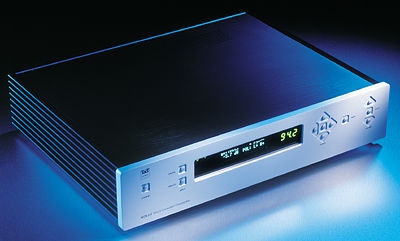
TacT Audio RCS 2.0 digital equalizer/preamplifier

I anticipated the installation of the TacT Audio RCS 2.0 room-correction processor with mixed emotions—I already liked my system and room, and such a device threatened to make all my studied efforts trivial. What if one might use any decent amps and speakers, cables that were merely conductive, and no room treatment at all? And what if, on top of that, you could just put them wherever your significant other thought they looked right? What if all the magic you needed was contained in this box? Scary.

Balanced Audio Technology VK-40 preamplifier

Few topics will get audiophiles into an argument more readily than a discussion of the relative merits of tubed and solid-state equipment. A pollhttp://www.stereophile.com/showvote.cgi?189">poll; on the Stereophile website showed 53% of respondents choosing solid-state as their preferred amplifier design, while 38% indicated a preference for tubes—the remainder choosing "other," which presumably means digital amplifiers. (There has been no corresponding survey regarding preamplifier designs.) Opinions tend toward the dogmatic, with one respondent declaring "solid-state is more accurate," another stating unequivocally that "tubes sound closer to the real thing."

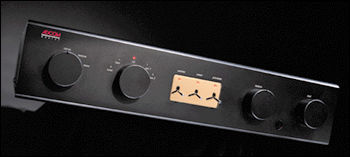
Adcom GFP-750 preamplifier

Adcom is one of those companies that's just too consistent for its own good. Year after year, they put out well-engineered, fairly priced gear, while we audiophiles become jaded and almost forget they're there... You want a good-sounding CD player that doesn't cost an arm and a leg? [Yawn.] Well, you could try Adcom. Need a power amplifier with some sock that won't make your tweeters crawl down your ear? There's always Adcom.

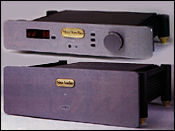
Simaudio Moon P-5 preamplifier & W-5 power amplifier

I first saw and heard SimAudio's Moon amp and preamp at WCES two years back, and something about their aesthetics appealed to me: Canadian ruggedness coupled with a decidedly French panache. I remember that those attributes also characterized the demo's sound, although I can't recall the speakers or the sources involved. At succeeding shows, it gradually dawned on me that the Moon components were the fixed elements in a succession of impressive demos.

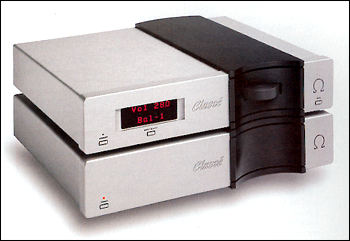
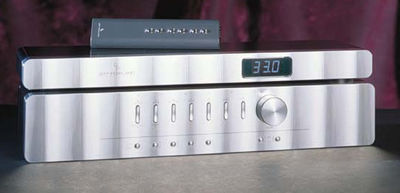
Jeff Rowland Design Group Synergy line preamplifier

One of the differences between mass-market and high-end audio is in product model longevity. By this I don't mean that high-end products necessarily last longer—although I think they generally do—but that models remain in a manufacturer's product line longer, perhaps being refined in an evolutionary manner. This helps products retain their value, and, when new models are introduced, these involve more than a cosmetic upgrade and some additional bells'n'whistles.

Mark Levinson No.380S preamplifier

"Comping," they call it at Madrigal. Once a circuit and its board layout have been finalized, passive components are substituted one by one in an exhaustive series of listening tests to determine the places where use of a premium part, or one of closer tolerances, results in an audible benefit. This fine-tuning process cannot be open-ended, however, as products do have to shipped. So what happens when new parts become available, or new manufacturing processes allow a better-sounding part to be used without financial penalty?

Advertisement
Advertisement
Advertisement