Recordings of April 1988: The First Colossus Recordings
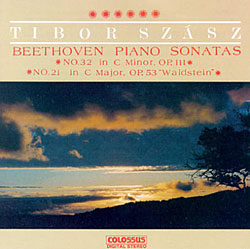 Beethoven: Sonata No.32, Op.111; Sonata No.21, Op.53 ("Waldstein")
Tibor Szasz, piano
Bainbridge BCD-6275 (CD). Leo de Gar Kulka, eng. & prod. DDD. TT: 58:03 Mozart: Piano Concerto No.13, K.415; Overture to Lucio Silla, K.135
Jeremy Menuhin, piano; George Cleve, 1987 Midsummer Mozart Festival Orchestra
Bainbridge BCD-6273 (CD). Leo de Gar Kulka, eng. & prod. DDD. TT: 36:58 Prokofiev: Alexander Nevsky, Lieutenant Kije
Andre Previn, Los Angeles Philharmonic
Telarc CD-80143 (CD). Jack Renner, eng.; Robert Woods, prod. DDD. TT: 63:37 Rachmaninov: Sonata for Cello and Piano, Op.19
Steven Kates, Montagnana cello; Carolyn Pope Kobler, Bösendorfer piano
Bainbridge BCD-6272 (CD). Leo de Gar Kulka, eng. & prod. DDD. TT: 40:42 The Sounds of Trains, Vols.1 & 2*
Bainbridge BCD-6270, -6271* (CDs). Brad Miller, eng. & prod. DDD. TTs: 60:45, 50:14* If you read my article in these pages about recording the Cumbres and Toltec Scenic Railway steam trains (January 1987, Vol.10 No.1), you may recall the mention of Colossus. Colossus is the name of a new digital recording system which designer Lou Dorren claims to be different from every other digital system in several ways, none of which has ever been disclosed to us. I had a chance to listen to some tapes made on it shortly after writing the C&TSRR article, but since they were made with a completely unfamiliar microphone (Mobile Fidelity Productions of Nevada's own design) and featured mainly the sounds of trains, airplanes, and other sources of potential ear damage, I couldn't really tell anything about the recording system, except that it had the kind of low end I expect from any respectable digital audio. A sonic evaluation had to wait until I heard Colossus on more familiar termsthat is, with music recordings. Now, that time has come.
 It is often said that anyone with a recorder and a couple of microphones can record an orchestra. It's true, assuming you can get permission to do it (another story entirely). But that statement fails to address an important question: "How well?"
The rudiments of any skill can be learned from books. Practice can develop a fair level of competence. Beyond competence, however, the student is governed by his genes and/or family environment, depending on which theory of human potential you subscribe to. Whatever the reason, some practitioners of both disciplines never seem able to transcend mere competence, while others go on to become legends in their own times.
It is often said that anyone with a recorder and a couple of microphones can record an orchestra. It's true, assuming you can get permission to do it (another story entirely). But that statement fails to address an important question: "How well?"
The rudiments of any skill can be learned from books. Practice can develop a fair level of competence. Beyond competence, however, the student is governed by his genes and/or family environment, depending on which theory of human potential you subscribe to. Whatever the reason, some practitioners of both disciplines never seem able to transcend mere competence, while others go on to become legends in their own times.