CD Player/Transport Reviews

Sort By:  Post Date TitlePublish Date

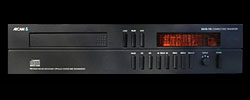
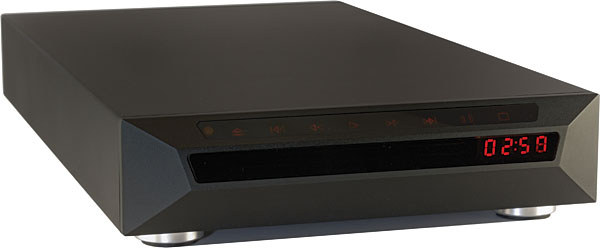
Arcam Delta 170 CD Transport

The Arcam Delta 170 is one of the first examples of an entirely new product category: CD transports. The concept of different CD transports having different sonic qualities is vexing. It is a simple matter to prove that the bit stream contains identical data from virtually any CD transport (see "Industry Update," Vol.12 No.8). According to Arcam, development of the Delta 170 was spurred by audible differences among transports heard by dealers, customers, and Arcam staff. The possibility that CD transports have their own sonic signatures is intriguing.

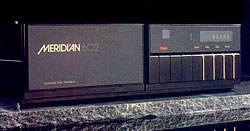
Meridian 602 CD transport

"I don't like Mondays!" sang Bob Geldof some years back, and I'm beginning to hate Mondays too. No, not for the obvious reason. You see, Monday is "hate-mail" day. Every day I get letters from Stereophile's readers. But for some reason known only to the mavens (or should that be Clavens?) of the US Postal Service, the ones pointing out my stupidity, dishonesty, and sheer incompetence as a human being arrive on Mondays.

For example: "Bits are bits, and it is therefore dishonest for Stereophile's writers to continue to insist that they can hear any differences between CD players or digital processors!" recently wrote an angry reader, canceling his subscription. (They always tell me they're going to cancel their subscription.) "Yeah, right!" thought I, having just sat through a comparative audition of, would you believe, digital data interconnects in Robert Harley's listening room. Some of the differences I heard were not trivial. They might even be audible in a blind listening test.

Vincent Audio C-60 CD player

Should an audio component accurately reproduce the signal it's fed, or should it evoke the sound and feel of live music? Accuracy or musicality? This question has been at the heart of high-end audio since its inception. Back then, the question often took the form of the tubes-vs-transistors debate. Proponents of solid-state pointed to the far superior measured performance of transistor designs, and claim that they thus more accurately reproduced the input signal. Tube lovers steadfastly maintained that their gear sounded better, more natural—more like music. Since then, both camps have eliminated the obvious colorations of their respective technologies, and the levels of performance of today's best tubed and solid-state gear have converged. At the same time, the circuits themselves have blurred into hybrids of various sorts, different mixes of devices and circuits.

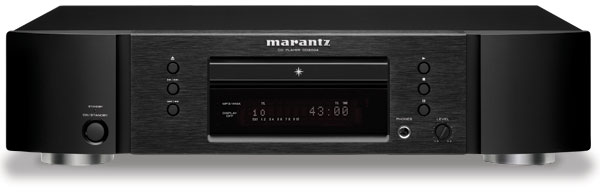
Marantz CD5004 CD player

After writing my very favorable review of Marantz's PM5003 integrated amplifier ($449.99) for the January 2010 issue, I began to fantasize about how it might be packaged with other components to create a dynamite entry-level system for about $1000 (excluding cables). A good place to start, I felt, was the companion model to the PM5003, Marantz's own CD5003 CD player. Since then, both have been replaced with new models, respectively the PM5004 and CD5004, so I sought out review samples of both. (To read how the PM5004 compares with the PM5003, see my "Follow-Up" on the Marantz PM5004 integrated amplifier.)

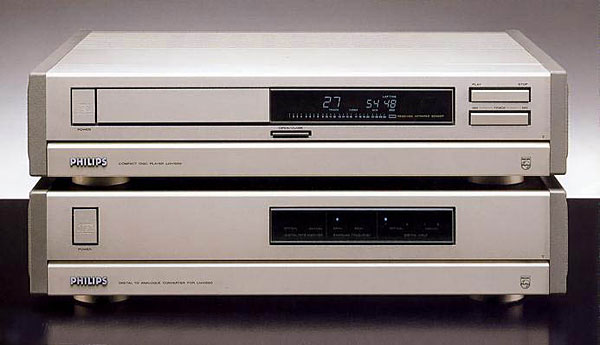
Philips LHH1000 CD player

Externally, the LHH1000 came as a bit of a surprise to these jaded eyes, over-familiar with plain black or brushed-aluminum boxes. Each enclosure is finished in an almost white, anodized finish, with greenish-gray endcaps (made from zinc alloy, I believe) painted with a nubbly, crackle finish—an attractively utilitarian styling with shades of military-surplus radio equipment, nicely set off by subdued blue fluorescent readouts. Internally, the units are constructed to audiophile standards. The transport uses Philips's top CDM-1 mechanism, which is fabricated from diecast aluminum, compared with the plastic CDM-4 mechanism which appears in less expensive and less well-specified players. The loading tray, too, which is made from metal, has a reassuringly solid feel to it.

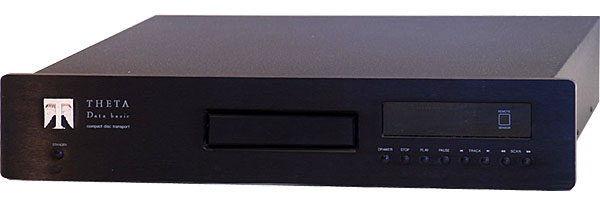
Theta Data Basic CD transport

It seems to me that it should be possible to make a perfectly jitter-free CD transport without resorting to elaborate, expensive mechanical structures. This idealized transport would ignore all mechanical considerations of disc playback—vibration damping and isolation, for example—and simply put a jitter-free electrical driver at the transport output. If such a circuit could be made, it wouldn't care about how bad the signal recovered from the disc was (provided the recovered data were error-free). The circuit would just output a perfect, jitter-free S/PDIF signal. The result would be the sound quality of the $8500 Mark Levinson No.31 Reference CD transport in $200 machines. Such a scheme would provide an electrical solution to what has been considered largely a mechanical problem.
But back in the real world there's no doubt that attention to mechanical aspects of transport design affects sound quality. Examples abound: listening to Nakamichi's 1000 CD transport with its Acoustic Isolation door open and closed; playing the Mark Levinson No.31 with the top open; and putting any transport on isolation platforms or feet are only a few of the dozens of experiences I have had that suggest that mechanical design is of utmost importance.

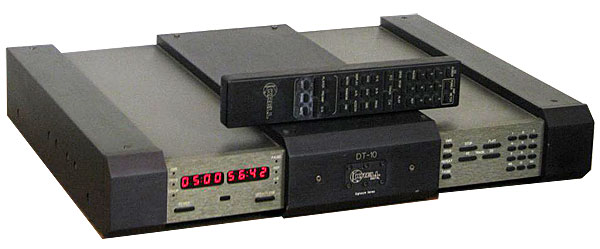
Krell DT-10 CD transport

So many things in this world are designed for convenience, not for excellence. That's all right if you have a choice, but it becomes a problem when products designed for convenience become universal standards and are thus foisted on everyone—including enthusiasts, who must then live with a product aimed at the lowest common denominator.

The digital interface between CD transports and digital processors is a perfect example of this dilemma. The Sony/Philips Digital Interface Format (S/PDIF) standard was designed so that connecting two digital products required only one cable. This single cable carries left and right audio channels as well as the timing clock essential to making the system work.

NuForce CDP-8 CD player

"So, what are you reviewing these days?" my friend Mark e-mailed me recently.

"A CD player," I said.

"They're still making those?"

Yes—and better than ever, for the most part. But I understood Mark's confusion. When a "Vote!" question on the Stereophile website asked readers what digital source components they used, a surprising number responded that they did not, or hadn't bought a dedicated player in years. Topping the list were computers and universal players.

Meridian 207 Pro CD player

In a way, you could say that Meridian started the now epidemic practice of modifying stock CD players (usually of the Philips-Magnavox species). The original Meridian player, the MCD, was a reworking of the first-generation Philips and was praised">http://www.stereophile.com/cdplayers/285meridian">praised by J. Gordon Holt in these pages in his 1985 review (Vol.8 No.2). The Meridian Pro (Vol.8 No.6) won similar plaudits, and is still to be seen lurking in JA's system. And the original 207 was well-received by MC in Vol.10 No.3.

Advertisement
Advertisement
Advertisement