Do you lend discs out to your pals?
Some of us find ourselves turning into music lending libraries; the rest of us keep our discs under lock and key. Can your pals borrow your discs?


Some of us find ourselves turning into music lending libraries; the rest of us keep our discs under lock and key. Can your pals borrow your discs?
Imitation, as the old saw would have it, is the sincerest form of flattery. It might also offer a way for DVD-Audio to establish credibility and build a customer base.
We kick off our anniversary collection with <A HREF="http://www.stereophile.com//features/708/">40 Years of <I>Stereophile</I>: What Happened When</A>. Editor John Atkinson recounts the complete history of <I>Stereophile</I>, starting in 1930 when J. Gordon Holt heard his first sound in North Carolina.
Promising technology, interesting programming, and good business plans may not be enough to keep satellite radio services <A HREF="http://www.xmradio.com">XM Radio</A> and <A HREF="http://www.siriusradio.com">Sirius Radio</A> aloft. Both companies are struggling with massive financial problems as they scramble to gain subscribers.
At present, the recording industry is based on a variety of analog and PCM digital audio formats, putting proponents of Super Audio Compact Disc (SACD, which is based on the Direct Stream Digital, or DSD, format) in a tough place when it comes to creating pure DSD works for showing off the format. To date, labels have had a limited number of options for creating, mixing, and mastering pure DSD projects.
US lawmakers have honored their promise to address a languishing small-webcaster royalty bill that was <A HREF="http://www.stereophile.com/news/11468/">put on hold</A> prior to the fall elections.
Earlier this month, an unambiguous and simple message went up on the Dunlavy Audio Labs <A HREF="http://www.dunlavyaudio.com/">web site</A>: "As of November 7, 2002, Dunlavy Audio Labs, LLC has ceased operations." A phone call to the company confirms that it is indeed out of business, although Dunlavy president Keny Whitright did not return calls seeking comment.
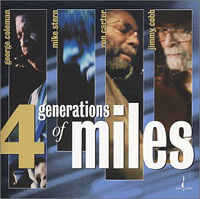
<B>CARTER, COBB, COLEMAN, STERN: <I>4 Generations of Miles</I></B><BR> George Coleman, tenor sax; Mike Stern, electric guitar; Ron Carter, bass; Jimmy Cobb, drums<BR> Chesky JD238 (CD). 2002. David Chesky, prod.; Barry Wolifson, eng.; Nicholas Prout, mastering. DDD. TT: 67:06<BR> Performance <B>****½</B><BR> Sonics <B>*****</B>
<IMG SRC="/images/archivesart/40thlogo.jpg" WIDTH=150 HEIGHT=150 HSPACE=6 VSPACE=4 BORDER=0 ALIGN=LEFT>And I used to think our annual "<A HREF="http://www.stereophile.com/showcategory.cgi?category=Records%202%20Die%… To Die For</A>" issue was difficult. Whew! When it came down to choosing the 40 most influential rock/pop, jazz, and classical records of the past 40 years, during which this magazine has been the most honest and enjoyable source of high-end audio journalism, my initial list contained more than 200 choices. A painful paring-down process ensued, with input from every member of the <I>Stereophile</I> staff.
 "The monthly miracle," it's called in publishing: that magical moment when the new issue of your magazine arrives in the mailbox hot from the printer. And with this issue of Stereophile—No.274, or Vol.25 No.11—we celebrate the 40th anniversary of the start of our "miracle." With the 20 pages of Issue No.1, Vol.1 No.1, cover-dated September-October 1962, "Ye Editor & Publisher" J. Gordon Holt introduced both a new audio magazine and the philosophy that an audio product is best reviewed by doing exactly what its purchasers will do: listen to it. On that small rock of an idea was founded not only Stereophile but the entire high-end audio industry. Here, reprinted from a 1974 anthology of the first 12 issues, is J. Gordon Holt's description of the events that led up to the founding of Stereophile: