Sirius Subs Double, But Trouble Looms
Digital satellite radio is one of the most promising entertainment developments since the invention of the DVD. It's also a high-risk venture for investors.


Digital satellite radio is one of the most promising entertainment developments since the invention of the DVD. It's also a high-risk venture for investors.
What music lovers have suspected for months, and record labels vehemently deny, has apparently been confirmed by <A HREF="http://www.forrester.com">Forrester Research</A>: Piracy is not responsible for the 15% drop in music sales in the past two years. According to a new report from Forrester, "Labels can restore industry growth by making it easier for people to find, copy, and pay for music on their own terms."
I have always had an affection for speakers designed and manufactured by the Canadian conglomerate Audio Products International Corp. (API), which markets speaker designs under the names Mirage, Energy, Sound Dynamics, and Athena. In fact, it was 20 years ago that API created the first budget speaker that caught my attention, the Mirage 350. At the time, the 350 was the only speaker I'd heard that cost less than $300/pair. It sounded open, musical, and detailed without seeming bass-shy. (A larger successor, the 460, was for many years my reference home-theater speaker.) Although I've been impressed with many other API designs I've heard over the years at friends' houses, press events, and hi-fi shows, it had been more than a decade since I'd formally reviewed an API product.
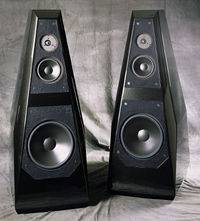
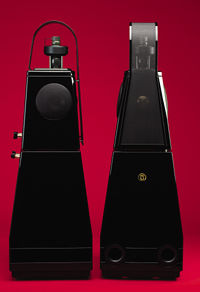
Antares is a giant red star in the constellation Scorpio. According to Rockport Technologies' Andy Payor, the $41,500/pair Antares loudspeaker is the "ultimate" reasonably sized, full-range loudspeaker, and is built to a standard "unequaled in the industry." Rockport's $73,750 <A HREF="http://www.stereophile.com//analogsourcereviews/258/">System III Sirius turntable</A> came with equally boastful claims that turned out to be anything but hyperbole. Has Rockport done it again with the Antares?
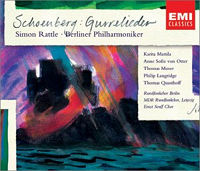
<B>SCHOENBERG: <I>Gurrelieder</I></B><BR> Karita Mattila, soprano; Anne Sofie von Otter, mezzo-soprano; Thomas Moser, Philip Langridge, tenors; Thomas Quasthoff, bass-baritone, speaker; Gentlemen of the Ernst Senff Choir, Berlin Radio Chorus, Leipzig Mitteldeutscher Rundfunk Chorus; Berlin Philharmonic Orchestra, Simon Rattle<BR> EMI 5 57303 2 (2 CDs). 2002. Stephen Johns, prod.; Graham Kirkby, Andy Beer, Mike Cox, engs. DDD. TT: 110:14<BR> Performance <B>****</B><BR> Sonics <B>****</B></B>
Last week we singled out DVD-Audio, which clearly has left readers wondering, when it comes to promotion. This week we get to see if SACD has done any better. Has SACD been marketed properly?
"You'd be hard-pressed to find a company more protective of its reputation than Krell," says Wes Phillips, as he heads off to evaluate the <A HREF="http://www.stereophile.com//digitalsourcereviews/638/">Krell KAV-300<I>cd</I> CD player</A>. WP ponders whether that reputation is still intact as the company tries to save its customers some money.
Issues surrounding the music industry are heating up, and most stories revolve around the record labels, musicians, congress, consumers, and music pirates. Often lost in the noise is the importance of another major player in the business: the technical folks who make recorded music happen.
The US Copyright Office is being pulled in opposite directions over a recent decree establishing royalty rates for music played by webcasters. On one side are radio stations and Internet-only music sites, which claim that the rates are too high. On the other side is the Recording Industry Association of America (RIAA), which claims that the rates are too low. Both sides have filed separate appeals in US federal court.