At the Pub with the Inklings
<I>The Lord of the Rings</I> would have ended quite differently if Tolkien's drinking buddies hadn't talked him out of it.


<I>The Lord of the Rings</I> would have ended quite differently if Tolkien's drinking buddies hadn't talked him out of it.
Graphic representations of every object in our solar system with a diameter greater than 200 miles: One star, four gas giant planets, four terrestrial planets, three dwarf planets, 21 moons, four asteroids, and 51 trans-Neptunian objects (TNOs).
Some combinations work and some don't. How about music and food? Do you eat food while you listen? If so, what is the perfect food/music combination?
There's a new drive-unit manufacturing company on the block, but it's really just the same old guys who brought you VIFA, ScanSpeak, and DST—the original pros from Dover, in other words.
I reviewed Sonny Rollins’ <A HREF="http://www.nytimes.com/2007/09/20/arts/music/20roll.html">Carnegie Hall concert</A> last Tuesday for the <I>New York Times</I>. Short version: The first half, when Rollins played in trio with drummer Roy Haynes and bassist Christian McBride, was wondrous; the second half, with his usual sextet, had its moments but was comparatively a drag. I only hinted at this in the review, but the concert typified the puzzle that is Rollins’ career: why, in the past 40 of its 50-plus years, has this titan of the tenor saxophone—the most inventive living improviser in jazz—chosen to play so often with musicians so clearly beneath him?
Philip O'Hanlon, formerly US marketing director for Halcro, has a new project. His distribution company, <A HREF="http://www.onahighernote.com">On a Higher Note</A>, is bringing Japanese high-end company Luxman back to the United States.
The Goldman Sachs Capital Partners/Kohlberg Kravis Roberts & Co. <A HREF="http://stereophile.com/news/043007harman/">$8 billion buyout of Harman International Industries, Inc.</A> announced last April may not go through, according to "two people familiar with the matter," <I>Bloomberg.com</I> reported September 21.
When folks visit from out of town, they frequently remark that my Brooklyn neighborhood reminds them of "a real neighborhood" from their neck of the woods. "Except that we know all our neighbors and talk to them when we're cutting the grass, watering the lawn, and walking the dog. You probably don't even know the names of any of yours."
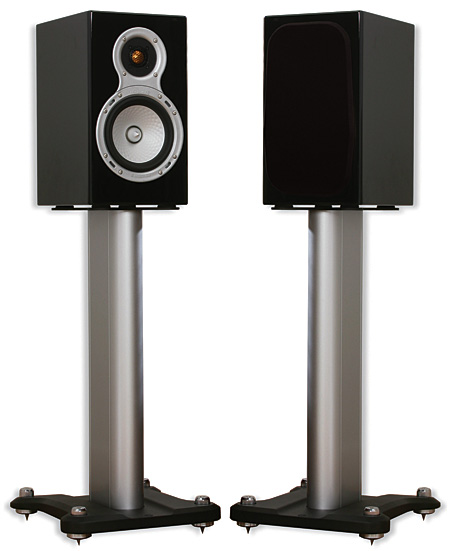
I had intended that my recent exploration of what was available in the world of high-performance minimonitors—the <A HREF="http://www.stereophile.com/floorloudspeakers/107era">Era Acoustics Design 4</A> ($600/pair) in January, the <A HREF="http://www.stereophile.com/floorloudspeakers/361/index12.html">Stirling LS3/5a V2</A> ($1695/pair) and <A HREF="http://www.stereophile.com/floorloudspeakers/1293harbeth/index5.html">H… HL-P3ES2</A> ($1850/pair) in April, the <A HREF="http://www.stereophile.com/floorloudspeakers/507psb">PSB Alpha B1</A> ($279/pair) in May—was to end in July, with my review of the <A HREF="http://www.stereophile.com/floorloudspeakers/707aad">American Acoustic Development Reference Silver-1</A> ($1550/pair). But there was one more real-world–priced, stand-mounted model that piqued my interest before I return to cost-no-object floorstanders in the substantial form of Sonus Faber's new Cremona Elipsa ($20,000/pair): the Gold Signature GS10 from Monitor Audio ($1495/pair).
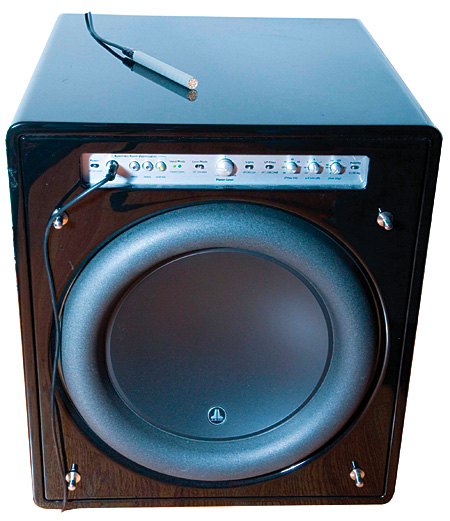
Carl Kennedy, director of JL Audio's Home and Professional Sales division, leaned forward and quietly asked, "Would you like to review our Fathom f113 subwoofer?"