When Private Locks Shackle Public Works
Bill Thompson explains how DRM supersedes copyright law and chills creativity.


Bill Thompson explains how DRM supersedes copyright law and chills creativity.
Mark Mortimer's review of <I>Einstein and the Old One</I> makes an interesting point—just because we "know" stuff our ancestors didn't doesn't actually make us smarter. We "know" without comprehending.
We've received your feedback about the Sonos cover on the latest <I>Stereophile</I>. If you were in charge of the magazine and could put anything you wanted on its cover, what would it be?
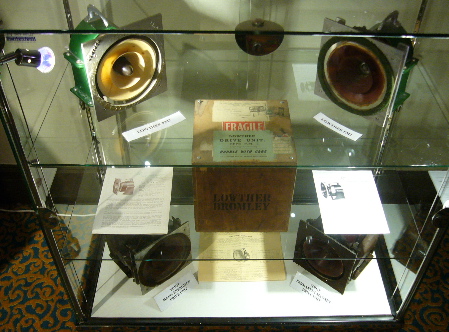
On display in the <I>Hi-Fi News</I> Show ballroom were classic Lowther and Voigt drivers (bottom left is an AC mains-energized field-coil Voigt).
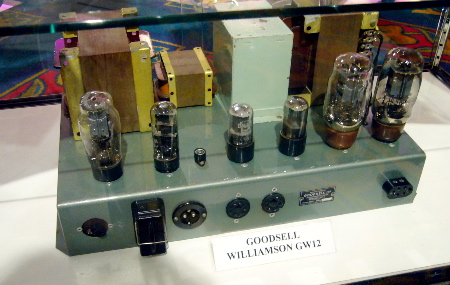
Perhaps the amplifier that had the most influence on modern tube-amp design was the D.T.N Williamson, shown here in an example made by Goodsell of Brighton.
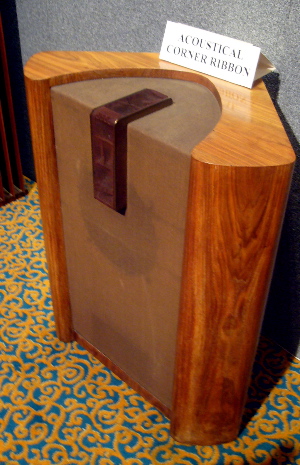
On display in the ballroom at the <I>Hi-Fi News</I> Show: an original early-'50s Corner Ribbon speaker from the Acoustical Company, later to change its name to Quad.
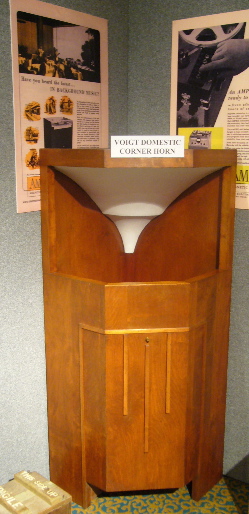
A fabulous and fascinating exhibition of classic historic hi-fi equipment made a visit to the ballroom of the <I>Hi-Fi News</I> Show a must. The complete history of Lowther-Voigt seemed to be on display, and a Voigt Corner Horn was actually playing music, from a "vintage" (first-generation) CD player via a compact Pye tube amplifier.
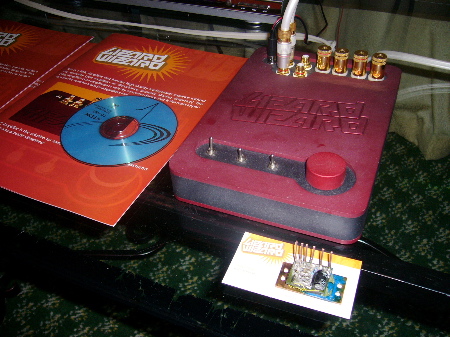
According to the glossy leaflet, the Lizard Wizard on show at the Heathrow Renaissance Hotel is, to quote verbatim: "a PMC amplifier that handles High Quality loudspeakers superior, without the everyday type amplifiers air disturbance [acoustic aliasing distortion]." No I'm not sure either, and the rest of the blurb is similarly opaque. Clearly translating Hungarian into English (or even American!) has its pitfalls, and I didn't get much further chatting face-to-face, either. What is certain is that this colourful amplifier looks cute and is incredibly compact—the actual electronics may be seen sitting on the business card just in front. In this case the PMC bit stands for a "ParaMagnetic Current," or virtual-coil amplifier, which is rated at 60Wpc into 8 ohms, but has a specified output impedance of 0–36 ohms. Curiouser and curiouser, as Alice once remarked.
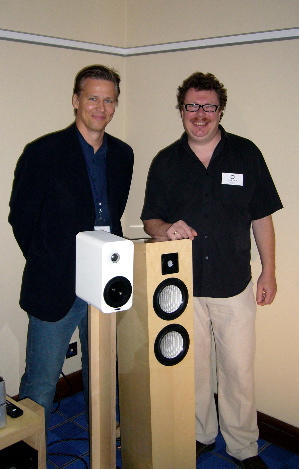
Finn Anssi Hyronen (left) and Swede Leif Mårten Olofsson (right), stand with their respective new babies at the Roy Bird Show. The tiny Amphion Ion (left) not only sounded remarkable for its size, but has also won a valuable design award back in Finland. At ten times the price of the Ion, Mårten's elegant new Miles III floorstander has tapered cabinetwork and costly Accuton ceramic-diaphragm drivers.