Turning Sound Into Electricity
Although I'm normally dealing with stuff that turns electricity into sound, I am fascinated that Zhong Lin Wang seems to have invented a nanotech power source.


Although I'm normally dealing with stuff that turns electricity into sound, I am fascinated that Zhong Lin Wang seems to have invented a nanotech power source.
"Police said the busted driver first shoplifted pepperoni and string cheese from the store after he couldn't find Hot Pockets for his pregnant girlfriend, who was waiting in the GMC. Then he stole the stereo and brought it back because 'it was not of high quality.'"
Ed Hitchcock writes: "As both a paleontologist and home brewer, I could not help but be attracted by the media coverage of the reproduction of an ancient Sumarian beer. The beer, called Ninkasi after the Sumarian goddess of beer, was produced by the Anchor Brewing Company (San Francisco, California), based on a hymn inscribed on a clay tablet (1). Dr. Solomon Katz of the University of Pennsylvania and Fritz Maytag of Anchor Brewing worked to decipher the brewing clues contained within the hymn to reproduce the beverage so revered by the ancient Sumarians."
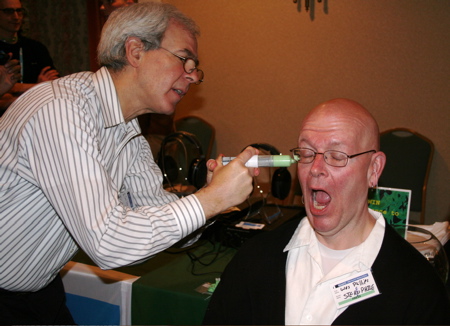
I'll soon be heading off to the Second Annual International Head-Fi Meet in San Jose on April 21 and 22. I went to the NY Meet <A HREF="http://www.stereophile.com/news/042406heaven/">last year</A> and I had a ball. This year's event is going to be bigger and, I'm betting, better.
As I transfer from the R line to the west side IRT, I'm frequently frustrated or surprised by the size of the crowds attending to subway musicians. What I almost never am is impressed by the performances. But that would be different, surely, if, say, an internationally known musician was playing on his Gibson ex Huberman Strad—wouldn't it? A performance like that would be guaranteed to have music lovers swooning with pleasure.
A must for Zappa fans. Studio Ralf is moving—and everything must go! At these prices, it will.
Via wonkosane.
<P ALIGN=CENTER
<object width="425" height="350"><param name="movie" value="http://www.youtube.com/v/4ys7IP8mtN4"></param><param name="wmode" value="transparent"></param><embed src="http://www.youtube.com/v/4ys7IP8mtN4" type="application/x-shockwave-flash" wmode="transparent" width="425" height="350"></embed></object>
Billing itself as a "personalized gateway for music discovery," <A HREF="http://www.mog.com">MOG</A> (a port manteau combination of "music" and "blog") has come out of beta testing and announced "the launch of your favorite new way to waste time on the Internet," MOG 2.0. Since my email tagline is "Waste more time: Read my <A HREF="http://blog.stereophile.com/wesphillips/">blog</A>," John Atkinson reckoned that I was the logical reporter for this new development.
The announcement went out on April 1: Apple Computers and EMI Group had scheduled a press conference for April 2 and the announcement was going to be "historic." It <I>was</I> April 1, after all, and there had been rumors swirling about for months that Apple Computers and Apple Corp. had settled their trademark differences as a first step to a bigger display of collaboration. I forwarded the announcement to Jon Iverson under the heading "April Fool's Joke or Genuine Press Release?"
I grew up on the works of Franklin W. Dixon and Victor Appleton II, which is to say the Hardy Boys and Tom Swift, Jr., as they appeared in the early 1960s. I've had the same disillusioning experience as Gene Weingarten—except that I also devoured the original 1930s versions when I discovered the pulps collection at Alderman Library at UVA.