Floor Loudspeaker Reviews

Sort By: Post DateTitle Publish Date

Infinity RS-4.5 loudspeaker system
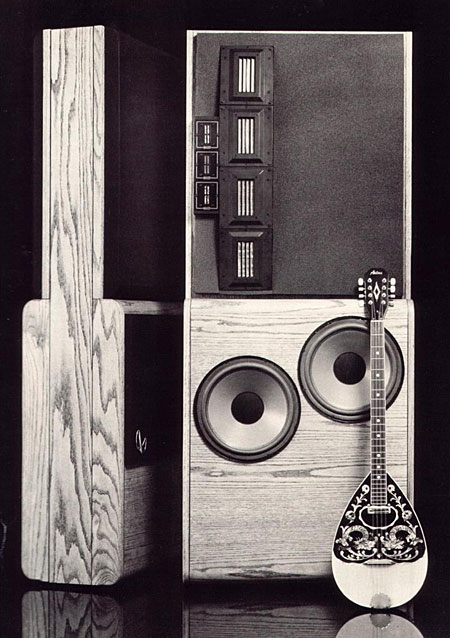
There are certain manufacturers for whom every new product implies the promise of countless modifications, Usually a month or so apart, culminating inevitably in a version so far removed from the original that it must be assigned a new model designation—usually a letter suffix ranging from A, to D. By the time E is envisioned, another CE Show is approaching, so the decision is made to give the unit an exterior facelift and a brand-new model number. Presto! A new product for CES.
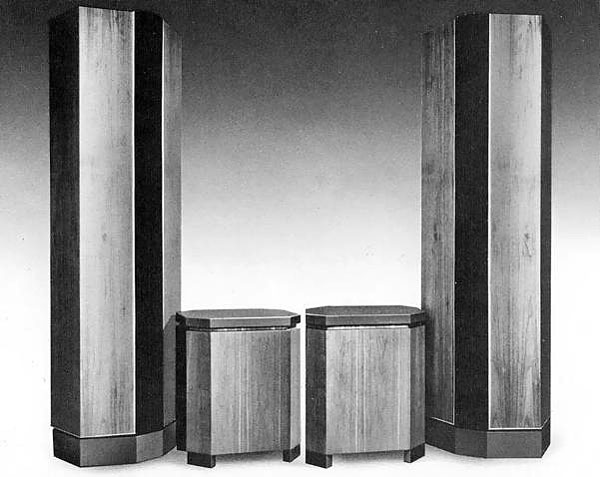
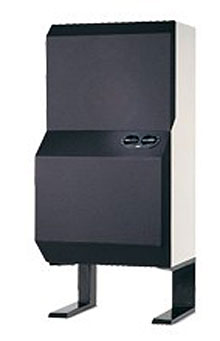
Beveridge 2SW loudspeaker system

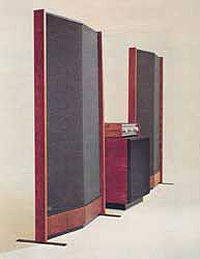
This is an electrostatic column speaker, 6' tall and costing $6000/pair. An integral, fan-cooled amplifier is located in the base. The 2SW is said to cover almost the entire frequency range and is based on a patent, number 3,668,335, issued to manufacturer/designer Harold Beveridge on June 6, 1972. Internal acoustic lenses in front of the electrostatic panels widen the speaker's dispersion: In the Beveridge literature, it says "This 6-foot high device consolidated the entire frequency range into a vertical line source, and uniformly disperses it over a horizontal pattern, 180 degrees wide. The beaming characteristics of the high frequencies are ingeniously translated into the same dispersive pattern as the low frequencies, creating a perfectly balanced cylindrical sound wave front."

B&W DM-6 loudspeaker

The B&W DM-6 is the second "phase-coherent" speaker system we have tested. (The first was the Dahlquist DQ-10 in January 1977.) From what we see in the latest ads from the US, England, and Japan, there will be more forthcoming. One speaker manufacturer who has been around for a long time and is currently pushing his own "phased" systems observed that many of his competitors' designs are being introduced merely because "phase response" sells these days. Yet the truth of the matter is that the experts still do not agree as to whether linear phase has any effect on reproduced sound.

The DM-6 is an expensively made product using three drivers specially designed for it. The woofer cone is of Bextrene plastic, common in England but rare in the US. The midrange unit is a 6" cone of DuPont aromatic polyamide, "Kevlar," which is claimed to have extremely high internal damping. (This is the first acoustical use of this material that we know of.) The tweeter is a ¾" dome. The cabinet is of complex construction, heavily braced and lined with bituminous felt, which can significantly reduce cabinet resonances.

Dahlquist DQ-10 loudspeaker

The Dalhquist DQ-10 loudspeaker has not as yet been formally submitted for review. (The designer tells us he is still working on the low end.) We auditioned a pair at the one local dealer we could find who had the DQ-10s on demo, and were immensely impressed. Obviously, Jon Dahlquist is on to something that other speaker designers have been overlooking, for, despite the multiplicity of driver speakers in the system, the DQ-10 sounds like one big speaker. There is no awareness of crossovers or separate drivers (except at the low end, about which more subsequently), and the overall sound has a degree of focus and coherence that is surpassed only by the Quad full-range electrostatic, which don't go as low at the bottom or as far out at the top.

Magnepan Tympani I loudspeaker

The Magnep1anar Tympani I that is the subject of this report is already an obsolete model, having been superseded by the Tympanis IA, II, and III that were unveiled at the CE Show in Chicago this past June. Since many of our readers already own Tympani Is, and dealer stocks of them are being sold at a substantial price reduction, the report should still be of interest. We will publish follow-up reports on the newer models as soon as they become available for testing.

Hegeman Model 1 omnidirectional loudspeaker

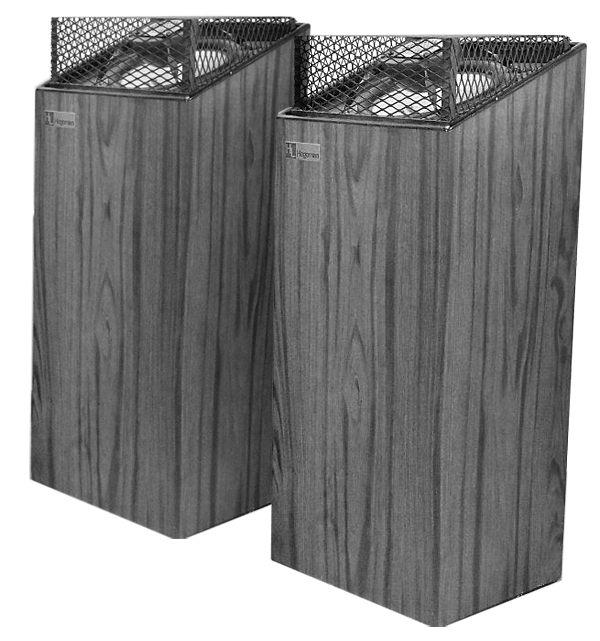
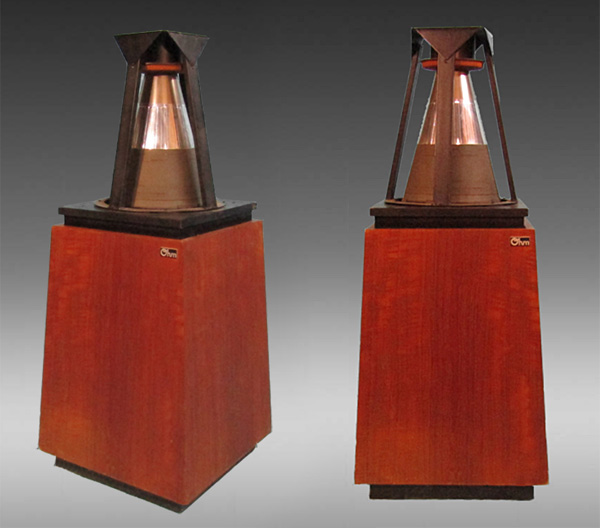
Ye Editor had his first exposure to a true omnidirectional speaker system 15 years ago, while he was employed as chief equipment tester for High Fidelity magazine. The speaker was a most unusual-looking device for its time, being roughly a foot square and standing 3 feet high, with a "cube" of grille cloth at the top like a cupola. Inside the cupola was an 8" woofer facing upwards. Directly above it was the weirdest-looking tweeter you ever saw.

Infinity Servo-Statik 1 loudspeaker

An equipment reviewer for one of the consumer hi-fi magazines once confided to a manufacturer that he found it hard to like electrostatics because of the kind of people who usually like electrostatics. His implication—that certain kinds of people gravitate towards certain kinds of sound—is an interesting thought, and one that might bear some further investigation. But there is no questioning the fact that electrostatic speakers in general do have a particular kind of sound, that might be characterized as "polite."

KLH Model Twelve loudspeaker

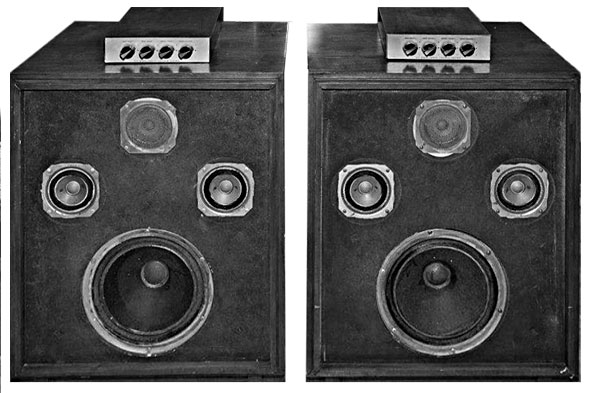
The idea of a loudspeaker system whose frequency response could be tailored to suit room acoustics and/or personal taste is one that has always appealed to the high-fidelity perfectionist. Ideally, such a loudspeaker would allow you to raise or lower the level of any part of the audio spectrum to correct for, say, a sharp 370Hz room resonance or a mild absorptive condition that weakens, say, the 800Hz–3kHz range. Obviously, though, this kind of flexibility would require an infinite number of bandpass networks, each with its own volume control—which is an obvious impracticality.
Advertisement
Advertisement
Advertisement