

The Dawn of Hardware Hacking?
Savvy music fans willing to ignore the built-in copying restrictions on consumer-targeted CD recorders have always had their computer-based CD and DVD recorders and hard drives to play with, especially when it comes to manipulating MP3 files. Maybe not for much longer. A new content-protection approach is attempting to tighten the digital noose around the necks of PC users who have spent the last few years virtually unencumbered when it comes to—as Apple so succinctly puts">http://www.apple.com/hardware/ads/ripmixburn.html">puts it—rip, mix, burn.
The Day the Music Died
See update at end of article. iTunes continues to grow and Napster has been reborn, but these last few months have been a bumpy ride for MP3.comhttp://MP3.com">MP3.com;. The music site, known for its large online music library featuring unsigned independent artists, was purchased on December 14 by San Francisco-based CNEThttp://www.CNET.com">CNET;.
The December Issue . . .
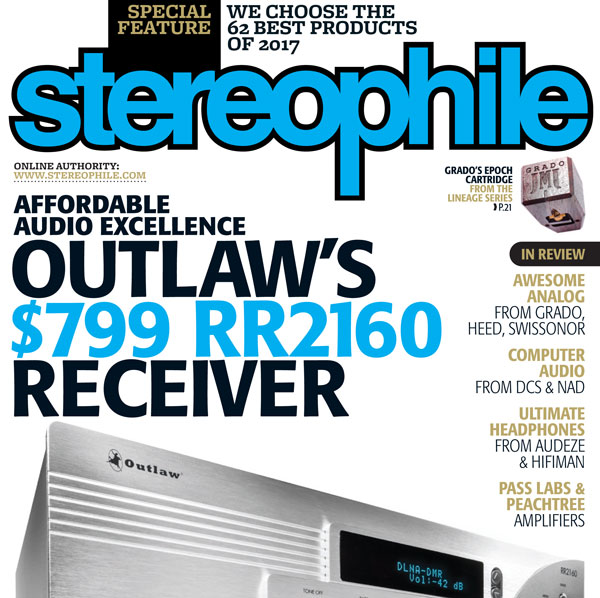
. . . is here, with Outlaw's $799 "retro receiver" on its cover. "A conspicuously good-sounding audiophile product at a ridiculously low price," declared Herb Reichert. At the other end of the price spectrum, Michael Fremer reviews the most-expensive Grado cartridge yet, John Atkinson and Herb Reichert audition cost-no-object headphones from Audeze and HiFiMan, and Jason Victor Serinus reviews the Network Bridge from dCS.
And for the 27th year in a row, the December Stereophile includes our choices for "Product of the Year."
The December Issue's Here
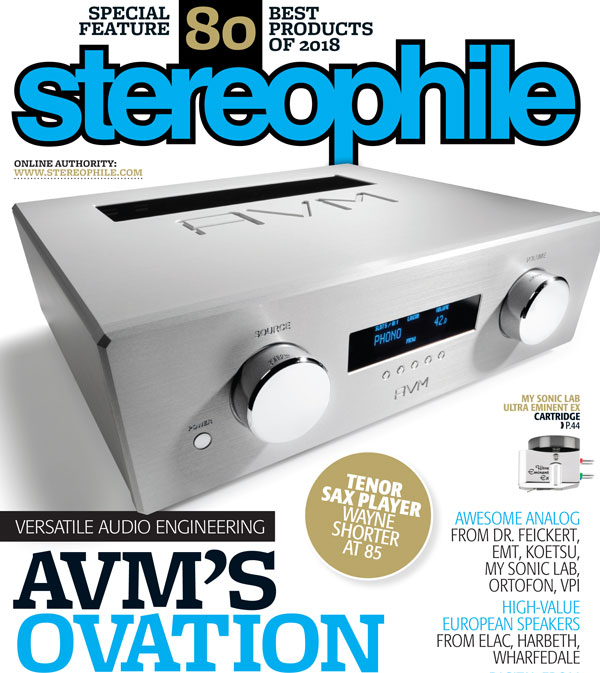
We know, we know, it's only November 12. But it's one heck of an issue, featuring our Products of 2018, and it's hitting newsstands, tablets, and mailbox now! The versatile Ovation PA 8.2 preamplifier from German company AVM is featured on the December cover and this issue's line-up of reviews has a European flavor: as well as the AVM, we audition Elac's Adante AF-61 speaker and EMT's HSD 006 phono cartridge (Germany); the ATC CDA2 CD player, Harbeth P3ESR minimonitor, and Wharfedale Diamond 11.2 bookshelf speaker (UK); Ortofon SPU Wood pickup head (Denmark); and Aqua Formula xHD DAC (Italy).
The Digital Audio Auto
Most folks have enough room in their homes (some college students excepted) to easily place 100W amplifiers without regard to size or heat. But in the car, high-powered amps have always been relegated to the trunk or under a seat, often requiring creative solutions for anything with real heft.
The Digital Den Emerges
Most audiophiles are generally loathe to think that they'd run their main audio systems from a computer. Last time we">http://cgi.stereophile.com/cgi-bin/showvote.cgi?346">we ran a poll, answers such as this one from David L. Wyatt, Jr. were typical: "Why in the world would I hook my computers to my stereo? If I want to make a compilation CD of the music I have purchased, I'll just burn one."
The DIY Chronicles, Part Five
Editor's Note: This is Part Five of a six-part series from reader Hervé Delétraz of Switzerland, who is chronicling the development of his DIY (do-it-yourself) audio amplifier. Part One of the series is herehttp://www.stereophile.com/news/10825/">here;, Part Two is herehttp://www.stereophile.com/news/10832/">here;, Part Three is herehttp://www.stereophile.com/news/10839/">here;, and Part Four is here.http://www.stereophile.com/news/10844/">here.;
The DIY Chronicles, Part Four
Editor's Note: This is Part Four of a six-part series from reader Hervé Delétraz of Switzerland, who is chronicling the development of his DIY (do-it-yourself) audio amplifier. Part One is herehttp://www.stereophile.com/news/10825/">here;, Part Two is herehttp://www.stereophile.com/news/10832/">here;, and Part Three is here.http://www.stereophile.com/news/10839/">here.;
The DIY Chronicles, Part One
Editor's Note: There is a large contingent of Stereophile readers who design and build their own equipment—the DIY (do it yourself) crowd. Hervé Delétraz from Switzerland has been e-mailing us photos and stories over the last year about his own ambitious DIY amplifier design, so we asked him if he'd be willing to share a chronicle of his progress, starting from the beginning. This is the first in a six-part series written by Mr. Delétraz.
The DIY Chronicles, Part Six
Editor's Note: This is Part Six of a six-part series from reader Hervé Delétraz of Switzerland, who has chronicled the development of his DIY (do-it-yourself) audio amplifier.