

Surrounded By Space
During the late 1950s, when high fidelity exploded into a multimillion-dollar industry, product advertisements bragged about bringing the orchestra into your living room. Apparently, no one realized what an absurd concept it was, but there are still many people today who believe that's what audio is all about. It isn't. There is no way a real orchestra could fit into the average living room, and if it could, we would not want to be around when it played. Sound levels of 115dB are just too loud for most sane people, and that's what a full orchestral fortissimo can produce in a small room.
Tandberg 3015A CD player
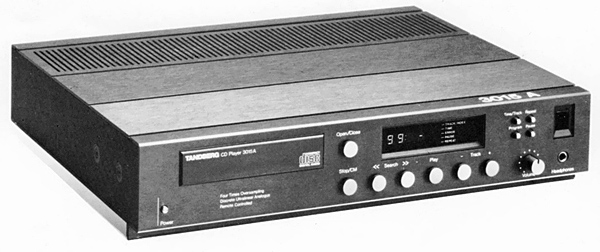
Tandberg of Norway has a rather ambiguous corporate image among audio perfectionists. Long considered to make some of the best tape-recording equipment around, the firm has never been seen as a leader in electronics, despite some boldand reportedly good-soundingforays into the realm of $2000 preamps and $3500 power amplifiers. Perhaps this is why, when Tandberg started making CD players, high-enders were uncertain how to respond.
Test Your Hi-FiQ
How do you rate as an audio expert? Test yourself on these 25 questions.
All of the following are multiple-choice questions, dealing with things that every audio hobbyist should know, either before or after completing the test. Most of them are easy, but take your time in answering and don't jump to conclusions. Some of the questions are quite tricky, and wrong answers will be subtracted from your final score, so read them and the possible answers carefully before committing yourself. Don't guess if you aren't fairly sure.
The 1986 Winter CES
I always enjoy CES. Like the Big Apple, or the City of Angels, the Consumer Elecronics Show is stimulatingly frenetic and enjoyably fatiguing—things that would soon put me in the funny farm if I lived with them year 'round, but can easily cope with twice a year. In fact, attending CES is rather like visiting the city of my birth, a place whose culture is one with my own because I grew up there, and where half the pleasure lies in seeing once again those audio people—the Allisons, Marantzes, Frieds, Beveridges, Haflers, and Tuckers—whose durability as friends always reminds me of how rapidly time passes and how little of it we may have left.
The Absolute Sound of What?
One of the things that distinguishes a dedicated audiophile from Joe Q. Public is that he has some notion of what audio fidelity is all about.
The Acoustic Research integrated amplifier
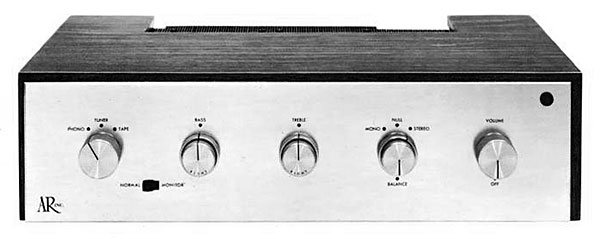
The first time we saw an AR amplifier (at a Hi-Fi Show), we were struck by its bland, almost antiseptic appearance. Amidst all those other audio products that looked as though they had been high-styled for Madame's boudoir, the unadorned simplicity of the AR amplifier made it stand out like an Eames chair at Williamsburg.
The Acoustical Standard (with follow-up)
From time to time in this column, I have alluded to what appears to be a loss of direction in high-end audio. It's not that the state of the audio art has stopped advancing; the technology is improving in many ways, as is obvious every time we listen to a new preamplifier or cartridge or loudspeaker that has better this, that, or the other thing than anything which has come before. The problem is that these improvements don't really seem to be getting us anywhere. And I believe the reason for this is that the audio community no longer agrees about where audio is supposed to be going in the first place.
The Advent Loudspeaker
After a number of years of equipment reviewing, one gets rather blasé about "compact" loudspeakers. The appearance of yet another one that looks like hundreds of others and embodies no radically new innovations to pique one's curiosity is likely to be greeted with a passionate Ho-Hum.
The Audio Centennial (+1) Revolution
Despite the myriads of technological breakthroughs announced month after month with tedious regularity by manufacturers of pickups, amplifiers and loudspeakers, there are only five developments in the 101-year history of audio reproduction (footnote 1) that we would call truly revolutionary. We will doubtless offend many by stating that Edison's phonograph was not one of them. It was the starting point, it was not a turning point. Emile Berliner's disc was revolutionary, in that it changed the whole format of sound reproduction, and made possible true mass production of recordings (footnote 2).
The Big Announcement
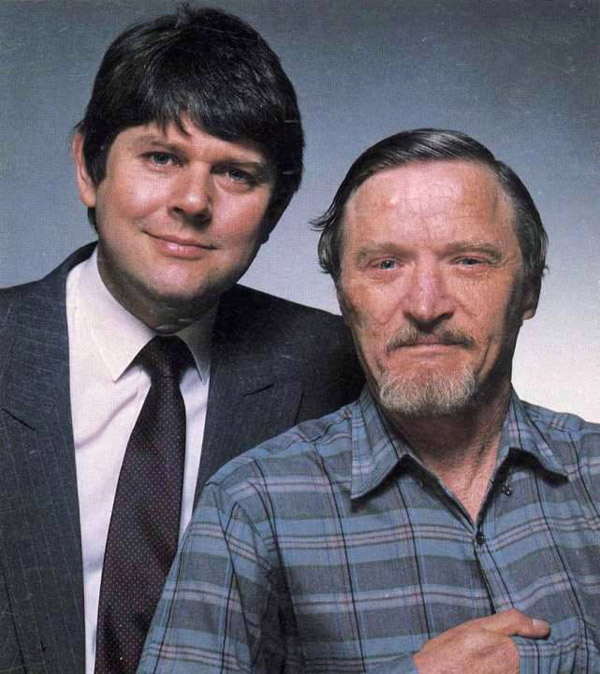
The rumors have been flying, and his arrival is imminent—a couple weeks after you read this—so it's time our readers know: John Atkinson, for the last four years Editor of Britain's prestigious Hi-Fi News & Record Review (left), is joining the staff of Stereophile as Managing Editor and International Editor.