

Lights in a Box?
"Without content, television is nothing more than lights in a box."
---Edward R. Murrow.
---Edward R. Murrow.
Linaeum Model 10 & Center-Channel loudspeakers
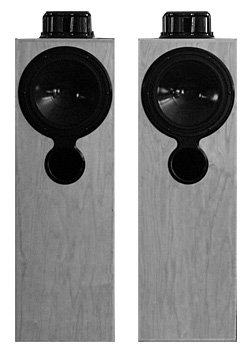 It's been a long time since we've seen a really new tweeter design. Only five basic types have ever been developed: cones, domes, panels, ribbons, and ionic plasmas. And the most recent of thesethe long-defunct DuKane "blue-glow" Ionovacwas introduced 40 years ago. Since then, tweeter development has been more evolutionary than revolutionary, a series of refinements that has made them more efficient, more reliable, and smoother and more extended in response.
Magnepan MG2.5/R loudspeaker
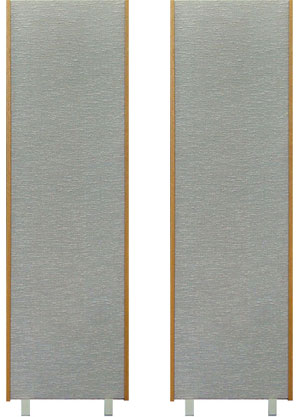 Now there's a Magneplanar speaker to fill the price gap between the $2000 MGIIIa and the $1225 MGIIc. The '2.5/R is priced almost exactly midway between them, which explains the unusual model number.
Like all the other single-panel Magneplanars, these are attractive enough in appearance to be surprisingly unobtrusive in the room, despite their imposing 6' height. Apart from the wooden endcheeks, they are covered with fabric grille all the way around, which could be a cosmetic liability as well as an asset: Domestic cats love to climb up fabric stretched tightly over wood (as at the bases of these) and, given the opportunity, will have these speakers in shreds in no time. Magnepan recommends spray-on cat repellent; I have to tell them that some cats don't seem to mind its odor as much as most people do.
Now there's a Magneplanar speaker to fill the price gap between the $2000 MGIIIa and the $1225 MGIIc. The '2.5/R is priced almost exactly midway between them, which explains the unusual model number.
Like all the other single-panel Magneplanars, these are attractive enough in appearance to be surprisingly unobtrusive in the room, despite their imposing 6' height. Apart from the wooden endcheeks, they are covered with fabric grille all the way around, which could be a cosmetic liability as well as an asset: Domestic cats love to climb up fabric stretched tightly over wood (as at the bases of these) and, given the opportunity, will have these speakers in shreds in no time. Magnepan recommends spray-on cat repellent; I have to tell them that some cats don't seem to mind its odor as much as most people do.Magnepan Tympani I loudspeaker
The Magnep1anar Tympani I that is the subject of this report is already an obsolete model, having been superseded by the Tympanis IA, II, and III that were unveiled at the CE Show in Chicago this past June. Since many of our readers already own Tympani Is, and dealer stocks of them are being sold at a substantial price reduction, the report should still be of interest. We will publish follow-up reports on the newer models as soon as they become available for testing.
Mark Levinson HQD loudspeaker system
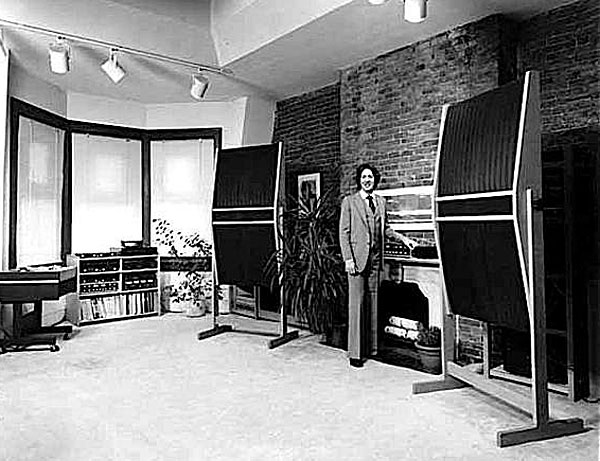
We wrote a long, rather unkind report on the HQD, pointing out that, if that was typical of the way it was supposed to sound (And why not, after Mr. Levinson had installed and tweaked it?), then it had to be the most expensive bomb ever to be made available for civilian use. Mr. Levinson responded with a phone call during which he:
1) Told us we had not heard it at its best, but refused to address himself to our specific criticisms;
2) Claimed that many practicing professional musicians felt the HQD to be "extremely realistic";
3) Informed us that, since he sold very few HQD systems and would soon be discontinuing them anyway because Quad had ceased making those speakers, the "sensible" thing to do would be to kill the report; and
4) Mentioned, just in passing of course, that he was currently writing a feature article for Time on the subject of "underground" audio magazines.
Mark Levinson ML-7A preamplifier
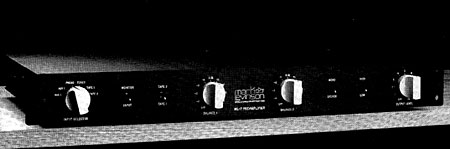
Before launching into Stereophile's first-ever report on a Mark Levinson product, an important point needs to be clarified. Although Mark Levinson products were originally made by Mark Levinson, they are no longer. Au contraire, Mark Levinson products are now being made by Madrigal, Ltd., which bought Mark Levinson Audio Systems' assets and trademark two years ago. Mark Levinson's products, as distinguished from Mark Levinson products, are now being manufactured by a company called Cello. But the subject of this report, the Mark Levinson ML-7A preamplifier, is a product of Madrigal, Ltd., not of Cello. Now that I've made that all perfectly clear, we may proceed.
MartinLogan Monolith loudspeaker
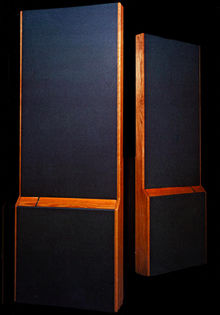
Most Stereophile readers are aware by now of why the full-range electrostatic should, in theory, be the ideal transducer. (If you aren't aware, see the accompanying sidebar.) Acoustat was the first manufacturer to design a full-range electrostatic that was so indestructible it came with a lifetime warranty. (MartinLogan is now offering a three-year warranty on their speakers, and is considering going to a lifetime warranty). But Acoustat was never able to solve another problem that has plagued all flat-panel speakers: treble beaming.
Matters of Opinion
Now that audio technology seems to be on the verge of being able to do anything asked of it, it seems only fitting to wonder about what we should be asking it to do. We probably all agree that high fidelity should yield a felicitous reproduction of music, but felicitous to what? Should a system give an accurate replica of what is on the disc, or of the original musical sounds?
Meridian MCD & MCD Pro CD players
Well, it was inevitable. Prior to the MCD, every CD player had been a product of a major Japanese or European manufacturer, and we all know what kind of audio electronics "major" manufacturers usually design: adequate, but rarely much better. The MCD is the first player from a small, perfectionist-oriented firm, and an English one at that (Boothroyd-Stuart).
Meridian's Bob Stuart
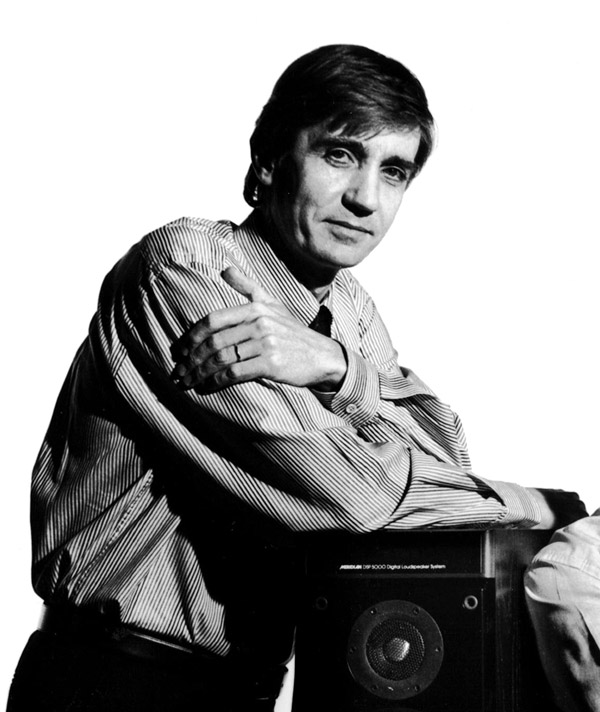
Meridian's MCD CD player was perhaps the first audiophile-quality player to be introduced in the high-end market. I met with Bob Stuart of Meridian at the Winter Consumer Electronics Show in Las Vegas, in January, 1986 (footnote 1). My first question was about the name of the company he runs with industrial designer Alan Boothroyd:
J. Gordon Holt: Meridian in England is called Boothroyd Stuart, right?
Bob Stuart: Yes, the company is called Boothroyd Stuart, Limited, and the trademark is Meridian.