

Joint Recordings of May 1988: Get Rhythm & Bring the Family
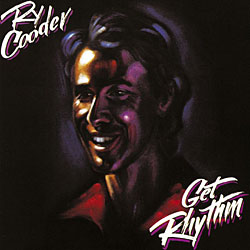 Ry Cooder: Get Rhythm
Warner Bros. 25639 (LP). Ed Cherney, eng.; Ry Cooder, prod. TT: 40:43
John Hiatt: Bring the Family
A&M SP5158 (LP). Larry Hirsch, eng.; John Chelew, prod. TT: 45:26 There are a few white men in American musicDelbert McClinton, Jerry Jeff Walker, John Fogarty, Van Morrison, Joe Ely, and Steve Earle all come to mindwhose music is consistently true, believable, honorable, and unpretentious. Ry Cooder has been one of those names since his solo debut in 1970; with Bring the Family, John Hiatt's must now be added to the list. Bring the Family is what Robbie Robertson's overrated new album should have been (sorry, Gary Krakow): simple, strong, mature, its feet rock-solid on the ground. "Thing Called Love," in fact, sounds much like the album The Band might have made between The Band and Stage Fright.
Joint Recordings of October 1990: The Hard Way & Stolen Moments
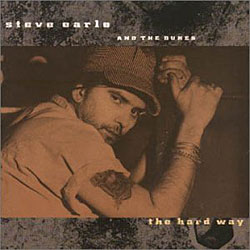
STEVE EARLE & the Dukes: The Hard Way
MCA MCA-6430 (LP), MCAD-6430 (CD). Steve Earle, Joe Hardy, prods.; Joe Hardy, eng. DDA/DDD. TT: 55:53
MCA MCA-6430 (LP), MCAD-6430 (CD). Steve Earle, Joe Hardy, prods.; Joe Hardy, eng. DDA/DDD. TT: 55:53
Recording of April 1967: An Audio Obstacle Course
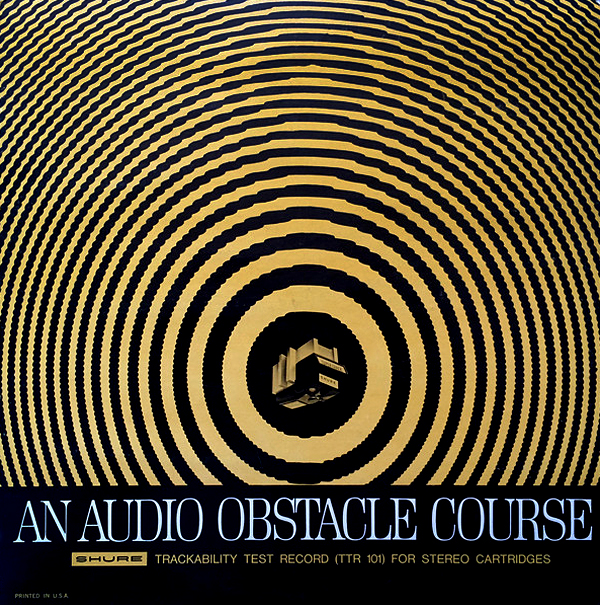
An Audio Obstacle Course: The Shure Trackability Test Record
Shure Bros. TTR-101. Shure's new "Supertrack" V-15 Type II pickup was designed as an answer to all those high-powered discs whose excessive modulations make them shatter all over the place on lesser pickups, But just in case anyone didn't happen to own any of these difficult discs, Shure decided to issue one of these, too. The result is a collection of some of the meanest modulations ever gathered together in one place.
Shure Bros. TTR-101. Shure's new "Supertrack" V-15 Type II pickup was designed as an answer to all those high-powered discs whose excessive modulations make them shatter all over the place on lesser pickups, But just in case anyone didn't happen to own any of these difficult discs, Shure decided to issue one of these, too. The result is a collection of some of the meanest modulations ever gathered together in one place.
Recording of April 1978: The Power and the Majesty
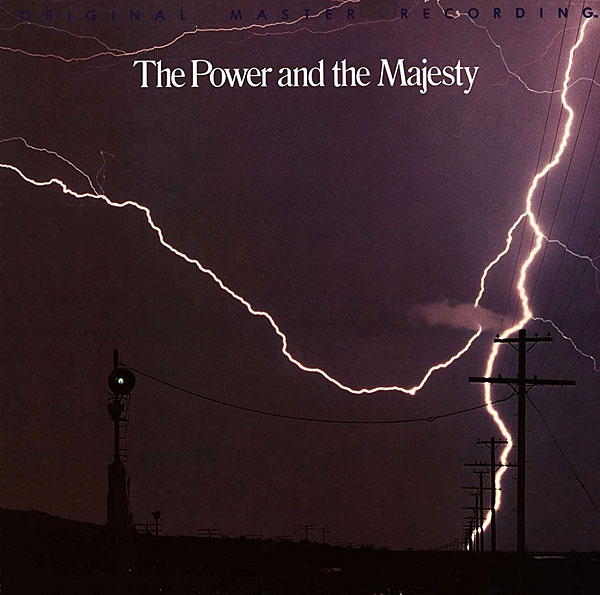
This is more to my liking than the other records I review this month! Side 1 is devoted entirely to a real humdinger of a thunderstorm, replete with rain, thimble-sized hailstones, and five minutes of someone diddling with a set of wind chimes. Side 2 is four sequences in the saga of Steam Locomotive 4449, which was refurbished from rusty decrepitude to haul the bicentennial Freedom Train 28,000 miles around the continent.
Recording of April 1982: Williams: Film Music
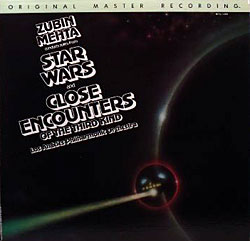 Williams: Suites from Star Wars and Close Encounters of the Third Kind
Los Angeles Philharmonic orchestra, Zubin Mehta.
Mobile Fidelity MFSL-C.008 (cassette). Originally released on London Records, then re-released with better sound on a Mobile Fidelity disc (now a cutout), these are stunning performances of these popular film scores, rivaling the composer's own performances of them. (Composers aren't always the best conductors of their own music, but John Williams is one who is.) Sonically, this is simply a tour de force: Without a doubt the best commercially made cassette I've ever heard (and I've heard a lot of them). Last month, I expressed some doubt that the high end on any cassette could rival that of a half-speed LP and, indeed, there is a softening at the top on this cassette, when compared with the Mobile Fidelity disc. But the truth of the matter is that the cassette's high end is substantially more natural than that from the disc, which was one of Mobile Fidelity's first and had a slightly steely edge to it.
Recording of April 1989: The Symphonic Soundstage
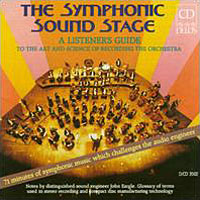 It is often said that anyone with a recorder and a couple of microphones can record an orchestra. It's true, assuming you can get permission to do it (another story entirely). But that statement fails to address an important question: "How well?"
The rudiments of any skill can be learned from books. Practice can develop a fair level of competence. Beyond competence, however, the student is governed by his genes and/or family environment, depending on which theory of human potential you subscribe to. Whatever the reason, some practitioners of both disciplines never seem able to transcend mere competence, while others go on to become legends in their own times. John Eargle, chief recording engineer for Delos Records and producer of this fascinating recording, may or may not qualify as a legend, but he is obviously 'way past "a fair level of competence."
It is often said that anyone with a recorder and a couple of microphones can record an orchestra. It's true, assuming you can get permission to do it (another story entirely). But that statement fails to address an important question: "How well?"
The rudiments of any skill can be learned from books. Practice can develop a fair level of competence. Beyond competence, however, the student is governed by his genes and/or family environment, depending on which theory of human potential you subscribe to. Whatever the reason, some practitioners of both disciplines never seem able to transcend mere competence, while others go on to become legends in their own times. John Eargle, chief recording engineer for Delos Records and producer of this fascinating recording, may or may not qualify as a legend, but he is obviously 'way past "a fair level of competence."
Recording of April 1990: Dvorák: Symphony 9
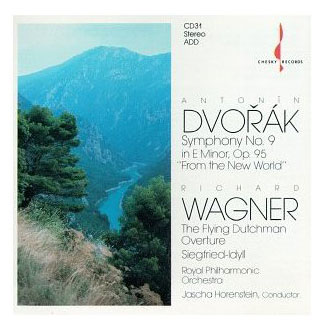
DVORÁK: Symphony 9, "From the New World"
WAGNER: Flying Dutchman Overture, Siegfried-Idyll
Jascha Horenstein, Royal Philharmonic Orchestra
Chesky Records CD 31 (CD only). Bob Katz, remastering eng.; David & Norman Chesky, executive prods. (Original 1962 recordings: K. E. Wilkinson, eng.; Charles Gerhardt, prod.) ADD. TT: 67:30
WAGNER: Flying Dutchman Overture, Siegfried-Idyll
Jascha Horenstein, Royal Philharmonic Orchestra
Chesky Records CD 31 (CD only). Bob Katz, remastering eng.; David & Norman Chesky, executive prods. (Original 1962 recordings: K. E. Wilkinson, eng.; Charles Gerhardt, prod.) ADD. TT: 67:30
Recording of April 1991: Rhythm, Blues, Soul & Grooves
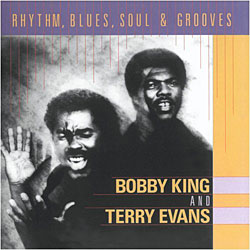
BOBBY KING & TERRY EVANS: Rhythm, Blues, Soul & Grooves
Rounder 2101 (LP), CD 2101 (CD). Brian Levi, eng.; Bobby King, Terry Evans, prods. AAA/AAD. TT: 49:53
Rounder 2101 (LP), CD 2101 (CD). Brian Levi, eng.; Bobby King, Terry Evans, prods. AAA/AAD. TT: 49:53
Recording of April 1992: Wagner: Parsifal
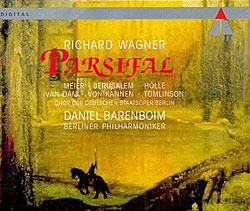
WAGNER: Parsifal
Siegfried Jerusalem, Parsifal; Matthias Hölle, Gurnemanz; Waltraud Meier, Kundry; José van Dam, Amfortas; Günter von Kannen, Klingsor; John Tomlinson, Titurel; others; Berlin Philharmonic, Daniel Barenboim
Teldec 9031-74448-2 (4 CDs only). Helmut Mühle, prod.; Jean Chatauret, eng. DDD. TT: 4:16:35
Siegfried Jerusalem, Parsifal; Matthias Hölle, Gurnemanz; Waltraud Meier, Kundry; José van Dam, Amfortas; Günter von Kannen, Klingsor; John Tomlinson, Titurel; others; Berlin Philharmonic, Daniel Barenboim
Teldec 9031-74448-2 (4 CDs only). Helmut Mühle, prod.; Jean Chatauret, eng. DDD. TT: 4:16:35
Recording of April 1993: A Meeting by the River
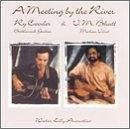
RY COODER/VISHWA BHATT: A Meeting by the River
Water Lily Acoustics WLA-CS-29-CD (CD only; LP available eventually). Kavichandran Alexander, prod., eng. AAD. TT: 39:48
Water Lily Acoustics WLA-CS-29-CD (CD only; LP available eventually). Kavichandran Alexander, prod., eng. AAD. TT: 39:48