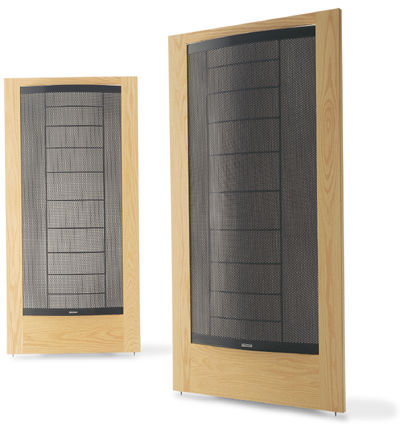
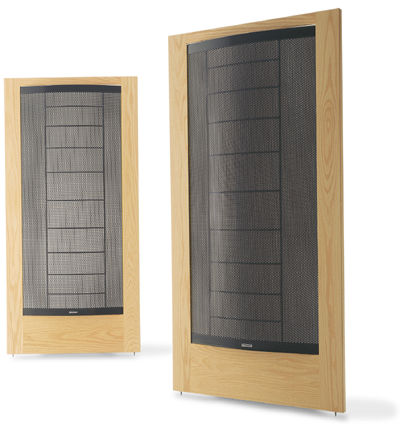
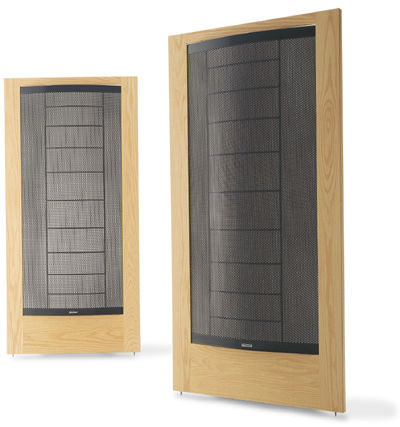
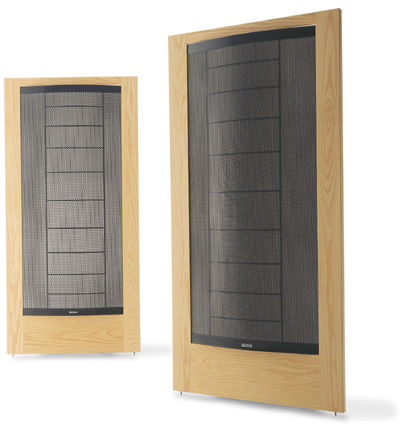
The quest for a full-range electrostatic loudspeaker has occupied many engineers' minds for many years. The problems are manifold: large physical size (which can lead to room placement problems and poor dispersion), the difficulty of achieving high sound pressure levels, the need for a potentially sound-degrading step-up transformer, and the unsuitability for production-line manufacture. Even so, the potential rewards are so great that one can understand why loudspeaker designers keep on attempting the apparently impossible. Epoch-making models do appear at infrequent intervals, keeping the flame burning since the appearance of the original Quad in 1955: Acoustat, Sound Lab, and Beveridge in the US, Stax in Japan, Audiostatic in Holland, Quad, of course, in England, and now MartinLogan.
The quest for a full-range electrostatic loudspeaker has occupied many engineers' minds for many years. The problems are manifold: large physical size (which can lead to room placement problems and poor dispersion), the difficulty of achieving high sound pressure levels, the need for a potentially sound-degrading step-up transformer, and the unsuitability for production-line manufacture. Even so, the potential rewards are so great that one can understand why loudspeaker designers keep on attempting the apparently impossible. Epoch-making models do appear at infrequent intervals, keeping the flame burning since the appearance of the original Quad in 1955: Acoustat, Sound Lab, and Beveridge in the US, Stax in Japan, Audiostatic in Holland, Quad, of course, in England, and now MartinLogan.
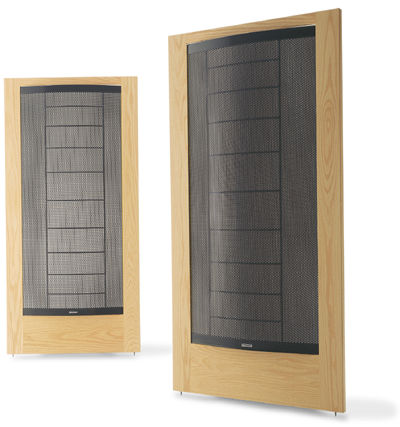
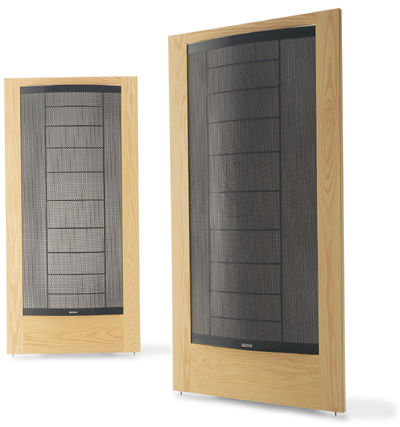
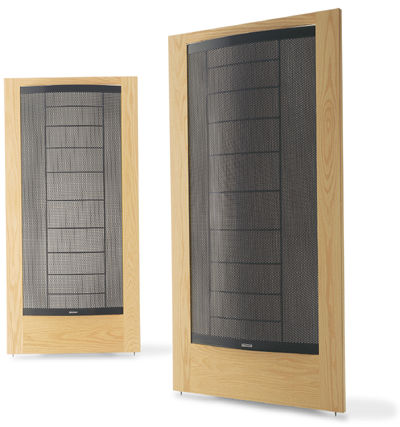
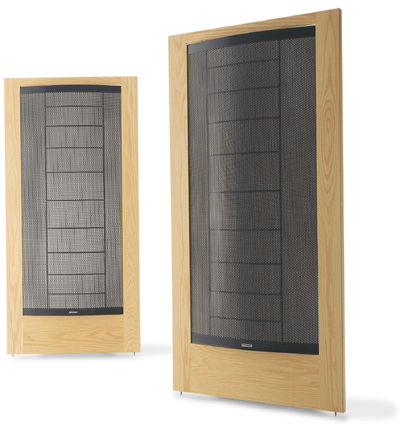
MartinLogan CLS loudspeaker Jack English, CLS IIA, December 1991
The quest for a full-range electrostatic loudspeaker has occupied many engineers' minds for many years. The problems are manifold: large physical size (which can lead to room placement problems and poor dispersion), the difficulty of achieving high sound pressure levels, the need for a potentially sound-degrading step-up transformer, and the unsuitability for production-line manufacture. Even so, the potential rewards are so great that one can understand why loudspeaker designers keep on attempting the apparently impossible. Epoch-making models do appear at infrequent intervals, keeping the flame burning since the appearance of the original Quad in 1955: Acoustat, Sound Lab, and Beveridge in the US, Stax in Japan, Audiostatic in Holland, Quad, of course, in England, and now MartinLogan.
The quest for a full-range electrostatic loudspeaker has occupied many engineers' minds for many years. The problems are manifold: large physical size (which can lead to room placement problems and poor dispersion), the difficulty of achieving high sound pressure levels, the need for a potentially sound-degrading step-up transformer, and the unsuitability for production-line manufacture. Even so, the potential rewards are so great that one can understand why loudspeaker designers keep on attempting the apparently impossible. Epoch-making models do appear at infrequent intervals, keeping the flame burning since the appearance of the original Quad in 1955: Acoustat, Sound Lab, and Beveridge in the US, Stax in Japan, Audiostatic in Holland, Quad, of course, in England, and now MartinLogan.
MartinLogan CLS loudspeaker Martin Colloms, January 1987
The quest for a full-range electrostatic loudspeaker has occupied many engineers' minds for many years. The problems are manifold: large physical size (which can lead to room placement problems and poor dispersion), the difficulty of achieving high sound pressure levels, the need for a potentially sound-degrading step-up transformer, and the unsuitability for production-line manufacture. Even so, the potential rewards are so great that one can understand why loudspeaker designers keep on attempting the apparently impossible. Epoch-making models do appear at infrequent intervals, keeping the flame burning since the appearance of the original Quad in 1955: Acoustat, Sound Lab, and Beveridge in the US, Stax in Japan, Audiostatic in Holland, Quad, of course, in England, and now MartinLogan.
The quest for a full-range electrostatic loudspeaker has occupied many engineers' minds for many years. The problems are manifold: large physical size (which can lead to room placement problems and poor dispersion), the difficulty of achieving high sound pressure levels, the need for a potentially sound-degrading step-up transformer, and the unsuitability for production-line manufacture. Even so, the potential rewards are so great that one can understand why loudspeaker designers keep on attempting the apparently impossible. Epoch-making models do appear at infrequent intervals, keeping the flame burning since the appearance of the original Quad in 1955: Acoustat, Sound Lab, and Beveridge in the US, Stax in Japan, Audiostatic in Holland, Quad, of course, in England, and now MartinLogan.
The quest for a full-range electrostatic loudspeaker has occupied many engineers' minds for many years. The problems are manifold: large physical size (which can lead to room placement problems and poor dispersion), the difficulty of achieving high sound pressure levels, the need for a potentially sound-degrading step-up transformer, and the unsuitability for production-line manufacture. Even so, the potential rewards are so great that one can understand why loudspeaker designers keep on attempting the apparently impossible. Epoch-making models do appear at infrequent intervals, keeping the flame burning since the appearance of the original Quad in 1955: Acoustat, Sound Lab, and Beveridge in the US, Stax in Japan, Audiostatic in Holland, Quad, of course, in England, and now MartinLogan.
The quest for a full-range electrostatic loudspeaker has occupied many engineers' minds for many years. The problems are manifold: large physical size (which can lead to room placement problems and poor dispersion), the difficulty of achieving high sound pressure levels, the need for a potentially sound-degrading step-up transformer, and the unsuitability for production-line manufacture. Even so, the potential rewards are so great that one can understand why loudspeaker designers keep on attempting the apparently impossible. Epoch-making models do appear at infrequent intervals, keeping the flame burning since the appearance of the original Quad in 1955: Acoustat, Sound Lab, and Beveridge in the US, Stax in Japan, Audiostatic in Holland, Quad, of course, in England, and now MartinLogan.
As someone who started out as a classically trained musician but who then stepped sideways into rock, I'm fascinated by the one music I've never played: jazz. It seems to me that the essential difference between a performance of a classical work and a jazz performance is that in the former, the musicians use their technique to breathe life into dead notes on a page, while in <I>good</I> jazz, the performer not only applies a similar level of technical expertise, but also has simultaneously to have all of music theory at the fingertips in order to decide what the next note should be. It is a rare musician---Keith Jarrett, for example---who can excel in both arenas.