E<I>ditor's Note: This is Part Six of a six-part series from reader Hervé Delétraz of Switzerland, who has chronicled the development of his DIY (do-it-yourself) audio amplifier.
Citing the potential danger of "collective dominance" of the music business, European Commission members have nixed the proposed merger of American media conglomerate Time Warner and British music-industry powerhouse EMI. The $20 billion joint venture may still have some small chance at a future, provided the companies make further concessions to allay fears of monopolistic control of music prices in Europe.
Watermarking, High-Resolution Audio Big Topics at AES
Oct 01, 2000
For the 109th convention of the <A HREF="http://www.aes.org/">Audio Engineering Society</A>, the main floor of the L.A. Convention Center was transformed into a bazaar of new tools for audio professionals—but the panel discussions upstairs were where the real action took place. On Friday, September 22—just an hour before researchers Dr. Stanley Lipshitz and John Vanderkooy of Ontario's University of Waterloo presented a paper offering a mathematical proof for the "imperfectability" of one-bit delta-sigma recording systems—Sony Corporation issued a clarification of the technical standards for its Direct Stream Digital technology, the basis of the Super Audio Compact Disc. DSD, it now appears, is a one-bit technique as it applies to consumer playback systems, but uses a multi-bit PCM quantizer [<I>presumably within a delta-sigma converter negative-feedback loop; see an article on this subject in the forthcoming November issue of </I>Stereophile<I>—Ed.</I>] at the recording and mastering ends of the business. (The Lipshitz/Vanderkooy paper is available as AES preprint #5188.)
Universal SACD/DVD-Audio/DVD-Video/CD Players for the Masses?
Oct 01, 2000
The dawning of the age of inexpensive universal DVD-Audio/SACD/CD players may finally be upon us. <A HREF="http://www.cirruslogic.com/">Cirrus Logic</A> recently announced the introduction of their CS4392 integrated circuit chip, which the company describes as a high-performance Crystal digital/analog converter that "delivers unrivaled sound quality while providing manufacturers a cost-effective solution for next-generation DVD-based audio products including DVD-Audio and Super Audio CD (SACD) players."
It is often observed that audiophiles are an aging, dying breed, and that the obvious antidote is to bring younger 'philes into the fold. To that end, BuzzNet 2000 has been created as a "touring educational festival of new music listening technologies" by the Consumer Electronics Association (CEA). The program launches this fall with two dates on the west coast: California State University at Long Beach and the University of California at Davis.
This smallish loudspeaker system has been getting high ratings in the English audio magazines for some years but was not available to US consumers until recently, when the small firm (literally a Mom'n'Pop enterprise, footnote 1) arranged for US distribution through Audio International.
The Spendor BC-1 is about as unimpressive-looking as any other smallish three-way loudspeaker, of which there are countless hundreds of models being made in the US at present. In fact, we were so ho-hummed by the mundane appearance of this speaker that we found it hard to connect the pair up and give them a listen.
Most people who now listen to tube amplifiers began with a transistor amp, and know from experience that a tube amp of a given measured power output sounds louder than its nominally identical transistorized equivalent. The unofficial consensus is that you need two to four times the transistor power to achieve the same loudness as you would using tubes. In other words, given the (subjectively) undistorted sound level a 25W (footnote 1) tube amplifier can provide, if you want the same loudness from solid-state technology you would have to replace it with at least a 50W transistor amp (footnote 2).
Most people who now listen to tube amplifiers began with a transistor amp, and know from experience that a tube amp of a given measured power output sounds louder than its nominally identical transistorized equivalent. The unofficial consensus is that you need two to four times the transistor power to achieve the same loudness as you would using tubes. In other words, given the (subjectively) undistorted sound level a 25W (footnote 1) tube amplifier can provide, if you want the same loudness from solid-state technology you would have to replace it with at least a 50W transistor amp (footnote 2).
Most people who now listen to tube amplifiers began with a transistor amp, and know from experience that a tube amp of a given measured power output sounds louder than its nominally identical transistorized equivalent. The unofficial consensus is that you need two to four times the transistor power to achieve the same loudness as you would using tubes. In other words, given the (subjectively) undistorted sound level a 25W (footnote 1) tube amplifier can provide, if you want the same loudness from solid-state technology you would have to replace it with at least a 50W transistor amp (footnote 2).
Most people who now listen to tube amplifiers began with a transistor amp, and know from experience that a tube amp of a given measured power output sounds louder than its nominally identical transistorized equivalent. The unofficial consensus is that you need two to four times the transistor power to achieve the same loudness as you would using tubes. In other words, given the (subjectively) undistorted sound level a 25W (footnote 1) tube amplifier can provide, if you want the same loudness from solid-state technology you would have to replace it with at least a 50W transistor amp (footnote 2).






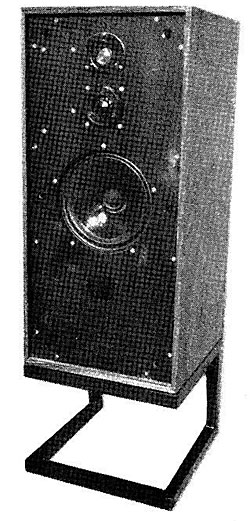 This smallish loudspeaker system has been getting high ratings in the English audio magazines for some years but was not available to US consumers until recently, when the small firm (literally a Mom'n'Pop enterprise, footnote 1) arranged for US distribution through Audio International.