Joseph's Pulsar

Joseph's Pulsar

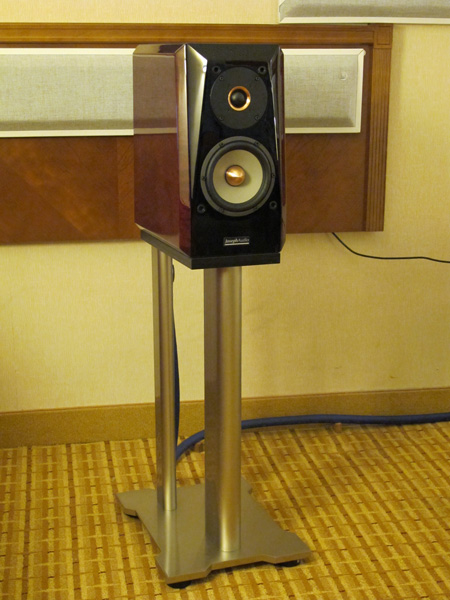
"It's like the Pearl but in a more easily digestible form," explained Jeff Joseph, as he demmed the Long Island's company's new Pulsar speaker for me. The stand-mounted speaker keeps as much as possible of the cost-no-object Pearl's qualities, but uses a new magnesium-cone woofer from SEAS with the same throw as the Pearl's 7" unit.

In All Directions

In All Directions

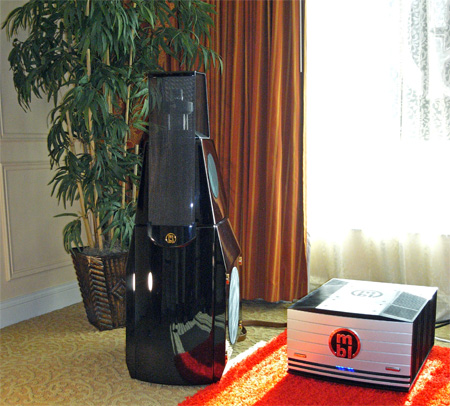
The omnidirectional MBL speakers, which use a unique pulsating quasi-spherical array of ribbons, make a strong argument for the benefits of this design approach. Featured in their room when I visited was the new 111F ($35,000/pair), which uses the "Radialstrahler" drivers for the treble and upper midrange, with conventional drive-units used for the lower frequencies. A big change from the earlier version I <A HREF="http://www.stereophile.com/loudspeakerreviews/643">reviewed in 2002</A> was the use of side-firing direct radiators for the bass rather than the 111B's coupled-cavity LF enclosure. These are mechanically coupled to eliminate vibrational excitation of the enclosure.

Fooled Ya!

Fooled Ya!

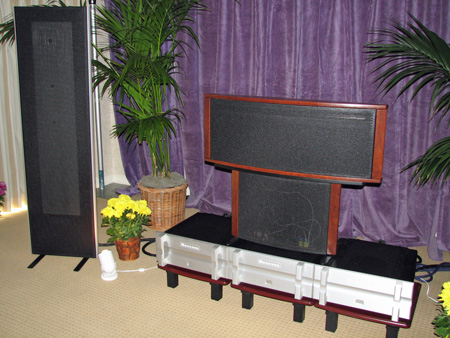
When I went into the Magnepan room at T.H.E. Show, the speakers were hidden behind a curtain. Magnepan's Wendell Diller ushered me into the sweet spot and started playing some sounds on the all-Bryston front-end: BCD-1 CD player (which LKG raves about in our February 2009 issue), BP-26 preamp, and a pair of 7B-SST monoblocks.

I'll Take a Pass

I'll Take a Pass

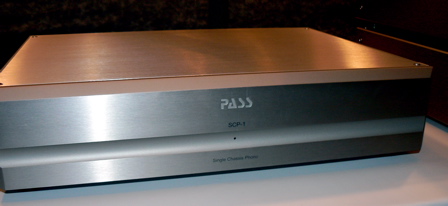
The Pass SCPI phono section ("under $4000") was an awfully slick looking piece of kit. "Basically, we took everything we learned in the Aleph Ono and improved upon it," said Pass engineer Wayne Colburn. The SCPI accommodates multiple inputs and has improved circuit traces, capacitors, and toroidal power supply.

Advertisement
Advertisement
Advertisement