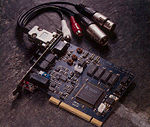
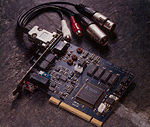
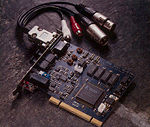
In the early days of digital audio, I remember talking with Dr. Tom Stockham, the developer of the groundbreaking Soundstream system used then by Telarc. As well as using a 50kHz sample rate, the excellent-sounding Soundstream stored its 16-bit data on large drum-shaped Winchester drives connected to a minicomputer. Twenty years later, the advent of ultra-high-density magnetic storage media and fast microprocessor chips has put high-resolution digital audio manipulation and storage within reach of anyone with a modern PC or Mac. And facilitating the transformation of the PC into a high-quality DAW has been a new generation of soundcards, such as the <A HREF="http://www.stereophile.com//digitalsourcereviews/280/">Digital Audio Labs CardDeluxe</A> I reviewed in September 2000 and the subject of this review, the German RME Digi96/8 Pro.
RME Digi96/8 Pro computer soundcard RME DIGICheck Software
In the early days of digital audio, I remember talking with Dr. Tom Stockham, the developer of the groundbreaking Soundstream system used then by Telarc. As well as using a 50kHz sample rate, the excellent-sounding Soundstream stored its 16-bit data on large drum-shaped Winchester drives connected to a minicomputer. Twenty years later, the advent of ultra-high-density magnetic storage media and fast microprocessor chips has put high-resolution digital audio manipulation and storage within reach of anyone with a modern PC or Mac. And facilitating the transformation of the PC into a high-quality DAW has been a new generation of soundcards, such as the <A HREF="http://www.stereophile.com//digitalsourcereviews/280/">Digital Audio Labs CardDeluxe</A> I reviewed in September 2000 and the subject of this review, the German RME Digi96/8 Pro.
RME Digi96/8 Pro computer soundcard Specifications
In the early days of digital audio, I remember talking with Dr. Tom Stockham, the developer of the groundbreaking Soundstream system used then by Telarc. As well as using a 50kHz sample rate, the excellent-sounding Soundstream stored its 16-bit data on large drum-shaped Winchester drives connected to a minicomputer. Twenty years later, the advent of ultra-high-density magnetic storage media and fast microprocessor chips has put high-resolution digital audio manipulation and storage within reach of anyone with a modern PC or Mac. And facilitating the transformation of the PC into a high-quality DAW has been a new generation of soundcards, such as the <A HREF="http://www.stereophile.com//digitalsourcereviews/280/">Digital Audio Labs CardDeluxe</A> I reviewed in September 2000 and the subject of this review, the German RME Digi96/8 Pro.
In the early days of digital audio, I remember talking with Dr. Tom Stockham, the developer of the groundbreaking Soundstream system used then by Telarc. As well as using a 50kHz sample rate, the excellent-sounding Soundstream stored its 16-bit data on large drum-shaped Winchester drives connected to a minicomputer. Twenty years later, the advent of ultra-high-density magnetic storage media and fast microprocessor chips has put high-resolution digital audio manipulation and storage within reach of anyone with a modern PC or Mac. And facilitating the transformation of the PC into a high-quality DAW has been a new generation of soundcards, such as the <A HREF="http://www.stereophile.com//digitalsourcereviews/280/">Digital Audio Labs CardDeluxe</A> I reviewed in September 2000 and the subject of this review, the German RME Digi96/8 Pro.
In the early days of digital audio, I remember talking with Dr. Tom Stockham, the developer of the groundbreaking Soundstream system used then by Telarc. As well as using a 50kHz sample rate, the excellent-sounding Soundstream stored its 16-bit data on large drum-shaped Winchester drives connected to a minicomputer. Twenty years later, the advent of ultra-high-density magnetic storage media and fast microprocessor chips has put high-resolution digital audio manipulation and storage within reach of anyone with a modern PC or Mac. And facilitating the transformation of the PC into a high-quality DAW has been a new generation of soundcards, such as the <A HREF="http://www.stereophile.com//digitalsourcereviews/280/">Digital Audio Labs CardDeluxe</A> I reviewed in September 2000 and the subject of this review, the German RME Digi96/8 Pro.
In the early days of digital audio, I remember talking with Dr. Tom Stockham, the developer of the groundbreaking Soundstream system used then by Telarc. As well as using a 50kHz sample rate, the excellent-sounding Soundstream stored its 16-bit data on large drum-shaped Winchester drives connected to a minicomputer. Twenty years later, the advent of ultra-high-density magnetic storage media and fast microprocessor chips has put high-resolution digital audio manipulation and storage within reach of anyone with a modern PC or Mac. And facilitating the transformation of the PC into a high-quality DAW has been a new generation of soundcards, such as the <A HREF="http://www.stereophile.com//digitalsourcereviews/280/">Digital Audio Labs CardDeluxe</A> I reviewed in September 2000 and the subject of this review, the German RME Digi96/8 Pro.
Investors have shown an inexplicable willingness to foot the bill for <A HREF="http://www.mp3.com/">MP3.com</A>'s $53.4 million settlement with <A HREF="http://www.umusic.com/">Universal Music Group</A>. In the four days following the announcement of a settlement on Tuesday, November 13, the now fully legitimate Internet music site watched its stock surge to four times the value it had only a month before. Shares of MP3.com closed Friday, November 17 at $9.42 each, triple the per-share price on the morning of the announcement. The stock had sunk to a 52-week low of $2.50 per share on October 11.
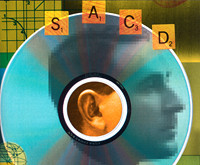
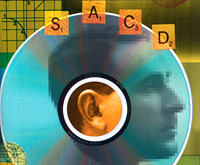
Super Audio CD: The Rich Report Postscript from December 2000
Although Philips invented the Compact Disc, it was only when Sony got involved in the early 1980s that it was decided—at the prompting of conductor Herbert von Karajan, a close friend of Sony's then-president Akio Morita—that the CD should have a long enough playing time to fit Beethoven's Ninth Symphony on a single disc (footnote 1). Even if the conductor was using very slow tempos, and even given the minimum pit size and track pitch printable at the time, the 16-bit data and 44.1kHz sampling rate they settled on gave them a little margin.
Super Audio CD: The Rich Report Manufacturer's Comment
Although Philips invented the Compact Disc, it was only when Sony got involved in the early 1980s that it was decided—at the prompting of conductor Herbert von Karajan, a close friend of Sony's then-president Akio Morita—that the CD should have a long enough playing time to fit Beethoven's Ninth Symphony on a single disc (footnote 1). Even if the conductor was using very slow tempos, and even given the minimum pit size and track pitch printable at the time, the 16-bit data and 44.1kHz sampling rate they settled on gave them a little margin.
Super Audio CD: The Rich Report Throw Away Your CDs!
Although Philips invented the Compact Disc, it was only when Sony got involved in the early 1980s that it was decided—at the prompting of conductor Herbert von Karajan, a close friend of Sony's then-president Akio Morita—that the CD should have a long enough playing time to fit Beethoven's Ninth Symphony on a single disc (footnote 1). Even if the conductor was using very slow tempos, and even given the minimum pit size and track pitch printable at the time, the 16-bit data and 44.1kHz sampling rate they settled on gave them a little margin.