On Sunday, December 1, 2002, we celebrated five years of uninterrupted webcasting, our website having emerged from the Internet darkness on December 1, 1997 to become, at least in my eyes, an institution. Ralph Waldo Emerson wrote that "an institution is the lengthened shadow of one man," and www.stereophile.com is definitely the shadow of erstwhile high-end audio retailer Jon Iverson.
When it comes to dynamic range, it's the little things that count. As <A HREF="http://www.ti.com">Texas Instruments</A> explains, "Dynamic range is a parameter that expresses numerically how accurately sounds of small amplitude can be reproduced without distortion." In other words, the higher the dynamic range, the higher the quality of the sound, especially at low levels.
As any major college dude will tell you, the file-sharing genie can never be put back into the digital audio bottle. But that hasn't stopped the music business from pursuing its scorched-market policy while simultaneously applying various use-restriction technologies to every digital audio format in sight.
I first met NHT co-founder <A HREF="http://www.stereophile.com//interviews/232/">Ken Kantor</A> in 1975 when we were both undergraduates at MIT. Kantor was sponsoring an extracurricular class entitled "Musical Ideas." The concept was to stick a dozen or so musicians in a classroom for free improvisation and hope to create music à la Miles Davis' <I>Bitches Brew</I>. The result was a mess; although talented guitarist Kantor meant well, there was no common vision or consistency of musical talent. Nevertheless, I had a blast trying to simulate a tamboura drone with a Hohner Clavinet, phase shifter, and volume pedal.
I first met NHT co-founder <A HREF="http://www.stereophile.com//interviews/232/">Ken Kantor</A> in 1975 when we were both undergraduates at MIT. Kantor was sponsoring an extracurricular class entitled "Musical Ideas." The concept was to stick a dozen or so musicians in a classroom for free improvisation and hope to create music à la Miles Davis' <I>Bitches Brew</I>. The result was a mess; although talented guitarist Kantor meant well, there was no common vision or consistency of musical talent. Nevertheless, I had a blast trying to simulate a tamboura drone with a Hohner Clavinet, phase shifter, and volume pedal.
I first met NHT co-founder <A HREF="http://www.stereophile.com//interviews/232/">Ken Kantor</A> in 1975 when we were both undergraduates at MIT. Kantor was sponsoring an extracurricular class entitled "Musical Ideas." The concept was to stick a dozen or so musicians in a classroom for free improvisation and hope to create music à la Miles Davis' <I>Bitches Brew</I>. The result was a mess; although talented guitarist Kantor meant well, there was no common vision or consistency of musical talent. Nevertheless, I had a blast trying to simulate a tamboura drone with a Hohner Clavinet, phase shifter, and volume pedal.
I first met NHT co-founder <A HREF="http://www.stereophile.com//interviews/232/">Ken Kantor</A> in 1975 when we were both undergraduates at MIT. Kantor was sponsoring an extracurricular class entitled "Musical Ideas." The concept was to stick a dozen or so musicians in a classroom for free improvisation and hope to create music à la Miles Davis' <I>Bitches Brew</I>. The result was a mess; although talented guitarist Kantor meant well, there was no common vision or consistency of musical talent. Nevertheless, I had a blast trying to simulate a tamboura drone with a Hohner Clavinet, phase shifter, and volume pedal.
I first met NHT co-founder <A HREF="http://www.stereophile.com//interviews/232/">Ken Kantor</A> in 1975 when we were both undergraduates at MIT. Kantor was sponsoring an extracurricular class entitled "Musical Ideas." The concept was to stick a dozen or so musicians in a classroom for free improvisation and hope to create music à la Miles Davis' <I>Bitches Brew</I>. The result was a mess; although talented guitarist Kantor meant well, there was no common vision or consistency of musical talent. Nevertheless, I had a blast trying to simulate a tamboura drone with a Hohner Clavinet, phase shifter, and volume pedal.
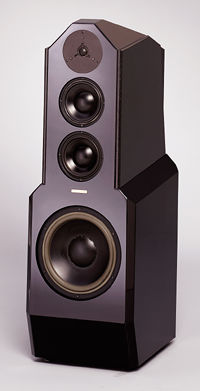
It's always tough to follow an award-winning act. Wes Phillips raved about the <A HREF="http://www.stereophile.com//loudspeakerreviews/237/">original EgglestonWorks Andra</A> back in October 1997, and it was subsequently dubbed <I>Stereophile</I>'s Speaker of the Year for 1997. The Andra won many other plaudits, and found its way into a number of top-shelf recording studios as the monitor of choice. Such a reputation for excellence is the stuff most speaker designers dream of. It also imposes the burden of expectation—the "new and improved" version of such a knockout product had better be good, or else.