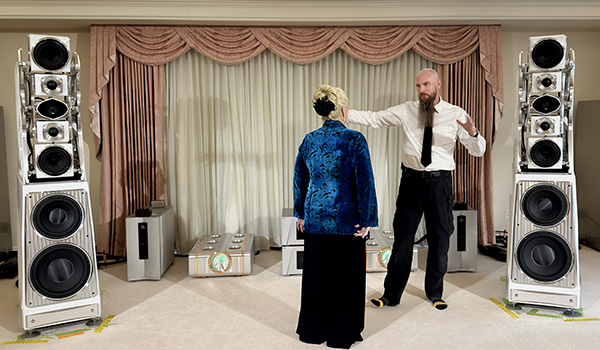
On Wednesday, April 22, I attended the unveiling of Wilson Audio's Autobiography speaker near the company's hometown of Provo, Utah. The event took place at the Springville Museum of Art in Springville, which is just south of Provo. Daryl Wilson (seen above talking with his mother, Sheryl Lee Wilson) introduced the new flagship speaker, which Wilson calls Autobiography.
This writer's judgment: The speaker is a tour de force. It takes all the features and design concepts of both the WAMM and the Chronosonic XVX models to an entirely new level. The name of it—Autobiography—is meant to encompass Wilson's life story, which now spans more than half a century.
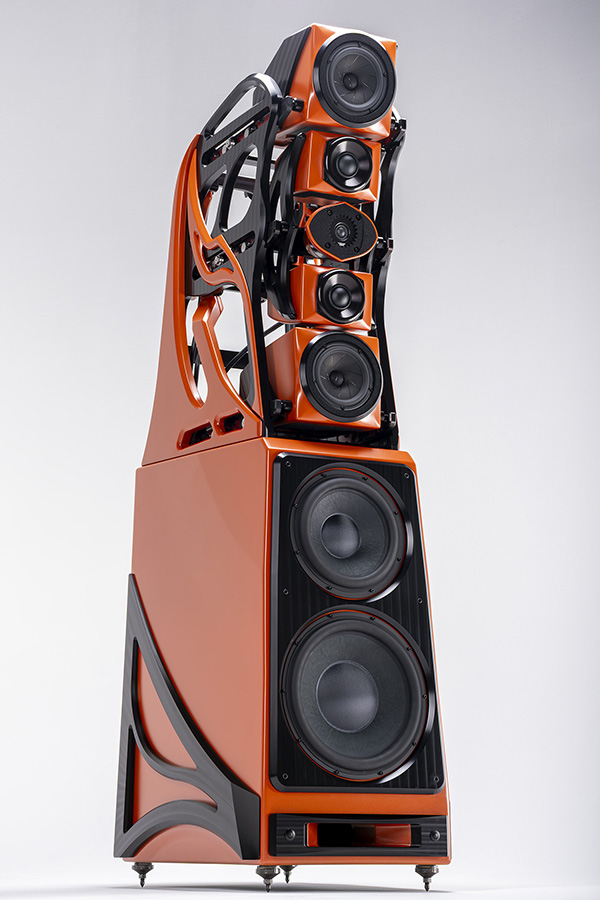
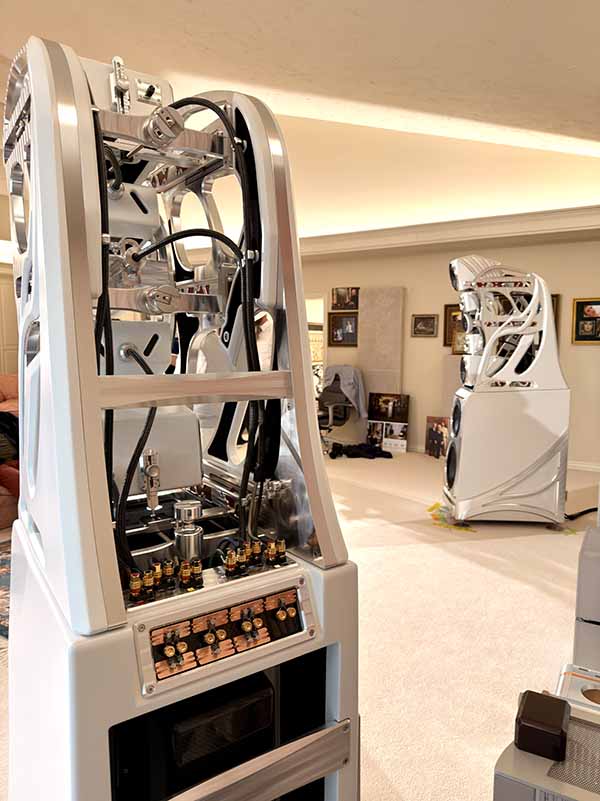 The Autobiography is big: approximately 83.5" tall, which is midway between the company's aforementioned XVX and limited-edition WAMM. What's most surprising is that the Autobiography sports a completely new driver complement, since Wilson has a history of introducing a new driver or two in a speaker, and then using the same driver on subsequent models.
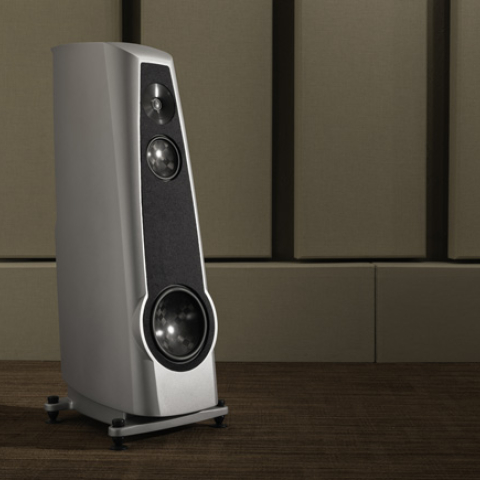
The Autobiography driver complement is similar in spirit to that of the WAMM. The top array has a tweeter in the middle flanked by two upper-midrange drivers; these three drivers are then flanked by two midrange drivers above and below. All five drivers are adjustable in their relative positions—relative to the bass unit below, and to each other—facilitating arrival-time coherence in the critical vocal and instrumental reproduction regions. Low frequencies are handled by two woofers—one 12", the other 15"—which are said to complement each other. Completing the driver lineup is a rear-firing tweeter installed in the top-back portion of the top midrange enclosure, designed to enhance the sense of space.
Key to the design improvements over previous Wilson speakers are full, continuous adjustability of the horizontal positions of all midrange, upper-midrange, and tweeter complements, plus continuous vertical-angle adjustment of the upper-midrange/tweeter subassembly. This allows for the most precise tuning of sound arrival times at the listening position of any speaker in Wilson's history. As Daryl Wilson explained, the continuous position adjustment allows for precise time alignment of the drivers—something that was all but impossible on earlier speakers, on which adjustment was stepwise. The result is a loudspeaker with exact timing accuracy, which is said to produce dynamic expression and tonal integrity across the audible spectrum.
The front-firing tweeter—Wilson calls it the Convergent Synergy Laser Sintered (CSLS)—uses a redesigned rear-wave chamber to improve energy dissipation and reduce internal reflections for enhanced clarity and microdynamics. The new 2" upper-midrange drivers that flank the CSLS tweeter include an optimized baffle machined from aluminum. These drivers are said to seamlessly bridge the transition between the speed of the tweeter and the lush rendition of the 7" PentaMag midrange drivers, integrating the midband with precision and natural flow. Completing the upper assembly, the rear-firing tweeter—said to enhance spatial depth and detail retrieval—has adjustable output to match room characteristics.
The Autobiography is big: approximately 83.5" tall, which is midway between the company's aforementioned XVX and limited-edition WAMM. What's most surprising is that the Autobiography sports a completely new driver complement, since Wilson has a history of introducing a new driver or two in a speaker, and then using the same driver on subsequent models.
The Autobiography driver complement is similar in spirit to that of the WAMM. The top array has a tweeter in the middle flanked by two upper-midrange drivers; these three drivers are then flanked by two midrange drivers above and below. All five drivers are adjustable in their relative positions—relative to the bass unit below, and to each other—facilitating arrival-time coherence in the critical vocal and instrumental reproduction regions. Low frequencies are handled by two woofers—one 12", the other 15"—which are said to complement each other. Completing the driver lineup is a rear-firing tweeter installed in the top-back portion of the top midrange enclosure, designed to enhance the sense of space.
Key to the design improvements over previous Wilson speakers are full, continuous adjustability of the horizontal positions of all midrange, upper-midrange, and tweeter complements, plus continuous vertical-angle adjustment of the upper-midrange/tweeter subassembly. This allows for the most precise tuning of sound arrival times at the listening position of any speaker in Wilson's history. As Daryl Wilson explained, the continuous position adjustment allows for precise time alignment of the drivers—something that was all but impossible on earlier speakers, on which adjustment was stepwise. The result is a loudspeaker with exact timing accuracy, which is said to produce dynamic expression and tonal integrity across the audible spectrum.
The front-firing tweeter—Wilson calls it the Convergent Synergy Laser Sintered (CSLS)—uses a redesigned rear-wave chamber to improve energy dissipation and reduce internal reflections for enhanced clarity and microdynamics. The new 2" upper-midrange drivers that flank the CSLS tweeter include an optimized baffle machined from aluminum. These drivers are said to seamlessly bridge the transition between the speed of the tweeter and the lush rendition of the 7" PentaMag midrange drivers, integrating the midband with precision and natural flow. Completing the upper assembly, the rear-firing tweeter—said to enhance spatial depth and detail retrieval—has adjustable output to match room characteristics.
 Peter McGrath—cofounder of the Audiofon label, chief recording engineer for Harmonia Mundi USA for many years, and a member of the Wilson Audio team—played some of his own recordings. Of particular note was the Autobiography's rendition of a piano, which had overtones and resonance true to the physical instrument in a real space.
Several other visitors and I toured the Wilson factory, where we witnessed the technology that is used to produce this and the other speakers in the line. I've worked at Fermilab—a particle physics and accelerator laboratory—and I have a deep reverence for engineering craftsmanship, and the people delivering it. I saw it here at Wilson. From CNC machining to capacitor building, cabinet polishing, and painting, the Wilson team's skill and dedication were apparent.
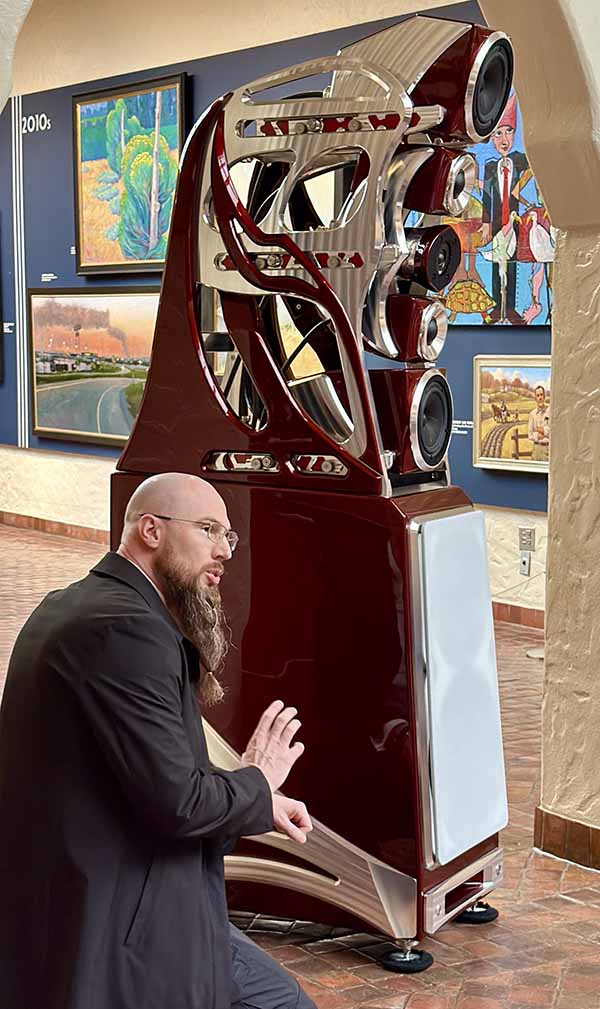
My verdict: The Autobiography pushes the boundaries of what is possible in a loudspeaker. As Daryl Wilson (seen below, crouching next to one of them) said, "If your goals don't scare you, they are not big enough."
Peter McGrath—cofounder of the Audiofon label, chief recording engineer for Harmonia Mundi USA for many years, and a member of the Wilson Audio team—played some of his own recordings. Of particular note was the Autobiography's rendition of a piano, which had overtones and resonance true to the physical instrument in a real space.
Several other visitors and I toured the Wilson factory, where we witnessed the technology that is used to produce this and the other speakers in the line. I've worked at Fermilab—a particle physics and accelerator laboratory—and I have a deep reverence for engineering craftsmanship, and the people delivering it. I saw it here at Wilson. From CNC machining to capacitor building, cabinet polishing, and painting, the Wilson team's skill and dedication were apparent.
My verdict: The Autobiography pushes the boundaries of what is possible in a loudspeaker. As Daryl Wilson (seen below, crouching next to one of them) said, "If your goals don't scare you, they are not big enough."
The Autobiography is big: approximately 83.5" tall, which is midway between the company's aforementioned XVX and limited-edition WAMM. What's most surprising is that the Autobiography sports a completely new driver complement, since Wilson has a history of introducing a new driver or two in a speaker, and then using the same driver on subsequent models.
The Wilson Audio Autobiography speaker, in Red Rock Sunset finish.
The low-frequency architecture of the Autobiography is designed to deliver bass that is immediate, articulate, and authoritative, while preserving tonal nuance and realism. The 12" driver, 15" driver, and enclosure were designed to work together. The new enclosure design is intended to improve bass delivery while minimizing vibrations. The goal is to deliver bass that is true to the music.
At the core of the design is a carefully considered crossover network with point-to-point connections and capacitors built in-house (in Wilson's own Rel-Caps facility) to 0.1% precision. All Wilson speakers utilize proprietary materials—a variety of high-density phenolic-resin composites designated X, M, S, V, H—and are designed to maximize loudspeaker performance: hard materials for enclosures and softer ones for vibration absorption; each material appropriate to its intended use.
What was the result of all this technological innovation? I heard the biggest, most holographic, and most tonally accurate sound I have experienced. In a comparative demo, the Chronosonic XVX produced sound that extended from the front to back and side to side seamlessly, while the Autobiography produced sound that floated totally free from the hardware creating it. They disappeared, even when I was staring straight at them.