Sidebar 3: Measurements
Because this speaker's size and 452-lb weight made shipping one of them to me for measurement impossible, I drove my test gear to Michael Fremer's place. I used DRA Labs' MLSSA system and a calibrated DPA 4006 microphone to measure the Wilson Audio Alexx's frequency response in the farfield, and an Earthworks QTC-40 for the nearfield and in-room responses.
The first dilemma was on what axis to examine the speaker's quasi-anechoic behavior. Wilson's Peter McGrath had adjusted the Alexx's tweeter and midrange modules so that their axes converged on the positions of Michael's ears in his listening room, which were 36" from the floor and 85" from the tweeter modules. The tweeters themselves were 54" from the floor, so after we'd wheeled one of the Wilsons (serial number 0145) into Michael's driveway—easier to say than to do—I set up the microphone at my usual 50" distance on the line connecting its tweeter to a position 85" away and 36" from the ground. I ran a set of tests, then moved the mike to where Michael's ears would have been and repeated the tests. The problem, however, was that at the greater distance, with the mike 36" above the ground, early reflections of the speaker's output from the ground drastically reduced the measurements' resolution in the midrange.
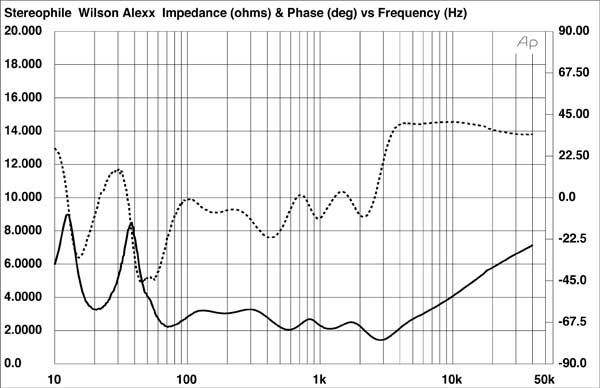
Looking first at the Alexx's voltage sensitivity, my estimate of 91.3dB(B) agreed with the specified 91dB/2.83V/m. This speaker will play loudly with relatively few amplifier watts—or it would if its impedance were not very low, meaning that the standard 2.83V drive signal used for specifying sensitivity is equivalent to much more than 1W. The impedance is specified as 4 ohms nominal, with a minimum magnitude of 1.5 ohms at 2.85kHz. My measurement is shown in fig.1. Although Wilson's specification is correct, in that the minimum magnitude (solid trace) is 1.5 ohms just below 3kHz—I measured 1.44 ohms at 2.9kHz—the impedance remains at or below 3 ohms from 55Hz to 6kHz, and the electrical phase angle (dotted trace) exacerbated the drive difficulty in some regions of the audioband. The combination of 3 ohms magnitude and a phase angle of –44° between 56 and 59Hz will stress amplifiers, as will the combination of 2.2–2.6 ohms and a phase angle of +40° between 4 and 5kHz. Alexx owners need to match the speakers with amplifiers unfazed by very low impedances.
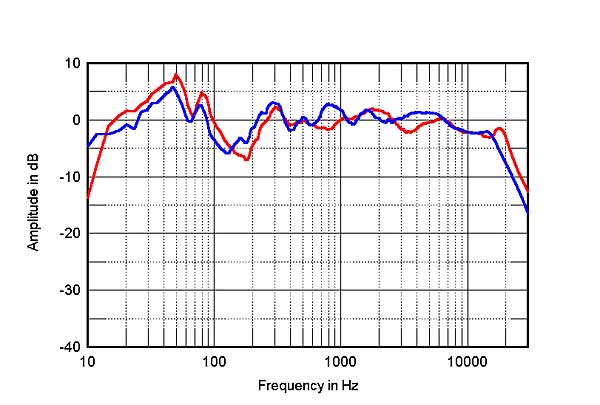
 Because of the Alexx's bulk, I wasn't able to examine its horizontal and vertical dispersions in any detail. However, looking at the individual responses that I averaged to produce the response in Michael's listening room (fig.3), it looks as if the Alexx maintains its spectral balance below 20kHz over windows of ±5° vertical and ±30° horizontal, both centered on the tweeter axis.
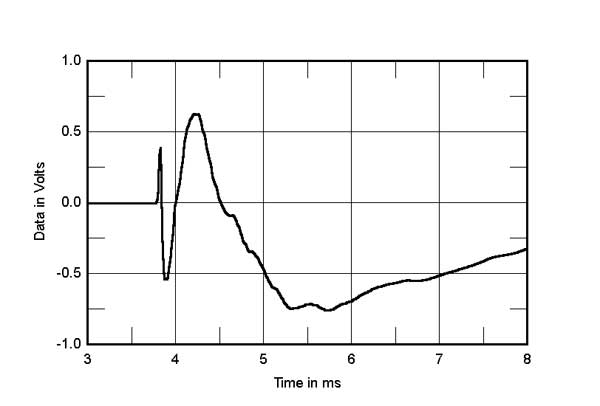
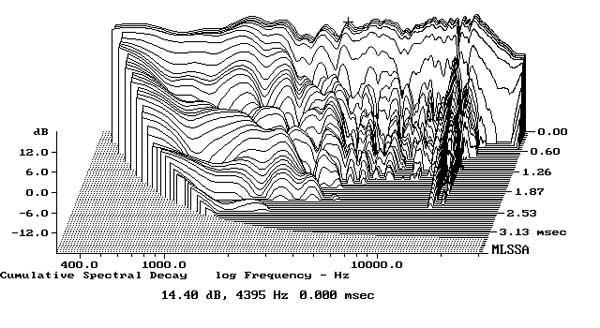
 In the time domain, the step response on the tweeter axis (fig.4) reveals that the tweeter and midrange units are connected in positive acoustic polarity (footnote 1), the woofers in negative polarity (footnote 2). More important, the output of each drive-unit can be seen to blend smoothly with that of the next lower in frequency, suggesting good crossover design. The cumulative spectral-decay or waterfall plot on the tweeter axis (fig.5) shows a clean initial decay, but with then some low-level hash throughout the midrange and treble. I suspect that this behavior is due in part to early reflections from the complicated, multi-part enclosure, but the tweeter does have a high-Q resonance apparent at 15kHz. (This should not be confused with the interference from the computer monitor's line-scan frequency just below 17kHz.)
Footnote 1: Following the review's publication, I reexamined the step responses of the 2 midrange units and have posted them here. You can see that while the output of the lower midrange unit is in positive acoustic polarity, that of the upper midrange unit is in negative polarity. However, in fig.4, it can be seen that the step response of the upper midrange unit still blends smoothly with the step responses of the tweeter and lower midrange unit to give a time-coherent output.
Footnote 2: In this respect, the Alexx differs from the Alexandria XLF, which has the tweeter and woofers in positive acoustic polarity, the midrange units in inverted polarity. See fig.8 here.
Fig.1 Wilson Audio Alexx, electrical impedance (solid) and phase (dashed) (2 ohms/vertical div.).
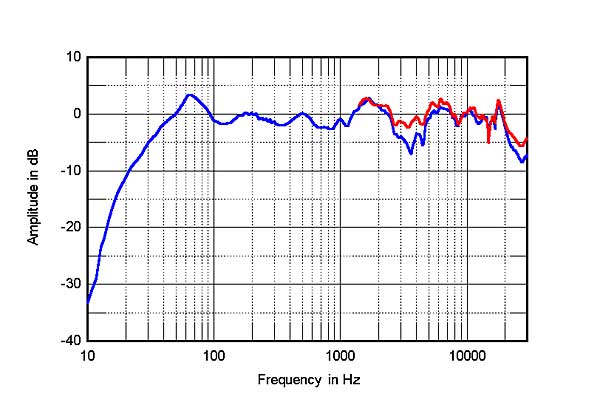
Wilson's heroic cabinet construction meant that I could find no panel resonances. The impedance graph suggests that the large port is tuned very low in frequency, and nearfield measurements of the woofers' outputs revealed that they each had a minimum-motion notch between 21 and 24Hz. The port's output, again measured in the nearfield, peaked between 10 and 30Hz, but didn't begin its upper-frequency rolloff until 65Hz. The port's output in the midrange was well suppressed, however. Though the upper woofer extends very slightly higher in frequency than the lower woofer, they otherwise have similar responses, and are crossed over to the lower-midrange unit at around 150Hz. That unit, in turn, seems to be crossed over to the upper midrange unit at about 800Hz.
Below 300Hz, the blue trace in fig.2 shows the complex sum of the nearfield port, woofer, and midrange responses, taking into account their radiating areas, amplitudes, and acoustic phase angles. The peak in the midbass is an artifact of the nearfield measurement technique; the Alexx's low frequencies don't quite extend to the port tuning frequency, which suggests that the woofer alignment is somewhat overdamped. Higher in frequency, the blue trace shows the Wilson's farfield response at 50" averaged across a 30° horizontal window centered on the tweeter axis. There is a small peak centered on 1.6kHz as well as a suckout an octave higher, but the suckout fills in at the 85" microphone distance (red trace). Other than the upper-midrange peak, the speaker's balance is relatively even between 100Hz and 20kHz, with small peaks balanced by small dips.
Fig.2 Wilson Audio Alexx, anechoic response on tweeter axis at 50" (blue) and 85" (red), both averaged across 30° horizontal window and corrected for microphone response, with complex sum of nearfield midrange, woofer, and port responses plotted below 300Hz.
Fig.3 Wilson Audio Alexx, spatially averaged, 1/6-octave response (red), and of Wilson Alexandria XLF (blue), in MF's listening room.
The spatially averaged response (fig.3, red trace) was produced by taking 20 1/6-octave–smoothed spectra individually for the left and right speakers using SMUGSoftware's FuzzMeasure 3.0 program and a 96kHz sample rate, in a rectangular grid 36" wide by 18" high and centered on the positions of MF's ears. For reference, the blue trace shows the response taken under identical conditions of the Wilson Alexandria XLF, which Michael reviewed in January 2013. The two speakers behave similarly above 200Hz, though the Alexx is more even overall. The slight peak in the upper midrange visible in fig.2 is evident here as well, but I suspect it emphasizes the presentation of recorded detail rather than being perceived as a coloration. The dip between 100 and 200Hz and the boosted output between 20 and 100Hz for both speakers will be respectively due to destructive and constructive interference between the direct sound and the reflections from the nearby boundaries. The Alexx produced more low frequencies in-room than did the Alexandria; while MF was impressed by the new speaker's bass, I found it a bit ripe for my taste.
Fig.4 Wilson Audio Alexx, step response on tweeter axis at 50" (5ms time window, 30kHz bandwidth).
Fig.5 Wilson Audio Alexx, cumulative spectral-decay plot on tweeter axis at 50" (0.15ms risetime).
Measuring a loudspeaker as large as Wilson Audio's Alexx without access to an anechoic chamber is problematic, and involves what speaker measurement maven Floyd Toole once referred to in an AES lecture I attended as "hand waving." But there's a lot to admire in the Alexx's measured performance—as well as some things that raised my eyebrows, such as its waterfall plot and amplifier-punishing impedance. But when Michael asked me if the measurements confirmed that he should sell his Alexandrias and buy the Alexxes, I'm afraid I punted. As much as I agree with Michael about the superiority of the Alexx's midrange and highs, I missed the Alexandria's lows.—John Atkinson
Footnote 1: Following the review's publication, I reexamined the step responses of the 2 midrange units and have posted them here. You can see that while the output of the lower midrange unit is in positive acoustic polarity, that of the upper midrange unit is in negative polarity. However, in fig.4, it can be seen that the step response of the upper midrange unit still blends smoothly with the step responses of the tweeter and lower midrange unit to give a time-coherent output.