I’ve been reading Matthew Crawford’s
Shop Class As Soulcraft: An Inquiry Into the Value of Work, which argues that an intimacy with manual trades may revitalize a connection to the material world lost to those who spend their lives in offices or cubicles, staring at computer screens for eight to twelve hours a day, unable to quantify exactly what it is that they
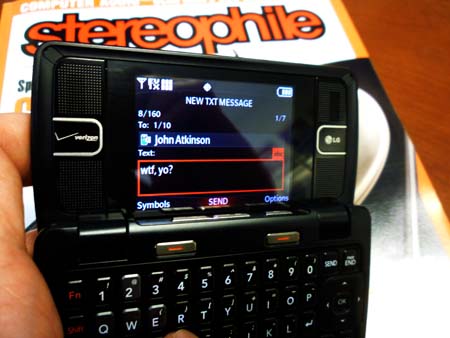
do. I’m digging it. It aligns, in many ways, with a philosophy John Atkinson has shared with me:
Do doingfully.
Even here, in our cushy office, we take great pride in getting under the hood, taking a wrench to our pages, doing the best job possible. We feel an intense connection to the finished product. We know what we do. We make magazines, the sort we’d like to read. My work here is not altogether foreign from the work I did as an apprentice pipefitter at the chemical plant in Port Newark. And I like that. I like getting dirty. I like busting my ass and having something real to show for it.
But I know that many people do not feel the same strong connection to their work, and I think that’s a shame. I think this disconnect is somehow related to our culture’s general tolerance for crap. If we felt a deep connection to our own work, taking good, strong pride in that which we build, we’d demand the same sort of quality from every aspect of our lives. We’d want and expect better tools, better experiences, better everything. Instead, it seems we increasingly settle for less, adapting to shit, sacrificing quality for “convenience.” But who is responsible for these so-called conveniences? Did I ask for the ability to know what 245 of my “friends” were feeling, thinking, and doing in 420 characters or less? What is that good for, really?
Keeping in touch? Bah.
Why are we obsessed with Farmville? Is it really the closest we can get to growing our own food?
If we spent as much time tending to our dreams as we do our fake farms, we’d create something beautiful. If only we knew what to do, if only someone would
tell us. This new world is stripping us of our ability to think, to dream, to care, and I’m concerned about the consequences. We should demand better, we should
want better.
Two recent articles in the New York Times have helped to inspire these thoughts. The first, “
In Mobile Age, Sound Quality Steps Back,” does a disservice to audiophiles, music lovers, and the generally curious by equating high-quality sound with astronomical prices, making it seem that a good stereo is unobtainable by all but the privileged, and references, again, the work done by Jonathan Berger, a professor of music at Stanford, who found that an increasing number of his students preferred the sound of shitty MP3s over that of high-fidelity recordings.
The article includes a picture of a stereo system in
Stereo Exchange’s big listening room, and notes the price: $125,000. The article does not mention that Stereo Exchange also offers more affordable gear from companies like NAD, Pro-Ject, Tangent, Rotel, and Totem. The article does not mention that Stereo Exchange could put together an outstanding system for a total cost of $1000. But of course the article omits these bits. What fun would it be to tell people the whole story?
Music is one of the most important things in my life. I consider myself an audiophile. I own a hi-fi. But $125,000 for a stereo seems crazy to me, too! And I know how good $125,000 can sound. Jeez, if I didn’t know better, the New York Times would have scared me away. The total cost of
my system, using the components’ retail prices when new, is around $6000, and I think it sounds pretty damn good. And, yes, you can put together a high-quality stereo for $1000; you can even put together a high-quality stereo for less, if you take some time and shop wisely.
There are questions surrounding Jonathan Berger’s research which, to my knowledge, have gone unaddressed. What source and accessories were used? If the students were listening through a low-quality MP3 player with cheap earbuds, the results of the study may be null. Even I would be hard-pressed to note differences in sound quality when my only tools were faulty. This would be like a carpenter trying to build a house with a plastic hammer. Further, what types of recordings were used? Were they well-recorded pieces of work, or were they overly compressed pop recordings? I have found that poor recordings can sound better when played through low-quality systems; higher quality systems reveal flaws that bad systems overlook. But hi-fi should not be punished because of what it does right. When we are sick, bad food can taste better, but wouldn’t we rather be well?
Finally, did the students know what they were listening to? Were they told beforehand that they were listening to the low-quality track? Were they taught what to listen for? My feeling is that, when given all the information and when
taught the difference between good and bad, the majority of the students would be more attracted to the higher quality music files. To think otherwise is an insult to the human spirit, an insult to our abilities to think and to choose wisely.
Another thing: Jonathan Berger wonders if his students’ attraction to low-quality MP3s, with their “sizzle,” bears a resemblance to older audiophiles’ preference for the crackle of vinyl records over the digital cleanliness of the compact disc. Is the “sizzle” of MP3, like the pops and ticks of our dear old vinyl, a sort of cultural bond, something that will bring fond memories to future generations of music lovers? Fuck no! Look, I know that pops and ticks are comforting to some people, but I don’t know a single audiophile—not even Art Dudley or 78-loving Jonathan Halpern of
Tone Imports—who’d prefer a scratched-up, dirty, worn-out vinyl record over a pristine copy of same. The audiophiles who rebelled against the compact disc did so because they heard its early flaws, not because they missed the pops and ticks of their old records.
Put another way, the audiophiles who rebelled against the compact disc did so because they still knew how to think. They demanded better. They had their pride. They
cared. They hadn’t yet been neutered by technological advantages. They knew what they wanted, and they were willing to fight for it.
Which brings me to today’s New York Times article, “
Cellphones Now Used More for Data Than for Calls.” Here we ponder the strange fact that, while more people are using cell phones—are, in fact, even going so far as to entirely remove landlines from their homes—fewer people are using their cell phones to make phone calls. WTF?
Might it have anything to do with the fact that, when it comes to call reception, cell phones are absolutely dreadful? Can you hear me now? Is there an app for that? What? I said…what? I’m sorry…what? Why can’t I hear what you’re saying?!
Remember the old days, when, if we had something important to say to someone far away, we’d pick up the phone and call that person? Now, we’ve been reduced to texts and all sorts of abused language. It’s true: Some people still pick up a phone when the message that needs to be communicated is sensitive or personal, but all too often we see people on Facebook or Twitter revealing extremely delicate shit to the entire world. People are having babies online, marriages are ending online, people are dying online. And there’s no such thing as privacy to the younger generation. Everything that happens is material for our online profiles.
I know: I sound like an old fart. Let me call you back on my landline.
I am astounded by the sonic quality of old-fashioned landlines. It’s like, “Holy shit. Wait a second…I can actually
hear what you’re saying! Dude, it’s been so long. Let’s talk!”
Landlines are like magic. Indeed, the difference in quality between cell phones and landlines is very similar to that between shitty-ass MP3 files and high-resolution audio. Why aren’t more people complaining about the poor reception of their cell phones? My fear is that we’ve become distracted by all of the little “conveniences” smart phones provide: easy access to our Farmvilles, for instance. Gotta water the crops.
We are being stripped of our personal agency by complete bullshit, living in virtual worlds where we are reduced to cartoon avatars and case-sensitive passwords, with little responsibility for our actions and increasingly dependent upon touch screens and invisible applications for problems that we should not have. WTF and OMG, I’m LMAO over here.
I want a big, black, Western Electric rotary phone—one with a brass bell that fucking rings like a bell should ring, something that I didn’t download for $4 a month—and I want to be able to hear my friends when I’m talking to them. I want a big, black record, pressed on extremely quiet vinyl, to have and to hold from this day forward, to be played at exactly the right speed on my badass hi-fi. I want the necessary knowledge to make my own decisions, and I want the necessary tools to do a good job. I want people to expect more from themselves, to expect more from those around them. We should fill our lives with quality. We should care.
In that first New York Times article I mentioned, Thomas Pinales, a 22-year old who listens to music through an iPod and earbuds, is asked whether sound quality matters to him. He confesses that he would be interested in upgrading, but quickly adds, “I don’t know if I could really tell the difference.”
My concern here goes beyond my love for hi-fi. I’m more concerned about the future of our civilization, really. Why is there this insecurity, this lack of pride? I want Thomas Pinales to know that he would certainly be able to tell the difference, if only he had the knowledge. It’s within his grasp, if he wants it.