As the jazz buyer for Tower Records's Lincoln Center (66th St.) location in the early 1990s, I held a unique vantage point on New York City, its music and culture. My position guaranteed daily encounters with an eclectic variety of unforgettable characters. Between regular visits by the likes of Kareem Abdul-Jabbar (grouchy), Kathleen Turner (pushy), and Michael J. Fox (perpetually running from the store's female staff), I saw a lot.
I also learned a lot about jazz records: from John Newcott of PolyGram/Universal; from A&R executive and Grammy-winning producer Brian Michel Bacchus; from fellow Tower employee Kevin Elliot—and from Joe Fields, the founder of Muse Records, and his son Barney. Joe had worked with Bob Weinstock of Prestige Records before he founded his own crucial imprint. Joe and Barney would go on to found HighNote records and its sublabel Savant; today Barney runs the two labels, which are still issuing jazz.
Not long after Muse Records was founded, Wynton Marsalis emerged and was heralded as one of the "Young Lions," a savior of jazz, the narrative being that great American jazz musicians like Dexter Gordon had abandoned the US for Europe, leaving behind a mishmash of styles that weren't really jazz at all (footnote 1).
A glance at the Muse discography serves as the ultimate rebuttal to the marketing hype foisted upon jazz lovers by Marsalis, writer Stanley Crouch, and Columbia Records. From Muse's first record in 1972 (James Moody's Never Again!) to its final release in 1994 (Jimmy Ponder's Something to Ponder), the label's 500-album discography, all out of print and rare, is a treasure chest of jazz profundity: soulful, swinging, and energetic. Highlights include records by Pat Martino, Jaki Byard, Cedar Walton, Catalyst, The Visitors, Dom Um Romão, Woody Shaw, Clifford Jordan, Joe Chambers, Harold Land, and many others. Not slackers. The Muse label chronicled New York City jazz, some funky and some fusiony, all drawing from a wellspring of creativity built over decades of performance, composition, collaboration, and camaraderie.
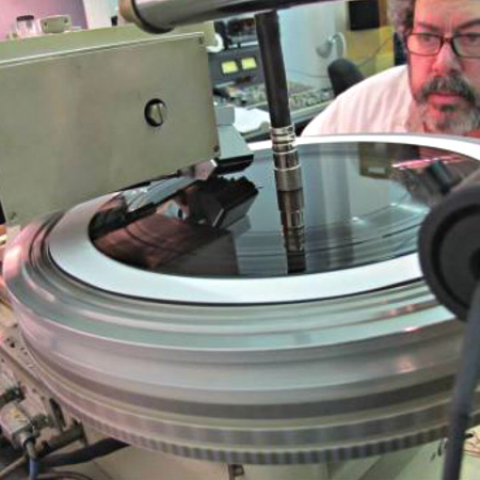
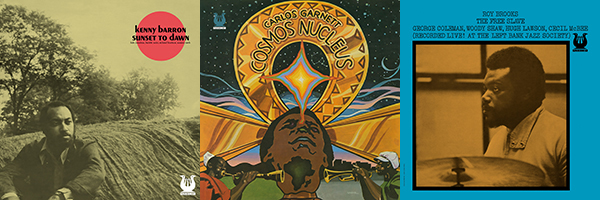
Zev Feldman's Time Traveler Recordings recently released three "Muse Master Edition Series" reissues: Drummer/leader Roy Brooks's 1972 live album The Free Slave; pianist Kenny Barron's Sunset to Dawn, from 1973; and funky 1976 wild card Cosmos Nucleus, from Panamanian tenor saxophonist Carlos Garnett. The records are all 180gm, analog mastered directly from the original tapes by Matthew Luthans at The Mastering Lab. They're pressed at Germany's Optimal Media.
Roy Brooks Jr. was a prolific and busy musician, as a well-documented sideman and as a bandleader. His extensive discography includes dozens of albums alongside Yusef Lateef, Blue Mitchell, Sonny Stitt, and Horace Silver, as well as the collective M'Boom, and more. While renowned for his driving, hard bop style, his thoughtful albums as a leader reveal a deeper artistry. The 2021 posthumous release Understanding proved that Brooks was more than just a hard bop titan; it unveiled an inventive, expansive spatiality—a mastery previously attributed solely to innovators such as Tony Williams, Milford Graves, and Rashid Ali—in impressively dynamic compositions.
Brooks's live 1972 release on Muse, The Free Slave, is a powerhouse statement. Recorded at Baltimore's Left Bank Jazz Society, it captures Brooks operating in two roles: fierce improviser/free thinker and grooving hard bop missionary. The date features an incandescent lineup: trumpeter Woody Shaw, tenor saxophonist George Coleman, bassist Cecil McBee, and pianist Hugh Lawson. As Brooks tumbles and twirls rhythms across drums, cymbals, percussion, and his "breath-a-tone," the quintet attacks the spritely arranged compositions with focus, intensity, and deep improvisation. The result is a practically perfect live recording, each musician fired, inspired, and in the zone.
Mint original copies regularly command nearly $500 at auction, yet its main value lies not in its rarity or its price but in its documentation of jazz perfection. Sunset to Dawn, Kenny Barron's 1973 debut as a leader, captured the electric zeitgeist of 1970s jazz. It features his trademark flowing grooves and luminous piano tones, supported by an exceptional band: vibraphonist Warren Smith, bassist Bob Cranshaw, drummer Freddie Waits, and percussionist Richard Landrum. The album is a fascinating exploration of the era's sound, Barron switching between acoustic piano and a heavily sustained, cosmically levitating Fender Rhodes. His compositions and performances unfold like a classic novel, shifting among high-energy, straight-ahead post-bop romps, evocative solo acoustic journeys, and shapeshifting, electric group workouts. The experience is held together by Barron's logical, consistently rich, utterly engaging piano work. The pristine sonics of the reissue beat my OG copy hands down.
Today, Kenny Barron is one of the true elder statesmen of jazz, happily pursuing his majestic craft. Sunset to Dawn is where he began. An electrifying album.
Cosmos Nucleus, the 1976 recording from tenor saxophonist Carlos Garnett, features the musician leading a 26-piece big band that includes trumpeters Roy Campbell and Ahmed Abdul-Malik, bassist Cecil McBee, and, on electric piano, a young Kenny Kirkland. In contrast to Barron, Garnett's pedigree was confirmed: He had already worked and recorded with Miles Davis, Norman Connors, and Pharoah Sanders.
Garnett reaches tremendous heights as a soloist on Cosmos Nucleus, but the accompanying big band lumbers. Their material, which recalls Lalo Schifrin or Jerry Fielding soundtracks, suffers from an unsteady feel and loose cadence—more college-level ensemble than professional band stacked with aces.
Subsequent releases from Time Traveler and Muse are planned from Woody Shaw, João Donato, Clifford Jordan, Joe Chambers, and others. My Muse wish list includes The Visitors' In My Youth, Motherland, and Rebirth; Carlos Garnett's Black Love; Catalyst's Unity; and Pat Martino's The Return.
Footnote 1: See, for example, nytimes.com/2004/10/18/arts/music/the-making-of-a-jazz-statesman.html.
Footnote 1: See, for example, nytimes.com/2004/10/18/arts/music/the-making-of-a-jazz-statesman.html.