 Yesterday morning, John Atkinson and I drove out to Mikey Fremer’s place to perform a set of test measurements on the Magico Q5 (review scheduled for our November issue). While JA set up his gear for the in-room measurements, I got to listen to music. Mikey was my personal DJ. He played some sultry Julie London, some angry Gil Scott-Heron, and some soothing Nat “King” Cole. All three, thanks to the outstanding recordings and thanks to the outstanding system, sounded very much alive.
Once JA was all set-up, we got out of his way and let him work. Here’s what it looked like:
Yesterday morning, John Atkinson and I drove out to Mikey Fremer’s place to perform a set of test measurements on the Magico Q5 (review scheduled for our November issue). While JA set up his gear for the in-room measurements, I got to listen to music. Mikey was my personal DJ. He played some sultry Julie London, some angry Gil Scott-Heron, and some soothing Nat “King” Cole. All three, thanks to the outstanding recordings and thanks to the outstanding system, sounded very much alive.
Once JA was all set-up, we got out of his way and let him work. Here’s what it looked like:

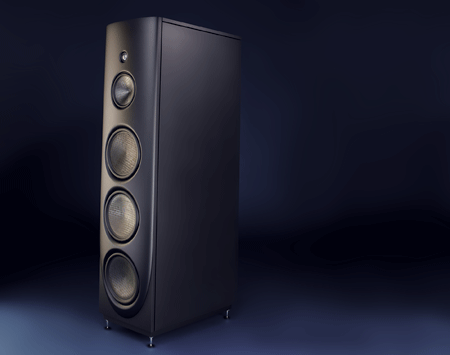
Here we see JA looking all hot and bothered, while the Magico Q5 waits on a dolly. By this point, John had already completed his in-room measurements. It took the three of us—me, John, and Mikey—to cajole the speaker onto the dolly and then carefully wheel it from Mikey’s listening room through his garage and into the driveway. To a greater degree than any other loudspeaker in my experience, the Q5 does not like to be moved. Unlike other Magico speakers that are fashioned out of plywood and utilize front and rear baffles of aluminum, the Q5 is all aluminum and metal.

Even inside, the Q5 has a complex metal framework. Magico’s Irv Gross informs me that the speaker’s internal architecture consists of 86 plates and 377 bolts, though from the outside, all anyone can see are its 16 very serious-looking locking bolts. The thing is solid. Knock against its extremely dense cabinet, and you’re likely to hurt yourself. The speaker weighs almost 400 lbs, which is significantly more than the larger Acapella High Violoncello we worked with last week. Because the Magico Q5 is too heavy for JA’s Outline speaker turntable, the dolly made good sense, allowing us to wheel the speaker around and position it just so.

John takes notes with a pink pen.
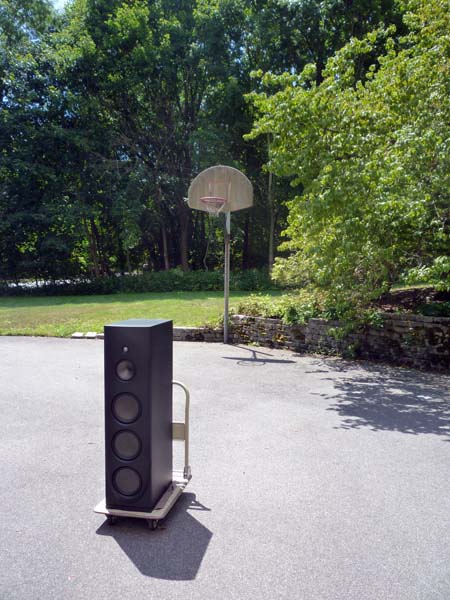
Hey, Q5, you’re open! Shoot the three! We set the Magico Q5 in the drive, away from any nearby boundaries or reflection points and away from the sun so that the speaker’s drivers wouldn’t bake. It was very hot out there.

This will feel a little uncomfortable, but only for a moment. I’m not sure what John is looking at here. I was going to make a rectal joke, but I don’t think it’s necessary. The speaker isn’t ported. Actually, I think John’s taking note of the serial number or something.
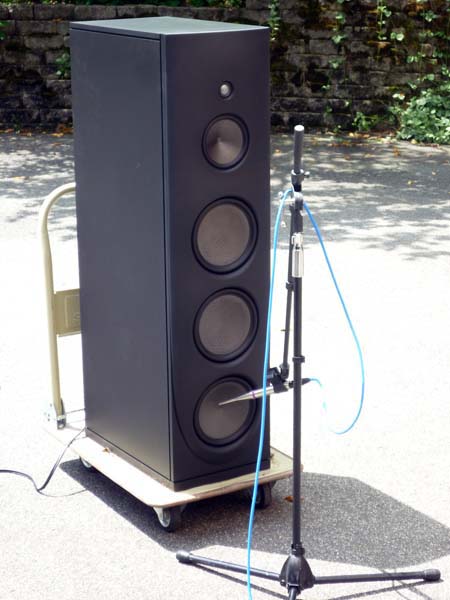
First, JA took the near-field response, starting with the bottom 9” woofer, what Magico calls a “Nano-Tec” driver.
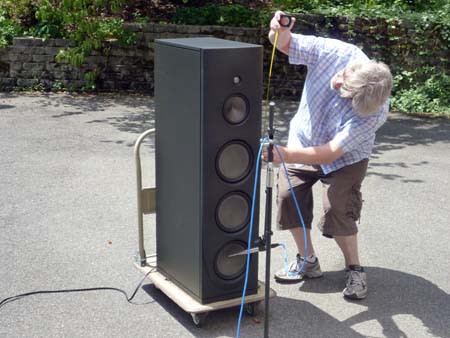
My, how you’ve grown, Q5.

Then, he worked his way up to the second woofer. (He did the same with the 9” mid-woofer, but I didn’t take a picture of it. You get the idea.)
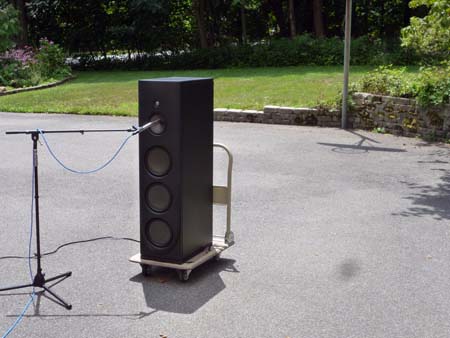
And, then, the 6” midrange “Nano-Tec” driver.

Here’s a close-up of the Q5’s 1” MBe-1 beryllium tweeter, claimed to be optimized for wide extension, low distortion, and excellent power handling.
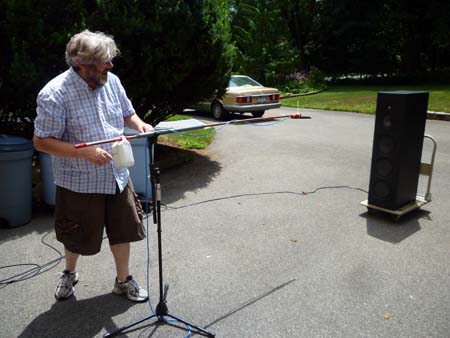
Next, JA prepared for his far-field tests.

Almost set.

John uses a small jug of lead shot as a ballast, keeping his mic set at the correct height.

Set.

Because we couldn’t utilize JA’s Outline speaker turntable, which is programmed to turn the speaker in five-degree increments, we used a simple protractor and rotated the speaker manually. Like men.

We used a long rule to mark our zero-degree starting point, then carefully rotated the speaker in five-degree increments.

Breathe in. John uses a stethoscope, also pink, and Faber Acoustical’s SignalSuite generator running on his iPod Touch to detect any abnormal cabinet resonances.

He carefully slides his thumb across the iPod Touch to sweep the signal while he listens closely.

And breathe out.

Now cough. After this last test, we packed up the measuring gear, slowly rolled the Q5 back into Mikey’s listening room, and had a heck of a time setting the speaker back into its original position. Did I mention that the Q5 doesn’t like to be pushed around?