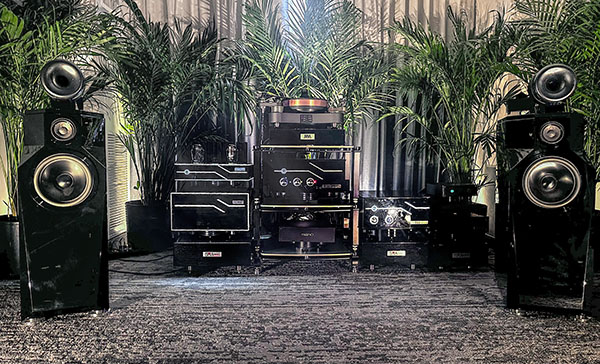
High Water Sound’s Jeffrey Catalano could give a master class in room setup. A veteran of hundreds of audio shows, he not only presents exceptional-sounding rooms but also curates adventurous vinyl selections. I invariably leave his room with music titles scribbled in my notebook, like recipes for marvelous dishes. At this year’s AXPONA, Catalano showcased an impressive array of cartridges, including a DaVa Soul Field ($9750), a Fuuga ($9995), a Red Sparrow ($16,500), and a Miyajima Infinity ($3745), each mounted on a TW-Acustic Raven 10.5" ($6000), TW-Acustic Raven 12" ($6500), or Glanz MH-1200S tonearm, all connected to his TW-Acustic Raven LS-3 Copper turntable ($25,000). 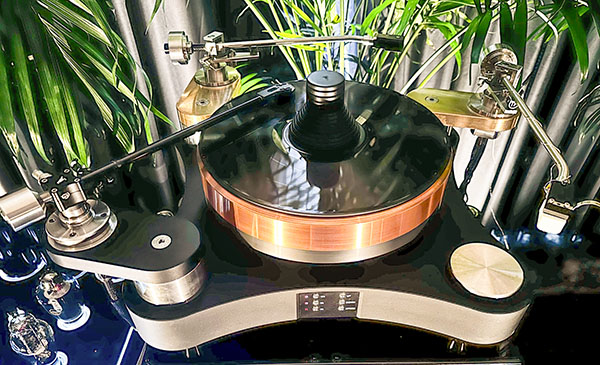 Amplification included an Alieno Phono Extreme phono stage ($60,000) into an Alieno 6H30 Line Stage Mk II ($75,000), driving the Alieno 250 LTD SE 300B amp ($80,000) that beautifully powered the US debut of the Cessaro Horn Acoustics Mendelssohn loudspeakers ($65,000/pair).
 Stein Music cables connected the system, which was supported by various racks, isolation platforms, and tuning devices, including the Codia Acoustic Design 7000 Titan, Silent Running Audio Virginia-Class, Shun Mook, and Stein Music, along with an ADD-Powr power supply. Catalano’s music selections were once again exceptional. Albums by Gary McFarland, Dino Saluzzi, and Lacuna featuring Tom Hamilton and Holly Bowling highlighted the system’s strengths with expansive atmospherics, nuanced tonality, and visceral physicality. I asked him some questions about setup. His responses are useful for anyone setting up a system, anywhere.
Ken Micallef: What’s the first thing you consider when setting up in a hotel room? Jeffrey Catalano: “I get a feel for the layout, dimensions, anything that’s out of the ordinary. Weird noises, windows, electricity issues, wall structure, carpet thickness, furniture that can’t be moved. In other words, I learn the room—both physically and mentally. I then visualize the system so I have a starting point.” KM: What are the typical problems you encounter? JC: “There’s never a typical problem, really. Each new setup presents an entire ecosystem based on a multitude of issues. The more you work the rooms, the more problems you discover.”
KM: Does that affect the choice of gear that you bring to a show? JC: “Room size is really the only thing that affects what I bring to any show, because room size determines which speaker to bring. Once I know the speaker, the rest of the system follows.” KM: Do you take room measurements? JC: “Not normally. If I bring subwoofers, I will do measurements to correct the phase for each sub to zero out the room and create a single bass wave.” KM: How do you decide whether you’re going to place the system on the short or long wall?
JC: “That’s pretty much determined by the same variables I mentioned. Only after I do a preliminary setup and get music playing will I know which is the proper wall to build the system on.” KM: How do you deal with problems like large windows or hollow walls? JC: “For the most part, I prefer large windows. Most hotel rooms are over-damped and the windows can be a great tool to create a more balanced presentation. With hollow walls, you need to mitigate bass from penetrating the wall.” KM: How do you decide what records to play at a show? JC: “I only bring music I want to hear. Each room sounds different, even with the same system. There is no way to know which records will sound the best. I don’t worry about it. I’m only concerned with the music, and if you love music and not just sound, you should be pleased. Yes, some records do sound better, but you can only know by playing them.”
KM: What’s the typical feedback you receive from attendees regarding the sound? JC: “Now we are opening an entire philosophical and metaphysical debate concerning life, worldview, universality, intellectual aptitude, and soul. It ranges from ‘I hate horns’ to ‘tube amps cause distortion’; ‘why records when digital is so much more accurate?’; ‘what are the plants for?’; ‘why multiple tonearms?’; ‘it’s too dark, I can’t see the equipment,’ and so on. Then there are people who never want to leave and find themselves coming back multiple times a day just to experience what I might be playing next. They feel a connection, a place to feel safe, to let go and just be free to listen.” In a show full of precision and polish, Catalano reminds us that listening is still a human act. The experience is shaped by context, not just by components; but when the music hits, it hits.
Stein Music cables connected the system, which was supported by various racks, isolation platforms, and tuning devices, including the Codia Acoustic Design 7000 Titan, Silent Running Audio Virginia-Class, Shun Mook, and Stein Music, along with an ADD-Powr power supply. Catalano’s music selections were once again exceptional. Albums by Gary McFarland, Dino Saluzzi, and Lacuna featuring Tom Hamilton and Holly Bowling highlighted the system’s strengths with expansive atmospherics, nuanced tonality, and visceral physicality. I asked him some questions about setup. His responses are useful for anyone setting up a system, anywhere.
Ken Micallef: What’s the first thing you consider when setting up in a hotel room? Jeffrey Catalano: “I get a feel for the layout, dimensions, anything that’s out of the ordinary. Weird noises, windows, electricity issues, wall structure, carpet thickness, furniture that can’t be moved. In other words, I learn the room—both physically and mentally. I then visualize the system so I have a starting point.” KM: What are the typical problems you encounter? JC: “There’s never a typical problem, really. Each new setup presents an entire ecosystem based on a multitude of issues. The more you work the rooms, the more problems you discover.”
KM: Does that affect the choice of gear that you bring to a show? JC: “Room size is really the only thing that affects what I bring to any show, because room size determines which speaker to bring. Once I know the speaker, the rest of the system follows.” KM: Do you take room measurements? JC: “Not normally. If I bring subwoofers, I will do measurements to correct the phase for each sub to zero out the room and create a single bass wave.” KM: How do you decide whether you’re going to place the system on the short or long wall?
JC: “That’s pretty much determined by the same variables I mentioned. Only after I do a preliminary setup and get music playing will I know which is the proper wall to build the system on.” KM: How do you deal with problems like large windows or hollow walls? JC: “For the most part, I prefer large windows. Most hotel rooms are over-damped and the windows can be a great tool to create a more balanced presentation. With hollow walls, you need to mitigate bass from penetrating the wall.” KM: How do you decide what records to play at a show? JC: “I only bring music I want to hear. Each room sounds different, even with the same system. There is no way to know which records will sound the best. I don’t worry about it. I’m only concerned with the music, and if you love music and not just sound, you should be pleased. Yes, some records do sound better, but you can only know by playing them.”
KM: What’s the typical feedback you receive from attendees regarding the sound? JC: “Now we are opening an entire philosophical and metaphysical debate concerning life, worldview, universality, intellectual aptitude, and soul. It ranges from ‘I hate horns’ to ‘tube amps cause distortion’; ‘why records when digital is so much more accurate?’; ‘what are the plants for?’; ‘why multiple tonearms?’; ‘it’s too dark, I can’t see the equipment,’ and so on. Then there are people who never want to leave and find themselves coming back multiple times a day just to experience what I might be playing next. They feel a connection, a place to feel safe, to let go and just be free to listen.” In a show full of precision and polish, Catalano reminds us that listening is still a human act. The experience is shaped by context, not just by components; but when the music hits, it hits.
Amplification included an Alieno Phono Extreme phono stage ($60,000) into an Alieno 6H30 Line Stage Mk II ($75,000), driving the Alieno 250 LTD SE 300B amp ($80,000) that beautifully powered the US debut of the Cessaro Horn Acoustics Mendelssohn loudspeakers ($65,000/pair). Stein Music cables connected the system, which was supported by various racks, isolation platforms, and tuning devices, including the Codia Acoustic Design 7000 Titan, Silent Running Audio Virginia-Class, Shun Mook, and Stein Music, along with an ADD-Powr power supply. Catalano’s music selections were once again exceptional. Albums by Gary McFarland, Dino Saluzzi, and Lacuna featuring Tom Hamilton and Holly Bowling highlighted the system’s strengths with expansive atmospherics, nuanced tonality, and visceral physicality. I asked him some questions about setup. His responses are useful for anyone setting up a system, anywhere.