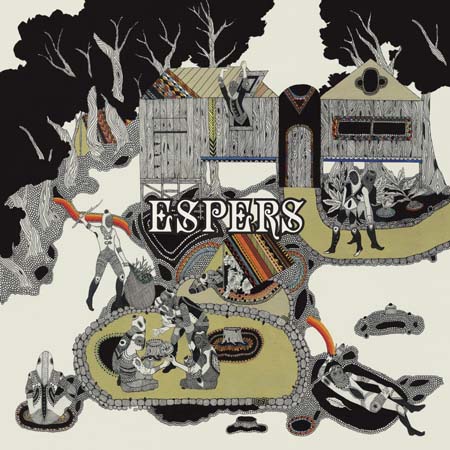
Right from the start—from the very first musical moment—it’s the gorgeous, spacious sound we’ve grown to love from Espers’ Greg Weeks and his
Hexham Head Studio in Philadelphia. While
III’s rather straightforward instrumentation (churning, scintillating acoustic guitars, appropriately warm, round bass, and steady, impactful drums) marks a subtle departure from the doumbek and dholak of
II, the quality of sound is no less complex or stirring. We hear the sounds of wood and brass meeting with flesh and skin, of bow hair as it courses along cello strings, of cello moan and sigh, of the most delicious fuzzed-out guitar placed in realistic, three-dimensional space—all with such
truth, such
blood, such respect of momentum and flow, that we are fooled into thinking that the very space around us is, in fact, growing, exhaling, beating.
The opening track, “I Can’t See Clear,” features an arrangement that moves easily, seamlessly, from luminous tranquility to an utterly dark ardor, trepidation bordering on fury; and, in doing so, proves symbolic of the whole:
III, in all its darkness and light,
flows constantly, assuredly, and gracefully. Tracks float from one to the next, like breaths, like old stories to be shared, without hesitation or end, and in circular patterns. Indeed,
III was recorded with the vinyl LP in mind, recorded to analog tape at the start and mixed to analog tape again at the end, forming a complete and certain vision.
It’s been too long since we last heard from Espers.
More than three years have passed since the release of
II. In that time, Greg Weeks has been hard at work with his Language of Stone label and at the controls of his Hexham Head Studio, where analog recording is cherished; drummer Otto Hauser has toured frequently with Sub Pop’s Vetiver; singer and guitarist Meg Baird released
Dear Companion, which combines traditionals with original material; cellist Helena Espvall released two albums with Masaki Batoh of the Japanese psyche band, Ghost. The members of Espers have kept busy, yes, and together again now, they sound more focused, and more
mature, than ever.
Whereas
II impressed with its exotic instrumentation,
III keeps things simpler, subtler. Mellotron makes itself known in “Caroline” (downloadable
here), nimbly adding texture and momentum to this shadowy, meditative folk song, channeling Led Zeppelin and also Pink Floyd, John Fahey and, strangely, the Eagles—no doubt, this is maturity and focus bordering on the innocuous. Yet, in “The Road of Golden Dust,” Greg Weeks’ supporting vocals lend flesh and just a touch of grit to Meg Baird’s ethereal veil. Acoustic and electric guitars, strummed and plucked by Baird, Weeks, and Brooke Sietinsons, lock hands and lead one another in graceful turns, completing each other’s thoughts, while bass and drums form a deep-pocket groove. “The Pearl,” with its lovely percussion and brassy strings, is sure to become one of my own “reference recordings.” You’ll want to turn this album up—way up—to rejoice in the all-encompassing warmth, the blood and body of these sounds, and you can—thank god, you can—because Weeks has maintained the recording’s dynamic range and, therefore, its
life.
“That Which Darkly Thrives” opens with a more upbeat, angular drum pattern. Otto Hauser weaves in and out of guitar notes that drop like stars, and complements warbling, groaning bass and cello runs that lift the listener from the ground. Weeks offers nightmarish guitar leads and matches Baird to form stirring, rising vocal harmonies. The piece ends in trembling guitar, sizzling effects, and chanted
ahhs, for a most intoxicating and satisfying combination of elements organic and synthetic. In “Sightings,” a repeated
sighing (I can’t be sure if it’s slide guitar, cello, synthesizer, or some combination thereof) plays the role of hook, holding the listener’s attention, while Weeks’ guitar work remains triumphant and able, moving expertly through ages and cultures, sounding in one moment medieval and in the next Middle Eastern. With luck, more bands will take note that recording
fewer tracks actually returns a more powerful, natural sound. Guitar leads throughout
III are appropriately large and moving.
“Meridian” recalls the thicker, denser work of
II, anchored by a prancing, leaping, lassoing break-beat groove, with a touch of
Grails’ doomsday metal. Again, Baird and Weeks share vocals, bringing haunting harmonies, while Hauser’s drumming is powerful and precise without being haughty or overwrought. The track strolls right into “Another Moon Song,” which provides a new mood altogether. We have the serenity of “I Can’t See Clear” with added emotional weight and tension. Notes are held to their fullest, most natural ends, fading into exquisite darkness, but only to pull you, headfirst, into the ominous sonic textures of “Colony.” Circling toms, needling guitar riffs, droning synths, and the thickest, meanest fuzz you’ve ever heard come leaping and tugging from the speakers with real force and menace.
This again gives way to reverie in “Trollslanda.” Synths, acoustic guitar, vocal harmonies, and sonorous cello move forward and bow to a timeless guitar solo. Espers’
III is lovely to the very end. And, still, one wonders how
III would dazzle and move if only it were a little
less lovely. While even the album’s greatest charms prove almost
too focused,
too harmless, such criticism falls in the face of the skilled musicianship and superb sonics of
III. This album should be a
Recording of the Month. With
III, Greg Weeks and Espers have achieved a beautiful and certain vision, and
Drag City, the little label that has delighted us with “
Records to Die For” from Joanna Newsom, Silver Jews, and Bill Callahan, has offered another gift.