Recording of March 2011: For the Ghosts Within
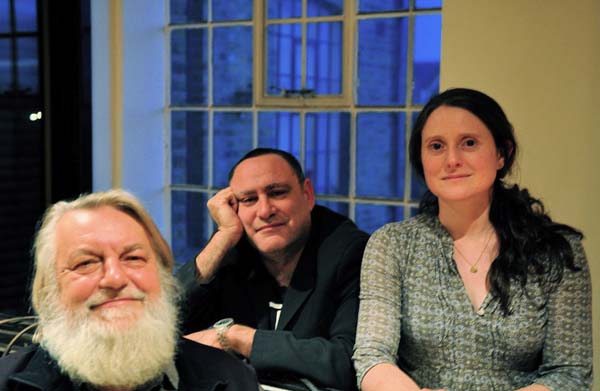
Wyatt/Atzmon/Stephen: For the Ghosts Within
Domino DNO271/WIGLP263 (CD/LP). 2010. Gilad Atzmon, prod.; Robert Wyatt, Jamie Johnson, Philip Bagenal, engs. ADD? TT: 56:13
Performance *****
Sonics **** For the Ghosts Within marks my introduction to the wonderful world of Robert Wyatt. It happened in Denver, Colorado, at around 1am, several hours after the first full day of the 2010 Rocky Mountain Audio Fest. I'd taken a break from posting blog entries to flip through the November 2010 issue of my other favorite magazine, The Wire. There, on p.11, I saw a neat, simple ad that offered little more than an album's intriguing cover art: stencil-like cutouts of three figures that seem meant to represent the album's three musicians, though these figures are almost entirely stripped of human form, reduced or distilled to their musical functionsas if the players are their instruments. Drawn by the rich colors and provocative imagery, I went straight to Domino Recording Co.'s website and listened to "Laura," track 1 of For the Ghosts Within. (Like so much of the album, "Laura" was completely new to me, but I have since learned that it is the title song from the 1944 film Laura, composed by David Raksin, and given fine treatments by Ella Fitzgerald, Frank Sinatra, and Julie London, among others.)
Domino DNO271/WIGLP263 (CD/LP). 2010. Gilad Atzmon, prod.; Robert Wyatt, Jamie Johnson, Philip Bagenal, engs. ADD? TT: 56:13
Performance *****
Sonics **** For the Ghosts Within marks my introduction to the wonderful world of Robert Wyatt. It happened in Denver, Colorado, at around 1am, several hours after the first full day of the 2010 Rocky Mountain Audio Fest. I'd taken a break from posting blog entries to flip through the November 2010 issue of my other favorite magazine, The Wire. There, on p.11, I saw a neat, simple ad that offered little more than an album's intriguing cover art: stencil-like cutouts of three figures that seem meant to represent the album's three musicians, though these figures are almost entirely stripped of human form, reduced or distilled to their musical functionsas if the players are their instruments. Drawn by the rich colors and provocative imagery, I went straight to Domino Recording Co.'s website and listened to "Laura," track 1 of For the Ghosts Within. (Like so much of the album, "Laura" was completely new to me, but I have since learned that it is the title song from the 1944 film Laura, composed by David Raksin, and given fine treatments by Ella Fitzgerald, Frank Sinatra, and Julie London, among others.)
 KEITH JARRETT: Dark Intervals
 It is often said that anyone with a recorder and a couple of microphones can record an orchestra. It's true, assuming you can get permission to do it (another story entirely). But that statement fails to address an important question: "How well?"
The rudiments of any skill can be learned from books. Practice can develop a fair level of competence. Beyond competence, however, the student is governed by his genes and/or family environment, depending on which theory of human potential you subscribe to. Whatever the reason, some practitioners of both disciplines never seem able to transcend mere competence, while others go on to become legends in their own times.
It is often said that anyone with a recorder and a couple of microphones can record an orchestra. It's true, assuming you can get permission to do it (another story entirely). But that statement fails to address an important question: "How well?"
The rudiments of any skill can be learned from books. Practice can develop a fair level of competence. Beyond competence, however, the student is governed by his genes and/or family environment, depending on which theory of human potential you subscribe to. Whatever the reason, some practitioners of both disciplines never seem able to transcend mere competence, while others go on to become legends in their own times.  Sun City Girls Funeral Mariachi
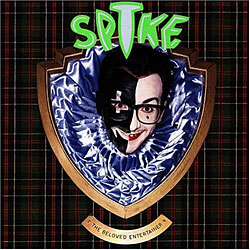 The ideal rock singer/songwriter? Someone who addresses adult issues with all the passion of adolescence (than which, believe me, there is none more monomaniacalthere's no righteous indignation like a teenager's). Someone who can sing about him- or herself and strike the universal; someone who can tell a story of what the swells call "the human condition," or of some social injustice, in terms of how it affects a single life in all that life's unique details. In this case, some musical near-illiterate like "The Beloved Entertainer," as it says on the little brass nameplate under the harlequin-painted face exploding from the golden Warner Brothers shield on the cover of SpikeThe Little Hands of Concrete himself.

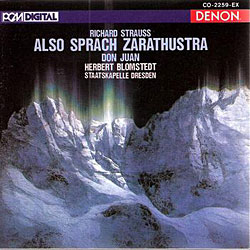 These are two very fine discs. Both convey to perfection the full weight of Richard Strauss's opulent orchestration for Zarathustra without the slightest hint of distortion, despite the huge dynamic range both employ. Both have the measure of the venues they are recorded in: Denon's Lukaskirche actually gives the impression of an acoustically superior concert hall, and it is astonishing to discover from the insert notes that the well tuned-in and integrated organ has been post-synchronized from the Schauspielhaus, Berlin.
Telarc's disc is their first of the Vienna Philharmonic, and their first from the Musikvereinsaal. It can hardly be faulted, except perhaps for the consistent richness of its more tonally refulgent soundsome may find this oppressive. But it does reflect perfectly Previn's more emotionally charged, almost maniacal response to this score. It is the kind of music he excels in; the meditative, almost ponderous fugue giving way to the near hysteria of "The Convalescent," and reflecting real joy at the climax of the "Dance Song." Previn is living these colorful swings of emotion, and if he makes great demands of the score in doing so (just as Blomstedt does), then his intuitive balance renders this all the more convincing.
These are two very fine discs. Both convey to perfection the full weight of Richard Strauss's opulent orchestration for Zarathustra without the slightest hint of distortion, despite the huge dynamic range both employ. Both have the measure of the venues they are recorded in: Denon's Lukaskirche actually gives the impression of an acoustically superior concert hall, and it is astonishing to discover from the insert notes that the well tuned-in and integrated organ has been post-synchronized from the Schauspielhaus, Berlin.
Telarc's disc is their first of the Vienna Philharmonic, and their first from the Musikvereinsaal. It can hardly be faulted, except perhaps for the consistent richness of its more tonally refulgent soundsome may find this oppressive. But it does reflect perfectly Previn's more emotionally charged, almost maniacal response to this score. It is the kind of music he excels in; the meditative, almost ponderous fugue giving way to the near hysteria of "The Convalescent," and reflecting real joy at the climax of the "Dance Song." Previn is living these colorful swings of emotion, and if he makes great demands of the score in doing so (just as Blomstedt does), then his intuitive balance renders this all the more convincing.