Analog Anxiety
Within the confines of the cozy analog audiophile kingdom, things couldn't be better: Turntables, cartridges and phono preamps can be found in abundance, while mounds of new and used vinyl can be scored by the truckload.


Within the confines of the cozy analog audiophile kingdom, things couldn't be better: Turntables, cartridges and phono preamps can be found in abundance, while mounds of new and used vinyl can be scored by the truckload.
As 2004 wound down, the Los Angeles sheriff's department successfully conducted five simultaneous raids on illegal CD replication plants in southern California on December 15. Dubbed "Operation Final Release," the joint operation between the Southern California High Tech Task Force and the LA sheriff's department put 65 officers into action, closing down five optical disc replication facilities in LA and Orange counties suspected of churning out millions of pirated CDs, which were sold throughout the United States.
If you're an audiophile, the words "hearing loss" are bound to strike terror into your heart. Of course, many of us aren't preternaturally acute—and all of us lose some high-frequency sensitivity as we age—but there's no excuse for not taking care of what you've got. When it comes to hearing, more is <I>always</I> better.
Some say it dates back 50 years, to when the late David Hafler introduced a tube amplifier with a "better-sounding" ultralinear output stage. Others claim it goes back to the introduction of electrical recording and playback in 1927, when <I>Gramophone</I> magazine's founder and editor, author Sir Compton McKenzie, thundered that electrical reproduction was a step <I>backward</I> in sound quality. But whenever it started, the "Great Debate" between "subjectivists," who hear differences between audio components, and "objectivists," who tend to ascribe such differences to the listeners' over-heated imaginations, rages just as strongly in the 21st century as it did in the 20th.
Medford, Long Island–based manufacturer Shahinian Acoustics has announced a recapitalization and a manufacturing-facilities expansion to meet demand for its quasi-omnidirectional loudspeakers. In a related development, Vasken Shahinian has succeeded his father as president and managing director.
Can the power cord make or break a particular component? Some say it does and others say it doesn't. Have you upgraded the power cords on any of your equipment?

<I><B>Editor's Note: </B>In 1954, a New York writer and teacher reinvented the world of audio with the modest-looking Acoustic Research AR-1 loudspeaker. A small fraction of the size of the behemoths that were then </I>de rigeur<I> for the reproduction of bass frequencies, Edgar Villchur's loudspeaker went as low with less distortion. Perhaps more importantly, the AR-1 pioneered both the science of speaker design and the idea that a low-frequency drive-unit could not be successfully engineered without the properties of the enclosure being taken into account.</I>
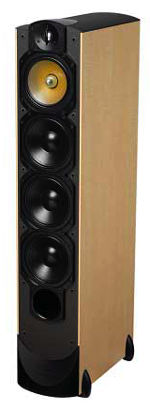
Like the Reference Studio/60, which was <A HREF="http://www.stereophile.com/loudspeakerreviews/1204paradigm">enthusiasti… reviewed</A> in the December 2004 issue by Kalman Rubinson, Paradigm's floorstanding Reference Studio/100 is now available in a v.3 version. The '100 is the flagship model in the Canadian manufacturer's Reference line. Its earlier incarnations, the original Studio/100 and the <A HREF="http://www.stereophile.com/loudspeakerreviews/252/">Studio/100 v.2</A>, were reviewed by Tom Norton and Robert Deutsch in the August 1997 and June 2000 issues of <I>Stereophile</I>, respectively, and both writers were well impressed at how much sound quality could be wrought from this competitively priced speaker design. Bob Deutsch, in particular, referred to the v.2 as a "a serious high-end contender, and a formidable one for just about any speaker in its price range and even well above."
Experienced reviewers know that shows are the wrong environments for critical audiophile listening. Convention centers—especially the one at Las Vegas—are huge, cavernous airplane hangers, not the intimate listening rooms reviewers thrive in. Extraneous sounds from subwoofer blasts and the constantly milling crowds leak in to sully the music. Booths set up by manufacturers on the show floor have very thin, flexible walls, and no bass treatment.
It's a common audiophile failing to remember the past as being much better than it actually was. (Though, of course, some things <I>were</I> better.) I remember the first time I heard a pair of Acoustic Research LST loudspeakers, in 1974 or thereabouts. Compared with the Wharfedales I used in my own system and the various Goodmans, Celestions, and home-brews I heard at friends' homes, the sound of classical orchestral recordings on the ARs was about as close to the real thing as I could imagine. And the AR ads reinforced my experience, telling me that musicians such as Herbert von Karajan also used LSTs. I never heard those speakers again, but occasionally I wonder how they would hold up today (footnote 1).