Take the A Train/Forty Days
The Dave Brubeck Quartet hits one out of the park in this 1966 performance. The fabulous Eugene Wright looks completely out of place as the only band member without eye-wear.


The Dave Brubeck Quartet hits one out of the park in this 1966 performance. The fabulous Eugene Wright looks completely out of place as the only band member without eye-wear.
Sometimes our favorite music sounds like crap, and sometimes the best-sounding work in our collection is an artistic failure, but we keep the thing anyway. Forget about the quality of the music, what percentage of your music collection sounds great?
<I>Oooohh! Aaaahh! Coochy-coo!</I> are not the usual spontaneous reactions from hard-boiled audio journalists to the unveiling of a hi-fi component. Nor is the Silverstone Circuit, the self-proclaimed Home of British Motor Racing, the usual venue for such a launch. But the news that UK audio manufacturer <A HREF="http://www.meridian.co.uk">Meridian</A> and Ferrari were cuddling up together on a joint project was enough to drag yours truly halfway across the country to deep Northamptonshire on a miserably wet February morning.
Audiophiles of a certain age may very well have first tasted high-end sound by way of Linn's 1972 <A HREF="http://www.stereophile.com/turntables/1103linn/">Sondek LP12 turntable</A> and/or Naim's 1982 <A HREF="http://www.stereophile.com/integratedamps/660/">Nait integrated amplifier</A>. There aren't many audio manufacturers that have managed to keep components in production for 25 years (35 for the Linn), but the two venerable British designs have been continuously upgraded over their lives, keeping them competitive.
John Atkinson forwarded a message to me on February 26 from reader Peter Clissold: "The Miller and Kreisel website is indicating that operations there are closed."
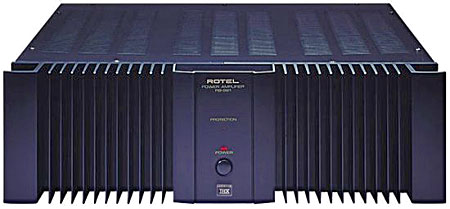
As a reviewer who has focused on seeking out high-quality audiophile gear for cost-constrained readers, I'm embarrassed to say that the flagship RB-991 stereo amplifier is the first Rotel product I've had in my house. (To be fair to myself, this 38-year-old family-owned company did not develop a large US market presence until this last decade.)
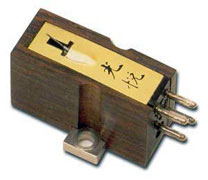
Among the more intriguing audio-related announcements this year was that Koetsu phono cartridges were once again available in the States. In fact, they're being handmade in limited quantities by the sons of founder Yoshiaki Sugano.
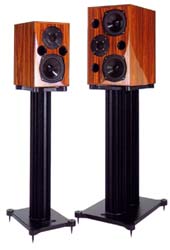
<I>Flip flip flip</I>]...Where the heck is it?...[<I>flip flip flip</I>]...Got it!" What am I looking for? There, in black and white, on p.634 of J. Gordon Holt's <I>Really Reliable Rules for Rookie Reviewers</I> (footnote 1), is the Prime Directive On Loudspeaker Setup: "Never, ever, choose a loudspeaker that has too much bass extension for your room!"
What's 1/16" narrower, over 1/2" shallower, and 3/16" higher than the <A HREF="http://www.stereophile.com/floorloudspeakers/1190mirage">Mirage M-3</A> loudspeaker? The new Mirage M-3si, that's what. Though the published dimensions for the old and new speakers are the same, my eyes told me there was a difference between them when I had them side-by-side in my listening room in Santa Fe. Being the compulsive type, I got out my trusty tape measure. No, my eyes had not deceived me—the M-3si <I>is</I> skinnier and taller. As I waltzed them into position, I sensed they weighed about the same as their predecessors; close enough that setting them on Arcici Super Spikes is a two-man operation. Though either speaker makes a definite presence in a room, I still find their high-gloss, black finish (the only finish available) unassuming, attractive, and elegant.
Steve Jones on the "paradox of enrichment."