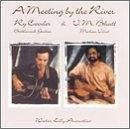
Recording of April 1993: A Meeting by the River
<B>RY COODER/VISHWA BHATT: <I>A Meeting by the River</I></B><BR>
Water Lily Acoustics WLA-CS-29-CD (CD only; LP available eventually). Kavichandran Alexander, prod., eng. AAD. TT: 39:48</FONT>
<B>RY COODER/VISHWA BHATT: <I>A Meeting by the River</I></B><BR>
Water Lily Acoustics WLA-CS-29-CD (CD only; LP available eventually). Kavichandran Alexander, prod., eng. AAD. TT: 39:48</FONT>
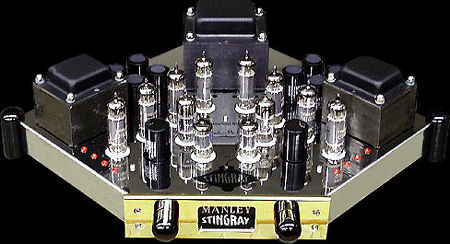
There's an aesthetic dimension to the Manley Laboratories Stingray that transcends high-end audio and borders on modern sculpture—not unlike the E.A.R. V20, which I auditioned in the October issue. Still, the Stingray is by no means an exercise in gimmickry. Form has clearly followed function at every step in the design process, the ultimate goal of which was to fashion a vacuum-tube integrated amplifier with real-world power that defined the outer limits of high-end performance in a functional, affordable, bare-bones package...with a touch of style.
Have you ever gone into a high-end audio emporium dressed not to the nines, but more like the threes or fours, and been ignored by the shop's staff because they've sized you up as being too low-budget? Even though you were carrying a high-powered, fully equipped, state-of-the-art wallet in that fanny pack, they assumed the opposite and shunned you.
Rudyard Kipling said that "never the twain shall meet." He was speaking of East and West, but in the world of audio, his adage has most often been applied to what has been the traditional chasm between the sounds of tubes and solid-state. Tube advocates thump the tub for the timbral and spatial glow, the absence of harsh, odd-order harmonic distortions, the harmonic completeness and holistic spatiality that only fire bottles can provide. Solid-state advocates point out the superiority of their preferred gear in terms of bass depth, power and control, low noise, and ultimate detail resolution. That chasm between the characteristic sounds of tube and transistor has narrowed appreciably in the latest generations of gear, as each type of circuit has become capable of embodying some of the other's trademark characteristics. But between the camps, friendly competition continues.

Audio pundits get to speculate all day long about high-rez audio. But tell us what you think: will either SACD or DVD-Audio make it? Why or why not?
With few exceptions, 2003 has been a slow year for specialty A/V retailers. In late November, both Ultimate Electronics and Tweeter Group reported disappointing figures for their third and fourth fiscal quarters, respectively. New York's Harvey Electronics, however, posted respectable gains given the stagnant economy.
It's bad enough that the consumer electronics giants and small fry compete with each other. Increasingly, they are finding they must defend themselves against an onslaught from the personal computer industry which is eating away at the market share of traditional CE vendors.
Is bigger better? Michael Fremer sets out to determine just that as he reviews the <A HREF="http://www.stereophile.com/amplificationreviews/1103pass">Pass Labs XA160 monoblock power amplifier</A>. As Fremer explains, "While the industry-feminizing tiny triode set has made a great deal of noise in the past few years (I can hear them hissing now), soft-walking, big-stick-carrying, mega-power amplifiers still circle the globe."
<I>See update at end of article.</I> iTunes continues to grow and Napster has been reborn, but these last few months have been a bumpy ride for <A HREF="http://MP3.com">MP3.com</A>. The music site, known for its large online music library featuring unsigned independent artists, was purchased on December 14 by San Francisco-based <A HREF="http://www.CNET.com">CNET</A>.
A couple weeks back, we asked our readers for the oddest audio tweak they've come across. Reader Jeff Peterson thinks we should accentuate the positive and ask readers what they think is the greatest audio component that they've discovered, not the strangest.