Need a Piano?
We have a few for sale.


We have a few for sale.

As Jeff Wong and I took our daily constitutional along Brooklyn's Greenbelt this morning, we spotted these colorful boulders along the shore. You never know who you're going to run across in this borough.
How <I>The Simpsons</I> has embiggened the English language.
Now that the dust has settled on <I>The Deathly Hallows</I>, Stephen King weighs in on the series and on J. K. Rowling. King, of course, is one of the few fiction authors who can write about Rowling's success without bitterness, and his thoughts on Rowling's craft are sharp. He also knows just a little bit about toiling in the genre-novel wilderness.
Sometimes less is more, but then again, maybe not when it comes to audio. Do you connect your loudspeaker cables to your amp and loudspeaker with bare wire at the ends or with connectors such as pins, spade lugs, or banana plugs? If you use connectors, what kind do you use?
<B>XM/Sirius:</B> Did we just hear the other shoe drop on the XM Satellite Radio/Sirius Satellite Radio merger? On July 25, XM founder and CEO Hugh Panero announced he would leave the company in August. The company named COO Nate Davis president and interim CEO.
Universal Music Group CEO Doug Morris isn't exactly a fan of portable digital players—in November 2006, he referred to them as "just repositories for stolen music." Yet, on August 9, UMG announced that it would offer at least some of its artists' music as MP3 files without digital rights management (DRM) on RealNetworks, Wal-Mart, Amazon, Rhapsody, PureTracks, Transworld, and artists' own websites. Everywhere, that is, except on Apple's iTunes Store, where UMG files will have Apple's FairPlay DRM installed.
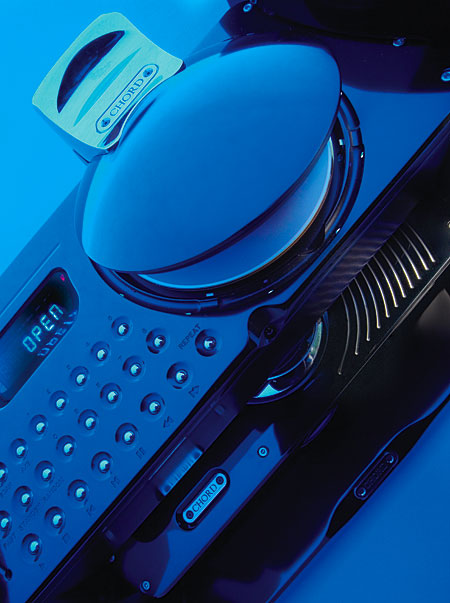
I was stumbling through the Denver Convention Center at CEDIA 2006 when I spotted John Franks, of Chord Electronics, and Jay Rein, of Chord's US importer, Bluebird Music, stranded in the basement purgatory for "niche" products. I couldn't resist asking, "What sin relegated you guys to this little hell?"
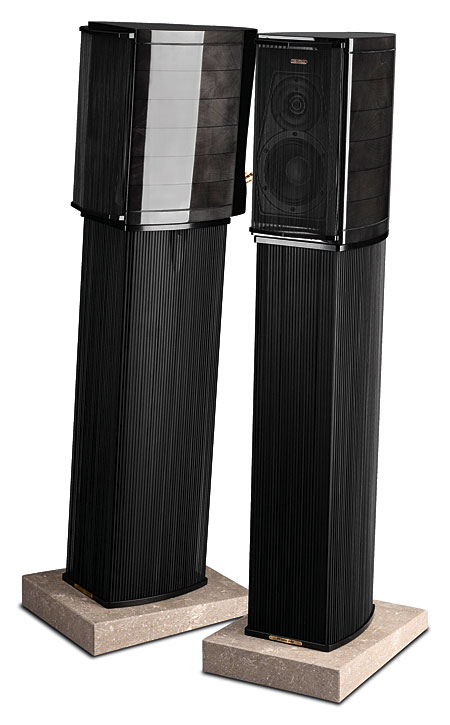
Audiophile eyes usually roll when a manufacturer describes a loudspeaker as a "genuine musical instrument." Musical instruments have specific characteristics of pitch and timbre. Ideally, a loudspeaker should be a portal to the music; the speaker itself should be neutral in pitch and timbre—in other words, the <I>opposite</I> of a musical instrument. That the <I>sound</I> produced should be "musical" is a different argument.