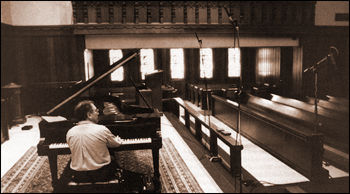
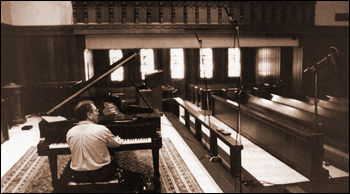
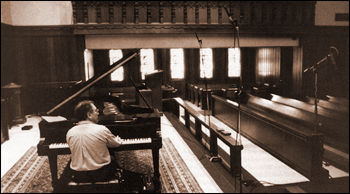
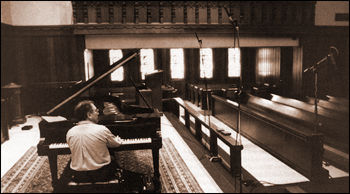
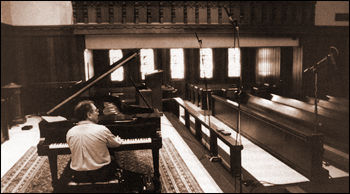
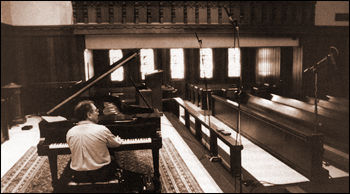
"What's that noise?" Bob Harley and I looked at each other in puzzlement. We thought we'd debugged the heck out of the recording setup, but there, audible in the headphones above the sound of Robert Silverman softly stroking the piano keys in the second <I>Scherzo</I> of Schumann's "Concerto Without Orchestra" sonata, was an intermittent crackling sound. It was almost as if the God of Vinyl was making sure there would be sufficient surface noise on our live recording to endow it with the Official Seal of Audiophile Approval. Bob tiptoed out of the vestry where we'd set up our temporary control room and peeked through a window into the church, where a rapt audience was sitting as appropriately quiet as church mice.
"What's that noise?" Bob Harley and I looked at each other in puzzlement. We thought we'd debugged the heck out of the recording setup, but there, audible in the headphones above the sound of Robert Silverman softly stroking the piano keys in the second <I>Scherzo</I> of Schumann's "Concerto Without Orchestra" sonata, was an intermittent crackling sound. It was almost as if the God of Vinyl was making sure there would be sufficient surface noise on our live recording to endow it with the Official Seal of Audiophile Approval. Bob tiptoed out of the vestry where we'd set up our temporary control room and peeked through a window into the church, where a rapt audience was sitting as appropriately quiet as church mice.
The Silverman Concert Who, What, When, Where, & How
"What's that noise?" Bob Harley and I looked at each other in puzzlement. We thought we'd debugged the heck out of the recording setup, but there, audible in the headphones above the sound of Robert Silverman softly stroking the piano keys in the second <I>Scherzo</I> of Schumann's "Concerto Without Orchestra" sonata, was an intermittent crackling sound. It was almost as if the God of Vinyl was making sure there would be sufficient surface noise on our live recording to endow it with the Official Seal of Audiophile Approval. Bob tiptoed out of the vestry where we'd set up our temporary control room and peeked through a window into the church, where a rapt audience was sitting as appropriately quiet as church mice.
"What's that noise?" Bob Harley and I looked at each other in puzzlement. We thought we'd debugged the heck out of the recording setup, but there, audible in the headphones above the sound of Robert Silverman softly stroking the piano keys in the second <I>Scherzo</I> of Schumann's "Concerto Without Orchestra" sonata, was an intermittent crackling sound. It was almost as if the God of Vinyl was making sure there would be sufficient surface noise on our live recording to endow it with the Official Seal of Audiophile Approval. Bob tiptoed out of the vestry where we'd set up our temporary control room and peeked through a window into the church, where a rapt audience was sitting as appropriately quiet as church mice.
"What's that noise?" Bob Harley and I looked at each other in puzzlement. We thought we'd debugged the heck out of the recording setup, but there, audible in the headphones above the sound of Robert Silverman softly stroking the piano keys in the second <I>Scherzo</I> of Schumann's "Concerto Without Orchestra" sonata, was an intermittent crackling sound. It was almost as if the God of Vinyl was making sure there would be sufficient surface noise on our live recording to endow it with the Official Seal of Audiophile Approval. Bob tiptoed out of the vestry where we'd set up our temporary control room and peeked through a window into the church, where a rapt audience was sitting as appropriately quiet as church mice.
"What's that noise?" Bob Harley and I looked at each other in puzzlement. We thought we'd debugged the heck out of the recording setup, but there, audible in the headphones above the sound of Robert Silverman softly stroking the piano keys in the second <I>Scherzo</I> of Schumann's "Concerto Without Orchestra" sonata, was an intermittent crackling sound. It was almost as if the God of Vinyl was making sure there would be sufficient surface noise on our live recording to endow it with the Official Seal of Audiophile Approval. Bob tiptoed out of the vestry where we'd set up our temporary control room and peeked through a window into the church, where a rapt audience was sitting as appropriately quiet as church mice.
"What's that noise?" Bob Harley and I looked at each other in puzzlement. We thought we'd debugged the heck out of the recording setup, but there, audible in the headphones above the sound of Robert Silverman softly stroking the piano keys in the second <I>Scherzo</I> of Schumann's "Concerto Without Orchestra" sonata, was an intermittent crackling sound. It was almost as if the God of Vinyl was making sure there would be sufficient surface noise on our live recording to endow it with the Official Seal of Audiophile Approval. Bob tiptoed out of the vestry where we'd set up our temporary control room and peeked through a window into the church, where a rapt audience was sitting as appropriately quiet as church mice.
"What's that noise?" Bob Harley and I looked at each other in puzzlement. We thought we'd debugged the heck out of the recording setup, but there, audible in the headphones above the sound of Robert Silverman softly stroking the piano keys in the second Scherzo of Schumann's "Concerto Without Orchestra" sonata, was an intermittent crackling sound. It was almost as if the God of Vinyl was making sure there would be sufficient surface noise on our live recording to endow it with the Official Seal of Audiophile Approval. Bob tiptoed out of the vestry where we'd set up our temporary control room and peeked through a window into the church, where a rapt audience was sitting as appropriately quiet as church mice.
If you read much promotional literature for recently introduced high-quality equipment, you'll notice a common theme emerging: balanced connection. Balanced inputs and outputs are becoming a must for any audio equipment that has any claim to quality. The word itself has promotional value, suggesting moral superiority over the long-established "unbalanced" connection (for the purpose of this discussion, I will call this "normal"). What's my problem with this? Simply this: The High End could be paying dangerous, costly lip service to the received wisdom that balanced operation is the goal for an audio system.
If you read much promotional literature for recently introduced high-quality equipment, you'll notice a common theme emerging: balanced connection. Balanced inputs and outputs are becoming a must for any audio equipment that has any claim to quality. The word itself has promotional value, suggesting moral superiority over the long-established "unbalanced" connection (for the purpose of this discussion, I will call this "normal"). What's my problem with this? Simply this: The High End could be paying dangerous, costly lip service to the received wisdom that balanced operation is the goal for an audio system.