E<I>ditor's Note: <A HREF="http://www.richardhess.com">Richard Hess</A> has recently spent time remastering several CDs and wrote about the experience for an engineering newsgroup. We think </I>Stereophile<I>'s online readers will find his comments about the process interesting.</I>
For technophiles, DVD is the current hot ticket. The compact disc is far from dead, however. The 20-year-old format has been given a new lease on life by <A HREF="http://www.sony.com/">Sony Corporation</A>, which in early July announced the development of a new technique that will double the data-storage capacity of recordable CDs.
Federal courts long ago established that music fans have certain "fair use" rights when it comes to making copies of recordings they own. They can transfer recordings from one format to another—such as from LP to cassette tape or from CD to MiniDisc—and they can share those recordings with others, provided that the results are only for private, noncommercial use.
Mark Levinson No.383 integrated amplifier Measurements part 3
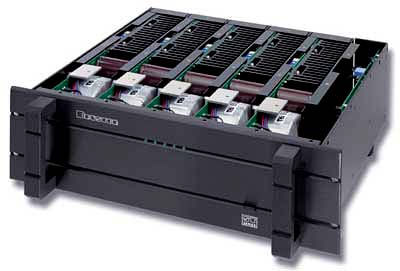
When I learned that Madrigal Audio Labs was marketing their first integrated amplifier, the Mark Levinson No.383, I felt this was a big change for the Connecticut company. Mark Levinson literally started the high-end marketing revolution back in the early 1970s by manufacturing cost-no-object separate amplifiers and preamplifiers. The purist designs had one overriding rule: employ the simplest circuit path possible. Each amplifier or preamplifier used only individual circuit-board components (no integrated circuits) and had a minimal number of controls, eschewing elaborate switches and tone controls. Mark Levinson Audio Systems and its successor, Madrigal Audio Laboratories, has continued this philosophy of separate components for the past 25 years.
Mark Levinson No.383 integrated amplifier Measurements part 2
When I learned that Madrigal Audio Labs was marketing their first integrated amplifier, the Mark Levinson No.383, I felt this was a big change for the Connecticut company. Mark Levinson literally started the high-end marketing revolution back in the early 1970s by manufacturing cost-no-object separate amplifiers and preamplifiers. The purist designs had one overriding rule: employ the simplest circuit path possible. Each amplifier or preamplifier used only individual circuit-board components (no integrated circuits) and had a minimal number of controls, eschewing elaborate switches and tone controls. Mark Levinson Audio Systems and its successor, Madrigal Audio Laboratories, has continued this philosophy of separate components for the past 25 years.
Mark Levinson No.383 integrated amplifier Measurements
When I learned that Madrigal Audio Labs was marketing their first integrated amplifier, the Mark Levinson No.383, I felt this was a big change for the Connecticut company. Mark Levinson literally started the high-end marketing revolution back in the early 1970s by manufacturing cost-no-object separate amplifiers and preamplifiers. The purist designs had one overriding rule: employ the simplest circuit path possible. Each amplifier or preamplifier used only individual circuit-board components (no integrated circuits) and had a minimal number of controls, eschewing elaborate switches and tone controls. Mark Levinson Audio Systems and its successor, Madrigal Audio Laboratories, has continued this philosophy of separate components for the past 25 years.
Mark Levinson No.383 integrated amplifier Associated Equipment
When I learned that Madrigal Audio Labs was marketing their first integrated amplifier, the Mark Levinson No.383, I felt this was a big change for the Connecticut company. Mark Levinson literally started the high-end marketing revolution back in the early 1970s by manufacturing cost-no-object separate amplifiers and preamplifiers. The purist designs had one overriding rule: employ the simplest circuit path possible. Each amplifier or preamplifier used only individual circuit-board components (no integrated circuits) and had a minimal number of controls, eschewing elaborate switches and tone controls. Mark Levinson Audio Systems and its successor, Madrigal Audio Laboratories, has continued this philosophy of separate components for the past 25 years.
Mark Levinson No.383 integrated amplifier Specifications
When I learned that Madrigal Audio Labs was marketing their first integrated amplifier, the Mark Levinson No.383, I felt this was a big change for the Connecticut company. Mark Levinson literally started the high-end marketing revolution back in the early 1970s by manufacturing cost-no-object separate amplifiers and preamplifiers. The purist designs had one overriding rule: employ the simplest circuit path possible. Each amplifier or preamplifier used only individual circuit-board components (no integrated circuits) and had a minimal number of controls, eschewing elaborate switches and tone controls. Mark Levinson Audio Systems and its successor, Madrigal Audio Laboratories, has continued this philosophy of separate components for the past 25 years.