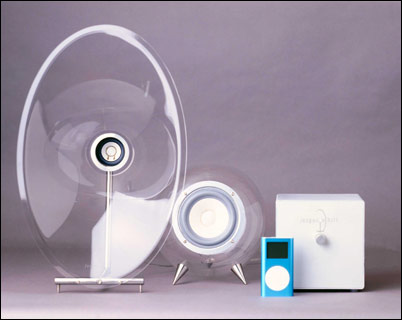
The speaker review in the July 1996 issue of the German audio magazine <I>Stereoplay</I> didn't hold back the praise. "Absolut Spitzenklasse III Referenz" was their overall rating, which I guess translates to "You'd better hear this, buddy," in American English. So when MBL of America's Marc Lawrence called to find out if I wanted to review the subject of that review, the MBL 111, I didn't need to be asked twice.
The speaker review in the July 1996 issue of the German audio magazine Stereoplay didn't hold back the praise. "Absolut Spitzenklasse III Referenz" was their overall rating, which I guess translates to "You'd better hear this, buddy," in American English. So when MBL of America's Marc Lawrence called to find out if I wanted to review the subject of that review, the MBL 111, I didn't need to be asked twice.
The speaker review in the July 1996 issue of the German audio magazine <I>Stereoplay</I> didn't hold back the praise. "Absolut Spitzenklasse III Referenz" was their overall rating, which I guess translates to "You'd better hear this, buddy," in American English. So when MBL of America's Marc Lawrence called to find out if I wanted to review the subject of that review, the MBL 111, I didn't need to be asked twice.
The speaker review in the July 1996 issue of the German audio magazine Stereoplay didn't hold back the praise. "Absolut Spitzenklasse III Referenz" was their overall rating, which I guess translates to "You'd better hear this, buddy," in American English. So when MBL of America's Marc Lawrence called to find out if I wanted to review the subject of that review, the MBL 111, I didn't need to be asked twice.
Bill Firebaugh: The Well-Tempered Innovator Page 4
Bill Firebaugh's first product, the outrageous-looking <A HREF="http://www.stereophile.com/tonearms/485well">Well-Tempered (tone) Arm</A>, established him as one of audio's most innovative designers. At the 1985 Winter CES, he showed a prototype companion product—the Well-Tempered Turntable—and was producing production units by January 1987. He discusses here the WTT's unusual design features. (Readers should note that, since we have not yet tested the new turntable, this interview is not to be interpreted as an endorsement of the product.)
Bill Firebaugh: The Well-Tempered Innovator Page 3
Bill Firebaugh's first product, the outrageous-looking <A HREF="http://www.stereophile.com/tonearms/485well">Well-Tempered (tone) Arm</A>, established him as one of audio's most innovative designers. At the 1985 Winter CES, he showed a prototype companion product—the Well-Tempered Turntable—and was producing production units by January 1987. He discusses here the WTT's unusual design features. (Readers should note that, since we have not yet tested the new turntable, this interview is not to be interpreted as an endorsement of the product.)
Bill Firebaugh: The Well-Tempered Innovator Page 2
Bill Firebaugh's first product, the outrageous-looking <A HREF="http://www.stereophile.com/tonearms/485well">Well-Tempered (tone) Arm</A>, established him as one of audio's most innovative designers. At the 1985 Winter CES, he showed a prototype companion product—the Well-Tempered Turntable—and was producing production units by January 1987. He discusses here the WTT's unusual design features. (Readers should note that, since we have not yet tested the new turntable, this interview is not to be interpreted as an endorsement of the product.)
Threshold SA-1 monoblock power amplifier Specifications
Eleven years ago, Threshold Corporation entered the high-end audio market with the first amplifier ever to use sliding bias (footnote 1) in its output stages. Some 10 years later, Threshold spawned another innovation: their so-called Stasis circuitry, which yielded the S-series amplifiers. The SA-1 and its lower-powered sister SA-2 are the latest from Threshold, and are the first Threshold amps to abandon sliding bias for straight class-A operation. Both use the Stasis circuit.