I had the pleasure to attend Bob Cordell's very enjoyable talk on amplifier measurements at the Rocky Mountain Audio Fest on Saturday. Bob presented some graphs, courtesy of John Atkinson, from a Boulder amplifier and a Portal Paladin amplifier. I was a bit perplexed when I saw the Paladin's frequency response graph depicting the amp's performance into different load impedances. Where the typical amp will show the simulated loudspeaker load around the top of the graph, the Paladin's graph showed the simulated load toward the bottom.
When I later asked to examine the graphs, I compared the Paladin response graph to another graph Bob had showing the impedance of the simulated loudspeaker model JA uses in his measurements. This was akin to wearing inverting glasses over my left eye.
By comparing the graphs, one could deduce that the output was raised (below 20KHz or so) as the impedance was lowered. One could also deduce the resistance value of the various constant load traces. I discussed this with Bob.
When I returned home from the show, I looked up the Paladin review, which pointed out the amp's "negative output impedance" and its effect on the frequency response. JA suspected that this effect is due to the use of positive feedback to compensate for the normally higher impedance of balanced output designs, an explanation that indeed accounts for the observed behavior.
The Paladin designer's choice of using what might be a safe amount of positive feedback -- which one could argue improves its output characteristics -- is not something I've come across in a commercial amplifier. Perhaps someone could point to other examples. I find it interesting in terms of the trade-off between the positive effect on output characteristics and the potential negative effects on distortion and stability.
Incidentally, while the explanatory text in the Paladin review's measurement section accurately describes what is happening in the graph, the text below the graph contains a small editing error (perhaps one of those overlooked cut-and-paste issues). The phrase "top to bottom" should be replaced with the phrase "bottom to top."
-atalio
Desont Corp.
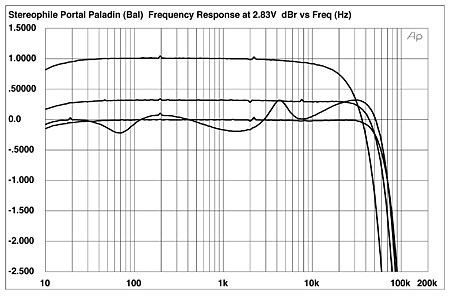

I had the pleasure to attend Bob Cordell's very enjoyable talk on amplifier measurements at the Rocky Mountain Audio Fest on Saturday. Bob presented some graphs, courtesy of John Atkinson, from a Boulder amplifier and a Portal Paladin amplifier. I was a bit perplexed when I saw the Paladin's frequency response graph depicting the amp's performance into different load impedances. Where the typical amp will show the simulated loudspeaker load around the top of the graph, the Paladin's graph showed the simulated load toward the bottom.
When I later asked to examine the graphs, I compared the Paladin response graph to another graph Bob had showing the impedance of the simulated loudspeaker model JA uses in his measurements. This was akin to wearing inverting glasses over my left eye.
By comparing the graphs, one could deduce that the output was raised (below 20KHz or so) as the impedance was lowered. One could also deduce the resistance value of the various constant load traces. I discussed this with Bob.
When I returned home from the show, I looked up the Paladin review, which pointed out the amp's "negative output impedance" and its effect on the frequency response. JA suspected that this effect is due to the use of positive feedback to compensate for the normally higher impedance of balanced output designs, an explanation that indeed accounts for the observed behavior.
The Paladin designer's choice of using what might be a safe amount of positive feedback -- which one could argue improves its output characteristics -- is not something I've come across in a commercial amplifier. Perhaps someone could point to other examples. I find it interesting in terms of the trade-off between the positive effect on output characteristics and the potential negative effects on distortion and stability.
Incidentally, while the explanatory text in the Paladin review's measurement section accurately describes what is happening in the graph, the text below the graph contains a small editing error (perhaps one of those overlooked cut-and-paste issues). The phrase "top to bottom" should be replaced with the phrase "bottom to top."
-atalio
Desont Corp.