LATEST ADDITIONS
Ultralink's Don Bouchard Dead at 58
Don Bouchard, Ultralink/XLO Products' executive vice-president, succumbed February 7, 2008 from injuries he sustained in a motorcycle accident on December 15, 2007. Bouchard, riding with friends, had his front wheel drop into a hole in the pavement while traversing a railroad crossing and was thrown over his handlebars. The resulting injuries included a severe skull fracture, right-brain trauma, a broken clavicle, a broken rib, which punctured a lung, as well as internal trauma, multiple contusions, and bruising.
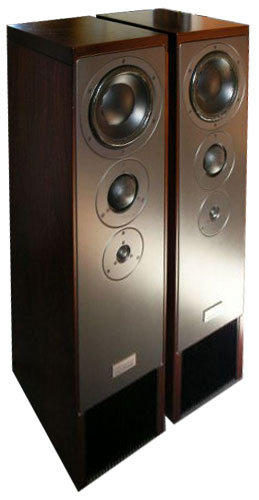
Dynaudio Accent 3 powered loudspeaker
When it comes to loudspeaker drivers, Dynaudio has earned an enviable reputation for quality and reliability. To use an automotive analogy, they are the Mercedes Benz of the driver universe. If you're a speaker builder, the odds are that you have already experimented with these drivers. And even if you're not a speaker builder, it's quite possible that your speakers use Dynaudio drivers. After all, some of the finest speaker systems in the world do. A case in point is the Duntech Sovereign, which single-handedly embodies almost the entire Dynaudio catalog.
What Goes Around...
I've told you about <a href="http://blog.stereophile.com/stephenmejias/121807complaint/">my love for CBS' Sunday Morning</a> news program. The show is simply fantastic. Charles Osgood is the host. Charles Osgood wears bowties and talks in perfect rhyme. Mo Rocca knows how to dress. David Edelstein takes me to the movies. Bill Geist is the most charming buffoon. Ben Stein has a strange way of lifting the human spirit. Serena Altschul makes me sigh.
Squeezebox Duet Puts the Display in Your Hand
Logitech's Squeezebox Network Systems has added a new model, the Duet, which adds a 2.4" color-LCD screen and a scroll-wheel to the unit's hand-held remote (not unlike the <A HREF="http://www.stereophile.com/mediaservers/1006sonos/">Sonos system</A>). The screen can display song titles, album art, customized wallpapers—even RSS feeds and radio station IDs.
Stacks
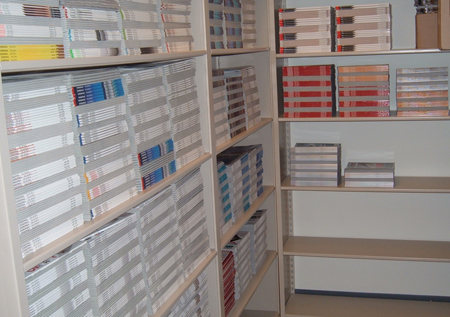
Much of the April issue shipped to prepress yesterday, and the big "Recommended Components" feature is on its way out right now. All that's left to go is "Letters," "Industry Update," and the table of contents. Often, our shipping days coincide with the arrival of our office supply of the previous month's issue. That is, as we send off the April issue, the completed and bound March issues are arriving here.
The Return of Physical Media?
The Sony Cards are in!!!! The Sony Cards are in???
We're like Freemasons and Julian Schnabel
We spent almost all of today proofreading the April 2008 edition of "Recommended Components." One day of proofreading, however, is not enough.
Polk Enters the Apple Stores
On February 5, <I>This Week in Consumer Electronics</I> announced that Polk Audio had announced plans to sell its I-Sonic ES2 iPod docking tabletop hi-fi ($499) and miDock Studio portable iPod speaker through the Apple website and freestanding store network. This came less than a week after Polk announced that Best Buy would carry its TSi loudspeakers, PSW powered subwoofers, select RM series drive-units and, of course, the SurroundBar 360 DVD Theater (all of which are currently available from the rival Circuit City chain).
Anti-Node: Active Room-Acoustics Correction
Recently, I assessed four disparate room-correction systems based on digital signal processing (DSP): Copland DRC205, Lyngdorf Audio RoomPerfect, <A HREF="http://www.stereophile.com/musicintheround/1105mitr">Velodyne SMS-1</A>, and <A HREF="http://www.stereophile.com/musicintheround/706mitr">Meridian DRC</A>. I concluded that Meridian's approach—which applies IIR (Infinite Impulse Response) "anti-resonance" filters to suppress room resonant modes, if only partially—was, in many respects, the best. What I particularly like about Meridian DRC is that, unlike the Copland and Lyngdorf processors, its approach to system tonal balance is largely hands-off. Yes, it lightens up the extreme bass a little, as you'd expect, but it doesn't recast the system balance in any way that might prove undesirable. If you like your system's tonal character as it is, Meridian DRC behaves just as you'd want a room-correction system to behave: it quells room resonance effects while leaving the system's essential sound well alone.