A January 2026 Follow-Up
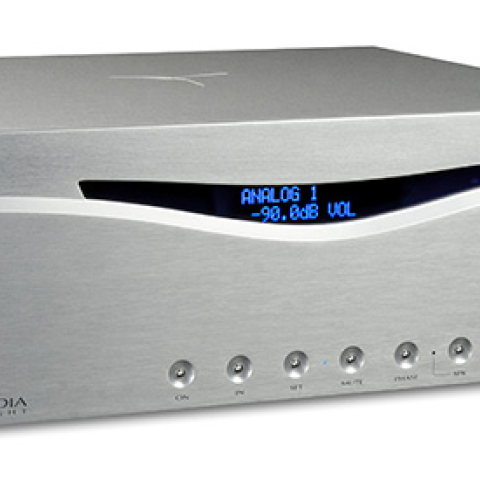
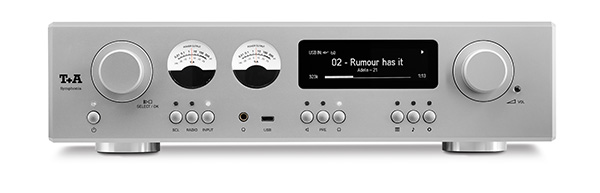 Rogier van Bakel reviewed the T+A Symphonia ($10,990) in last November's issue, covering its aesthetics, streaming capabilities, and sound qualities through speakers and headphones. Editor Jim Austin asked me to spend some time with it, focusing on the Symphonia's analog capabilities, including its built-in phono preamplifier.
Unpacking the Symphonia invoked flashbacks to the larger, similarly versatile T+A R 2500 R, which I reviewed in 2024. The Symphonia's visual aesthetic is quite different from that of the R 2500 R, yet its front-panel controls have the same names and do the same things. Its screen is smaller but displays similar information. The setup menus are similar. Both streaming receivers use the same T+A Navigator G3 app, for phone or tablet. Due partly to my familiarity and partly to simplicity of operation, I was able to get the Symphonia on my Wi-Fi network quickly. I used the Symphonia both Ethernet-wired and wireless during my reviewing time.
As soon as the Symphonia was online, it was evident that T+A has kept pace with the evolving streaming world since the earlier review. The Symphonia arrived Roon Ready and Qobuz Connect compatible. (T+A streamers have long been Tidal Connect and Spotify Connect compatible; Spotify only recently went lossless.) If your only digital music comes from the streaming services—that is, if you don't maintain a library of music files—then the streaming-service apps are all you need, though you'll still need to use the Navigator G3 app to set up and make changes to the Symphonia system. Select the Symphonia as the output device on the streaming-service app, and the Symphonia receives the stream directly from the provider, not through the phone or tablet running the streamer app as it does with AirPlay, GoogleCast, or Bluetooth, which also limit bandwidth. This is all good news for those of us who are streaming-centric.
To the task at hand: the phono preamp
Rogier van Bakel reviewed the T+A Symphonia ($10,990) in last November's issue, covering its aesthetics, streaming capabilities, and sound qualities through speakers and headphones. Editor Jim Austin asked me to spend some time with it, focusing on the Symphonia's analog capabilities, including its built-in phono preamplifier.
Unpacking the Symphonia invoked flashbacks to the larger, similarly versatile T+A R 2500 R, which I reviewed in 2024. The Symphonia's visual aesthetic is quite different from that of the R 2500 R, yet its front-panel controls have the same names and do the same things. Its screen is smaller but displays similar information. The setup menus are similar. Both streaming receivers use the same T+A Navigator G3 app, for phone or tablet. Due partly to my familiarity and partly to simplicity of operation, I was able to get the Symphonia on my Wi-Fi network quickly. I used the Symphonia both Ethernet-wired and wireless during my reviewing time.
As soon as the Symphonia was online, it was evident that T+A has kept pace with the evolving streaming world since the earlier review. The Symphonia arrived Roon Ready and Qobuz Connect compatible. (T+A streamers have long been Tidal Connect and Spotify Connect compatible; Spotify only recently went lossless.) If your only digital music comes from the streaming services—that is, if you don't maintain a library of music files—then the streaming-service apps are all you need, though you'll still need to use the Navigator G3 app to set up and make changes to the Symphonia system. Select the Symphonia as the output device on the streaming-service app, and the Symphonia receives the stream directly from the provider, not through the phone or tablet running the streamer app as it does with AirPlay, GoogleCast, or Bluetooth, which also limit bandwidth. This is all good news for those of us who are streaming-centric.
To the task at hand: the phono preamp
I reset the Symphonia to factory settings so that I could approach it as a new user. Using the Navigator G3 app, I set analog input 2 to phono preamp rather than line level via the Settings > Source Configuration menu tree. The Symphonia's phono preamp is intended for higher-output cartridges (moving magnet, high-output moving coil, or variable reluctance/"moving iron") intended to be used with a 47k ohm load. T+A's Jim Shannon told me that the circuit's input capacitance is 47pF; combined with a typical cable capacitance, the load is in the range of 150pF. The preamp gain is 43dB, meaning you may need to turn up the volume with some records to attain the volume levels you get easily with digital sources. This makes sense for a product like the Symphonia, which by the standards of T+A at least is relatively affordable. Symphonia buyers may already have a lower-end or midline vinyl-playing rig that will interface perfectly. If, eventually, the user equips their turntable with a low-output MC, easy-peasy: Just add a step-up transformer or headamp, or switch analog input 2 back to line level and plug in an external preamp.
My first listening was in my office system: Philips AF-887 turntable, Shure M97XE cartridge, and Amphion One18 speakers. I connected everything, switched to analog input 2 (which I relabeled "Phono" using the app), and cranked the volume. I wanted to hear if the Symphonia could tame the hum that sometimes plagues this turntable. I heard no hum, and there was very little background hiss even at full volume (70 on screen readout).
 The first record I spun was the 2018 remix of Pink Floyd's Animals (Pink Floyd Music PFR28D), cut by Bernie Grundman from James Guthrie's HD digital master. I also streamed the 24/192 digital version of this album using Qobuz Connect. With levels roughly matched, the LP sounded quite similar to the stream, except for the LP surface noise. Digital produced a wider stereo image. Tonally, the two versions were very similar, which I took to indicate that T+A designed their phono preamp for neutrality and not to have a "sound." I count that as a plus.
One of my current vinyl reference tracks, "The Hawk Talks" from Duke's Big 4 (Analogue Productions APJ 153), swung and popped, and Louis Bellson's drums were meaty as expected. I heard no sluggish, foggy bottom end. The rest of the frequency spectrum was in scale and realistic.
I finished in the office system with an old vinyl chestnut, my original pressing of the Rolling Stones' Get Yer Ya-Ya's Out! (London NPS-5). Recorded live at Madison Square Garden in NYC, November 27–28, 1969, the album flat-out rocked through the Symphonia, showcasing a great band at the beginning of its peak. I especially appreciated how Charlie Watts's drums snapped and Keith Richards's guitar growled on the right as Mick Taylor's axe sounded more poetic on the left.
Spinning records on the big system
The first record I spun was the 2018 remix of Pink Floyd's Animals (Pink Floyd Music PFR28D), cut by Bernie Grundman from James Guthrie's HD digital master. I also streamed the 24/192 digital version of this album using Qobuz Connect. With levels roughly matched, the LP sounded quite similar to the stream, except for the LP surface noise. Digital produced a wider stereo image. Tonally, the two versions were very similar, which I took to indicate that T+A designed their phono preamp for neutrality and not to have a "sound." I count that as a plus.
One of my current vinyl reference tracks, "The Hawk Talks" from Duke's Big 4 (Analogue Productions APJ 153), swung and popped, and Louis Bellson's drums were meaty as expected. I heard no sluggish, foggy bottom end. The rest of the frequency spectrum was in scale and realistic.
I finished in the office system with an old vinyl chestnut, my original pressing of the Rolling Stones' Get Yer Ya-Ya's Out! (London NPS-5). Recorded live at Madison Square Garden in NYC, November 27–28, 1969, the album flat-out rocked through the Symphonia, showcasing a great band at the beginning of its peak. I especially appreciated how Charlie Watts's drums snapped and Keith Richards's guitar growled on the right as Mick Taylor's axe sounded more poetic on the left.
Spinning records on the big system
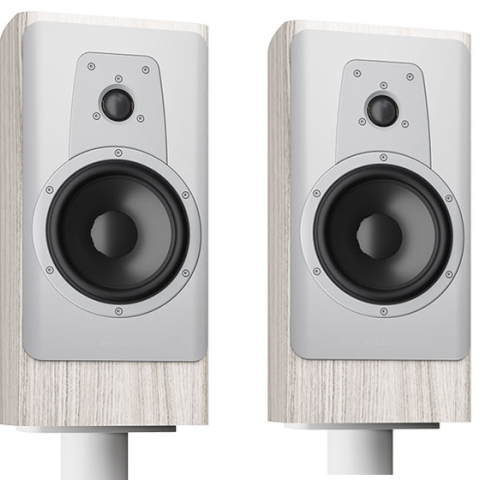
I moved the Symphonia up to the living room and plugged in my main record player: a Technics SL-1200MKV with KAB three-speed, fluid damping, and tonearm rewire mods. I used The Vessel moving magnet cartridge, with a MicroRidge stylus on an aluminum cantilever. A vintage SME cable connected the turntable to the Symphonia. As on my office system, records needed a volume boost to match digital sources. My usual living room speakers had been replaced temporarily by the EgglestonWorks Andra 5s. The Symphonia was an ideal partner for these; more on that in my forthcoming Andra review.
I didn't feel the need to compare the Symphonia to other phono preamps, nor did I swap a variety of cartridges in and out. I decided to just play records and describe what I heard.
 I began with two new Rhino High Fidelity AAA platters: Never Mind the Bollocks, Here's the Sex Pistols (LP, RHF1 3147) and the Monkees' Pisces, Aquarius, Capricorn & Jones Ltd. (LP, RHF1 727727). Very different albums! Neither is truly "high fidelity" by any modern definition. The Sex Pistols album sounds better streaming than on record; the vinyl has very little top end and sounds like the tapes are worn out, or maybe poorly made copy tapes were used. My favorite track, "Anarchy in the U.K.," growled and rumbled appropriately, but Johnny Rotten's vocals were so lacking in top end that the snarling lyrics didn't sound clear as they do on my original USA Sire single.
The Monkees album, according to its insert notes, is the first vinyl release mastered from the original mixdown tapes as opposed to equalized and dynamics-limited "cutting masters." It sounded primitive, and not in the exciting garage-rock sense. To me The Monkees always sound like a manufactured sorta group making TV-friendly sorta rock. Which is what they were. The Rhino HF packaging and presentation were superb as always, and vinyl surface noise was impressively low. These somewhat negative experiences make a positive point: The Symphonia didn't mask or tart up bad-sounding records.
To clear my aural palette, I put on the Blue Note Tone Poet version of Bobby Hutcherson's Dialogue (LP, BST 84198). The music on this album is complex and at times abstract—not free jazz but often loosely structured. Recorded by Rudy Van Gelder on April 3, 1965, its sound was crisp and punchy, from Freddie Hubbard's trumpet to Sam Rivers's multiple reed instruments and flute, to Andrew Hill's busy piano. And then of course there's Hutcherson's plinky vibes and mellower marimba. The foundation of Richard Davis's bass and Joe Chambers's drums sat perfectly with the lead instruments.
The title track, composed by Chambers, at times seemed the musical equivalent of a Jackson Pollock painting: many colors on many trajectories everywhere at once, yet with each element discernable from the others. And like a large-scale Pollock painting, the effect was mesmerizing.
Interestingly, Kevin Gray mastered all three of these albums, both Rhinos and the Tone Poet, from master tapes. The varied sound reflects his dedication to faithfully transmitting the sound of the source tapes, for better or worse. In that respect, he and the Symphonia are on the same page.
I began with two new Rhino High Fidelity AAA platters: Never Mind the Bollocks, Here's the Sex Pistols (LP, RHF1 3147) and the Monkees' Pisces, Aquarius, Capricorn & Jones Ltd. (LP, RHF1 727727). Very different albums! Neither is truly "high fidelity" by any modern definition. The Sex Pistols album sounds better streaming than on record; the vinyl has very little top end and sounds like the tapes are worn out, or maybe poorly made copy tapes were used. My favorite track, "Anarchy in the U.K.," growled and rumbled appropriately, but Johnny Rotten's vocals were so lacking in top end that the snarling lyrics didn't sound clear as they do on my original USA Sire single.
The Monkees album, according to its insert notes, is the first vinyl release mastered from the original mixdown tapes as opposed to equalized and dynamics-limited "cutting masters." It sounded primitive, and not in the exciting garage-rock sense. To me The Monkees always sound like a manufactured sorta group making TV-friendly sorta rock. Which is what they were. The Rhino HF packaging and presentation were superb as always, and vinyl surface noise was impressively low. These somewhat negative experiences make a positive point: The Symphonia didn't mask or tart up bad-sounding records.
To clear my aural palette, I put on the Blue Note Tone Poet version of Bobby Hutcherson's Dialogue (LP, BST 84198). The music on this album is complex and at times abstract—not free jazz but often loosely structured. Recorded by Rudy Van Gelder on April 3, 1965, its sound was crisp and punchy, from Freddie Hubbard's trumpet to Sam Rivers's multiple reed instruments and flute, to Andrew Hill's busy piano. And then of course there's Hutcherson's plinky vibes and mellower marimba. The foundation of Richard Davis's bass and Joe Chambers's drums sat perfectly with the lead instruments.
The title track, composed by Chambers, at times seemed the musical equivalent of a Jackson Pollock painting: many colors on many trajectories everywhere at once, yet with each element discernable from the others. And like a large-scale Pollock painting, the effect was mesmerizing.
Interestingly, Kevin Gray mastered all three of these albums, both Rhinos and the Tone Poet, from master tapes. The varied sound reflects his dedication to faithfully transmitting the sound of the source tapes, for better or worse. In that respect, he and the Symphonia are on the same page.
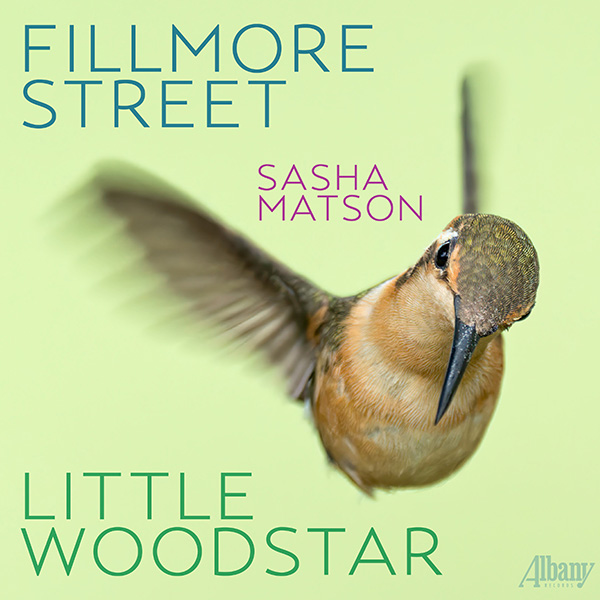 Then I spun Fillmore Street, a suite by my Stereophile colleague Sasha Matson, from Fillmore Street/Little Woodstar (Albany Records TROY1985). The last time I listened carefully to this record was through the mighty, small Technics SC-CX700 wireless amplified streaming speaker-gadgets. With the Vessel cartridge, the Symphonia, and the EgglestonWorks speakers, it sounded new and fresh. I heard more detail and noted an ample and satisfying low end.
This is one of the most natural-sounding recordings I have on vinyl. Each instrument sounds as I would expect if it were in the room in front of me.
Each time I listen, I get more details from Sasha's complex arrangements. The record offers audiophile-grade sound and interesting music.
Finally, I played the Rhino High Fidelity reissue of Wilco's A.M., yet another album from the Kevin Gray stable. I wasn't familiar with this album, but I liked it from the start. It's the most Uncle Tupelo–like Wilco album, less down-tempo and dragged-out than their later work. This is high-grade 1990s rock, and here Gray had a snappy and audibly good-condition master tape to cut the lacquers from. This record is a showcase for the Rhino High Fidelity series.
For playing records, what's included in the Symphonia fit perfectly with my workingman's phono rigs and sits on the right side of my "90% rule": It's fine for 90% of the turntables and cartridges out there and for playing 90% of records 90% of the time.
The other analog medium: FM radio
Then I spun Fillmore Street, a suite by my Stereophile colleague Sasha Matson, from Fillmore Street/Little Woodstar (Albany Records TROY1985). The last time I listened carefully to this record was through the mighty, small Technics SC-CX700 wireless amplified streaming speaker-gadgets. With the Vessel cartridge, the Symphonia, and the EgglestonWorks speakers, it sounded new and fresh. I heard more detail and noted an ample and satisfying low end.
This is one of the most natural-sounding recordings I have on vinyl. Each instrument sounds as I would expect if it were in the room in front of me.
Each time I listen, I get more details from Sasha's complex arrangements. The record offers audiophile-grade sound and interesting music.
Finally, I played the Rhino High Fidelity reissue of Wilco's A.M., yet another album from the Kevin Gray stable. I wasn't familiar with this album, but I liked it from the start. It's the most Uncle Tupelo–like Wilco album, less down-tempo and dragged-out than their later work. This is high-grade 1990s rock, and here Gray had a snappy and audibly good-condition master tape to cut the lacquers from. This record is a showcase for the Rhino High Fidelity series.
For playing records, what's included in the Symphonia fit perfectly with my workingman's phono rigs and sits on the right side of my "90% rule": It's fine for 90% of the turntables and cartridges out there and for playing 90% of records 90% of the time.
The other analog medium: FM radio
The Symphonia's little box of accessories includes a T-shaped dipole FM antenna and the appropriate connector to screw it into a 75 ohm socket on the rear panel. I live in an FM dead zone: I'm too far out to hear NYC stations, and the few local stations aren't interesting, so I rarely listen and haven't had a tuner in my system for decades. However, I was impressed that T+A included FM radio in this compact component and wanted to see if they had skimped on quality. I guessed that they didn't, and I was right.
After connecting the T-antenna and hanging it over two picture frames on the wall above my stereo rack, I pressed the FM button on the G3 control app. A few minutes later, a menu of FM choices appeared on my iPad screen. I started at the top of the list and tried them all out.
First positive impression: For the two stations that came in strong enough for stereo reception, the sound was really good, free of static and crackle. Unfortunately, one was a "classic rock" station devoid of imaginative programming, and the other was an NPR station having a fundraising drive. This is why I don't listen to the radio.
Second positive impression: The tuner automatically picks up digital side-band broadcasts. Only one I was able to receive was in stereo, but none sounded awful or were plagued with digital noise or dropouts. The rock station had more channels of stereotypically programmed rock music, nothing new under the sun. The NPR station had a classical channel, which was playing quiet chamber music.
The FM tuner in the Symphonia is good. It will suit those who live in places with good radio choices. Pair it with a high-quality (especially outdoor) antenna, and the choices will multiply. I'm surprised and impressed that T+A's engineers took such good care of old-style streamers—radio listeners—in designing a device focused on the newer kind of streaming, the online/Ethernet kind. FM not doing it for you? The Symphonia/G3 combination has a robust Airable internet radio and podcast interface, which I described in my R 2500 R review. You can get lost for hours surfing the world's broadcasts. With so many to choose from, it's easy to locate some really good radio stations.
More streaming bliss: Spotify lossless
While I had the Symphonia, Spotify announced the rollout of lossless streaming for Spotify users with Premium subscriptions—including me. So I took the opportunity to compare the sound of newly lossless Spotify Connect with Qobuz Connect, which was always lossless, streaming the same albums at the same (CD) resolution. I could barely tell them apart. Some music may sound more open and airy via Qobuz, and any differences would be made plainer on an ultrapremium system. A Spotify spokesman told me that their lossless streaming uses the FLAC format—same as Qobuz—whereas lossy Spotify uses OGG. The spokesman said Spotify down-converts 24-bit content with sample rates greater than 44.1kHz to 24/44.1. He told me that no additional digital signal processing like tone shaping or dynamic compression takes place.
Using Spotify Connect, I compared a few albums with playback quality set to "high quality" lossy streaming with lossless. The improvement with lossless was quite audible. With lossless, aspects of the sound like reverb tails and "air and space" around instruments were as they should be; with lossy, some of that was missing, and in some cases the tonality and stereo image width was altered.
Lossy is fine with earbuds while on-the-go, but not with big speakers in the living room. The Symphonia ably demonstrated these sonic differences.
 Sound qualities
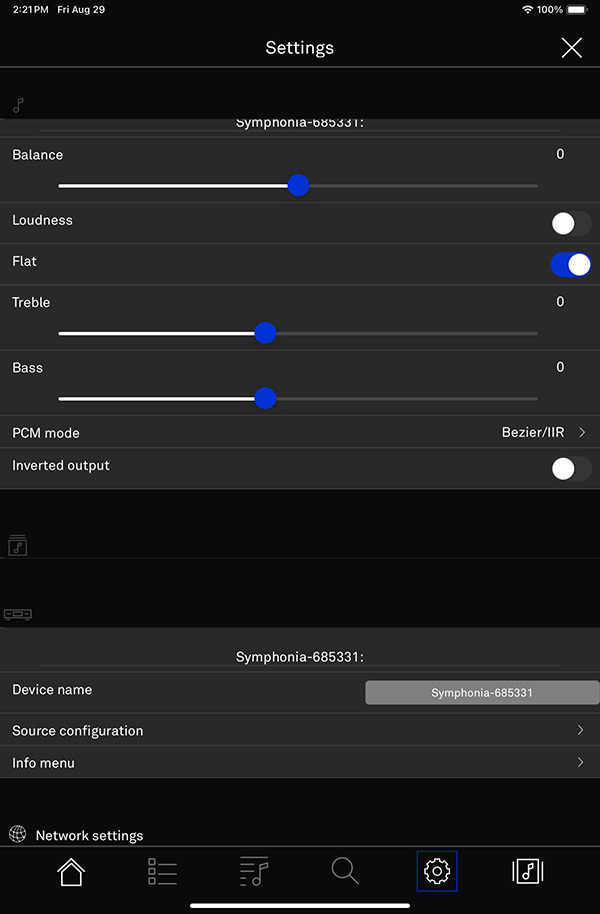
I auditioned the Symphonia in the living room with EgglestonWorks Andra 5 speakers in place of my reference Bowers & Wilkins 808s. The Andra 5s sound a bit more modern and "forward" than my B&Ws. I found the Symphonia's tone controls useful here: Most of the time, I kept bass on +2 and treble either flat or –2, depending on the content. Those adjustments made the sound of this EgglestonWorks-based system more to my taste.
With the tone controls flat, the Symphonia sounded a little bit less authoritative than my reference Benchmark LA-4 preamp/AHB2 power amp combo. It wasn't a huge difference, and I'd be fully content with the Symphonia if I didn't already know and love the sound of the Benchmark "stack."
The stereotypical class-D "glaze," widely believed to affect the upper midrange and low treble with some class-D amplification, was absent with the Symphonia. That's not surprising considering that T+A starts with Bruno Putzeys's excellent Purifi technology and makes some changes. Shannon told me that rather than use stock Purifi amplifier modules, T+A buys some of the "core components, especially the Processor including the Eigentakt Software," and integrates them into amplifier circuit boards of their own design. Among other differences from the stock modules is a higher operating voltage. What I heard convinced me that the tag team of Purifi and T+A together have eliminated undesirable class-D sound characteristics.
My time with the Symphonia led me to the same conclusions I had after listening to the R 2500 R: T+A's engineers know what they're doing. The company makes solidly built components capable of conveying all the music, whether from an over-air signal, a black vinyl disc, or a streaming source. The Symphonia's impressive flexibility and the variety of input sources put it in the upper echelon of current-production modern-day receivers.
Like the more expensive R 2500 R, the Symphonia impressed me thoroughly.—Tom Fine
Rogier van Bakel reviewed the T+A Symphonia ($10,990) in last November's issue, covering its aesthetics, streaming capabilities, and sound qualities through speakers and headphones. Editor Jim Austin asked me to spend some time with it, focusing on the Symphonia's analog capabilities, including its built-in phono preamplifier.
Unpacking the Symphonia invoked flashbacks to the larger, similarly versatile T+A R 2500 R, which I reviewed in 2024. The Symphonia's visual aesthetic is quite different from that of the R 2500 R, yet its front-panel controls have the same names and do the same things. Its screen is smaller but displays similar information. The setup menus are similar. Both streaming receivers use the same T+A Navigator G3 app, for phone or tablet. Due partly to my familiarity and partly to simplicity of operation, I was able to get the Symphonia on my Wi-Fi network quickly. I used the Symphonia both Ethernet-wired and wireless during my reviewing time.
As soon as the Symphonia was online, it was evident that T+A has kept pace with the evolving streaming world since the earlier review. The Symphonia arrived Roon Ready and Qobuz Connect compatible. (T+A streamers have long been Tidal Connect and Spotify Connect compatible; Spotify only recently went lossless.) If your only digital music comes from the streaming services—that is, if you don't maintain a library of music files—then the streaming-service apps are all you need, though you'll still need to use the Navigator G3 app to set up and make changes to the Symphonia system. Select the Symphonia as the output device on the streaming-service app, and the Symphonia receives the stream directly from the provider, not through the phone or tablet running the streamer app as it does with AirPlay, GoogleCast, or Bluetooth, which also limit bandwidth. This is all good news for those of us who are streaming-centric.
I reset the Symphonia to factory settings so that I could approach it as a new user. Using the Navigator G3 app, I set analog input 2 to phono preamp rather than line level via the Settings > Source Configuration menu tree. The Symphonia's phono preamp is intended for higher-output cartridges (moving magnet, high-output moving coil, or variable reluctance/"moving iron") intended to be used with a 47k ohm load. T+A's Jim Shannon told me that the circuit's input capacitance is 47pF; combined with a typical cable capacitance, the load is in the range of 150pF. The preamp gain is 43dB, meaning you may need to turn up the volume with some records to attain the volume levels you get easily with digital sources. This makes sense for a product like the Symphonia, which by the standards of T+A at least is relatively affordable. Symphonia buyers may already have a lower-end or midline vinyl-playing rig that will interface perfectly. If, eventually, the user equips their turntable with a low-output MC, easy-peasy: Just add a step-up transformer or headamp, or switch analog input 2 back to line level and plug in an external preamp.
The first record I spun was the 2018 remix of Pink Floyd's Animals (Pink Floyd Music PFR28D), cut by Bernie Grundman from James Guthrie's HD digital master. I also streamed the 24/192 digital version of this album using Qobuz Connect. With levels roughly matched, the LP sounded quite similar to the stream, except for the LP surface noise. Digital produced a wider stereo image. Tonally, the two versions were very similar, which I took to indicate that T+A designed their phono preamp for neutrality and not to have a "sound." I count that as a plus.
One of my current vinyl reference tracks, "The Hawk Talks" from Duke's Big 4 (Analogue Productions APJ 153), swung and popped, and Louis Bellson's drums were meaty as expected. I heard no sluggish, foggy bottom end. The rest of the frequency spectrum was in scale and realistic.
I moved the Symphonia up to the living room and plugged in my main record player: a Technics SL-1200MKV with KAB three-speed, fluid damping, and tonearm rewire mods. I used The Vessel moving magnet cartridge, with a MicroRidge stylus on an aluminum cantilever. A vintage SME cable connected the turntable to the Symphonia. As on my office system, records needed a volume boost to match digital sources. My usual living room speakers had been replaced temporarily by the EgglestonWorks Andra 5s. The Symphonia was an ideal partner for these; more on that in my forthcoming Andra review.
I began with two new Rhino High Fidelity AAA platters: Never Mind the Bollocks, Here's the Sex Pistols (LP, RHF1 3147) and the Monkees' Pisces, Aquarius, Capricorn & Jones Ltd. (LP, RHF1 727727). Very different albums! Neither is truly "high fidelity" by any modern definition. The Sex Pistols album sounds better streaming than on record; the vinyl has very little top end and sounds like the tapes are worn out, or maybe poorly made copy tapes were used. My favorite track, "Anarchy in the U.K.," growled and rumbled appropriately, but Johnny Rotten's vocals were so lacking in top end that the snarling lyrics didn't sound clear as they do on my original USA Sire single.
The Monkees album, according to its insert notes, is the first vinyl release mastered from the original mixdown tapes as opposed to equalized and dynamics-limited "cutting masters." It sounded primitive, and not in the exciting garage-rock sense. To me The Monkees always sound like a manufactured sorta group making TV-friendly sorta rock. Which is what they were. The Rhino HF packaging and presentation were superb as always, and vinyl surface noise was impressively low. These somewhat negative experiences make a positive point: The Symphonia didn't mask or tart up bad-sounding records.
Then I spun Fillmore Street, a suite by my Stereophile colleague Sasha Matson, from Fillmore Street/Little Woodstar (Albany Records TROY1985). The last time I listened carefully to this record was through the mighty, small Technics SC-CX700 wireless amplified streaming speaker-gadgets. With the Vessel cartridge, the Symphonia, and the EgglestonWorks speakers, it sounded new and fresh. I heard more detail and noted an ample and satisfying low end.
This is one of the most natural-sounding recordings I have on vinyl. Each instrument sounds as I would expect if it were in the room in front of me.
Each time I listen, I get more details from Sasha's complex arrangements. The record offers audiophile-grade sound and interesting music.
The Symphonia's little box of accessories includes a T-shaped dipole FM antenna and the appropriate connector to screw it into a 75 ohm socket on the rear panel. I live in an FM dead zone: I'm too far out to hear NYC stations, and the few local stations aren't interesting, so I rarely listen and haven't had a tuner in my system for decades. However, I was impressed that T+A included FM radio in this compact component and wanted to see if they had skimped on quality. I guessed that they didn't, and I was right.
While I had the Symphonia, Spotify announced the rollout of lossless streaming for Spotify users with Premium subscriptions—including me. So I took the opportunity to compare the sound of newly lossless Spotify Connect with Qobuz Connect, which was always lossless, streaming the same albums at the same (CD) resolution. I could barely tell them apart. Some music may sound more open and airy via Qobuz, and any differences would be made plainer on an ultrapremium system. A Spotify spokesman told me that their lossless streaming uses the FLAC format—same as Qobuz—whereas lossy Spotify uses OGG. The spokesman said Spotify down-converts 24-bit content with sample rates greater than 44.1kHz to 24/44.1. He told me that no additional digital signal processing like tone shaping or dynamic compression takes place.
Sound qualitiesI auditioned the Symphonia in the living room with EgglestonWorks Andra 5 speakers in place of my reference Bowers & Wilkins 808s. The Andra 5s sound a bit more modern and "forward" than my B&Ws. I found the Symphonia's tone controls useful here: Most of the time, I kept bass on +2 and treble either flat or –2, depending on the content. Those adjustments made the sound of this EgglestonWorks-based system more to my taste.