This review started with a gentle handoff. My ol' pal Walter Swanbon of Fidelis Distribution stopped by Brooklyn to take away the $10,000 Limited Edition Falcon LS3/5a loudspeakers and drop off the $10,000 eos DAC by Ideon. As he was getting in his car, I yelled, "Walter! I'm warning you! If that thing's not plug'n'play, I'll put it right there on that curb."
The day after Walter visited, Jack Wu, the founder of Woo Audio, came by and picked up his beautiful $13,000 WA24 headphone amplifier. As soon as Jack left, at exactly 4:15pm, I set the Ideon eos DAC in the spot the WA24 had occupied. The eos came with no manual and no menu, but on the back I spotted three digital inputs, S/PDIF on RCA and BNC and type-B USB (footnote 1), so I did what seemed obvious: I used a Kimber Kable DS60 S/PDIF cable to connect the eos to the TEAC VRDS 701T CD transport and an AudioQuest Cinnamon USB cable to connect the eos to my Mac mini. AudioQuest Thunderbird interconnects connected the eos to the Linear Tube Audio Z10e integrated amplifier. The LTA amp was connected to my Falcon "Gold Badge" LS3/5a's.
I tried Qobuz Connect. Qobuz recognized the Ideon immediately—in fact, Pogues singer Shane MacGowan started singing loudly from my Falcons. After a quick mute and a Qobuz reset, I relaxed, listening peacefully to Merle Haggard's 2006 anthology Mama Tried/Pride in What I Am (16/44.1 FLAC Capital/Qobuz). It wasn't yet 4:30.
That's what I call plug'n'play.
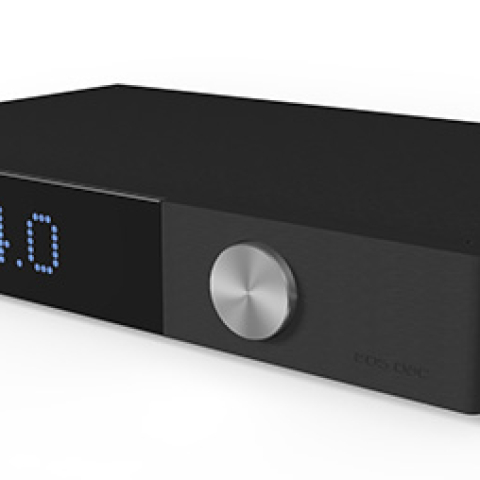
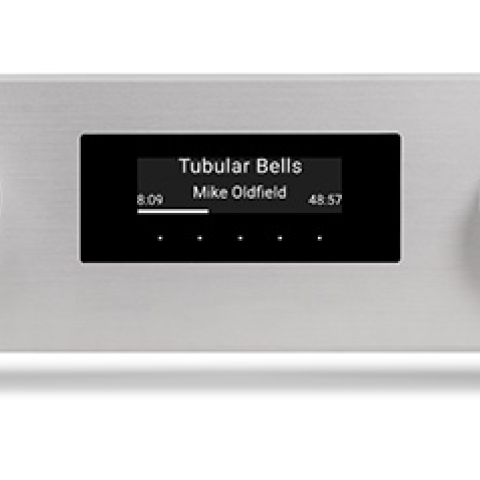
When I paused Merle, the eos's display said "Idle" in bright blue LED letters nearly 2" high and 4" wide. When I saw that, my brain shifted into cognitive dissonance, wondering why this machine thought I needed that information.
A few moments later, I found the eos's User Guide on the internet, but I could find no instructions for how to put the blue LEDs to sleep. I might be more accepting of these casino-odds-board graphics if they told me something I needed to know, like what track is playing.
As a humorous comparison, the front-panel lettering on the Schiit Audio Stjarna phono preamp (see Gramophone Dreams #99) is just 2mm high. Before I memorized its layout, I needed a flashlight and a magnifier to read it. Most audio products reflect countless small decisions made by mostly anonymous people with widely varying understanding. I guess that's part of the charm.
When I pushed Play on Qobuz, Johnny Cash was doubling his pal Merle's voice on "Folsom Prison Blues." Merle's voice came through water clear, with all its colorful Merleness intact. From the start, the eos played with intense presence and spot-on tone.
 Description
The Ideon eos is a two-channel D/A converter. It is made in Greece. It's part of Ideon's three-piece eos stack, which also includes the eos Stream streamer and the eos Time, which Ideon describes as "a USB conditioning device." The eos stack is the first step down from the flagship "Absolute stack." It weighs 22lb. It is low-slung and modern-looking, 18" wide × 3" high. On the Ideon eos's back panel, I found one USB-B and two S/PDIF inputs (BNC and RCA), two sets of stereo analog outputs (balanced XLR and single-ended RCA), and a toggle switch for setting the display's brightness to High or Low—but not off. Ideon is cautious about revealing its secret sauce. The website announces, "What's inside the eos will remain undescribed." All that's revealed is a broad statement—"As with all Ideon offerings, the eos DAC is a fully proprietary design, with audio technologies developed in-house"—and a few bullet-point teasers:
Whenever I compare one DAC to another, the first thing I notice is the fundamental tone quality of each. How much do wood, metal, and flesh sound like themselves? After that, I notice how brightly or darkly their soundstages are lit: Under what form of illumination is this cabaret of wood, metal, and flesh being presented? This leads my mind into the darkness at the back of the soundspace, wherein I study how it feels, hoping to find power there, seeing if the darkness feels dead, as in switched-off, or alive and sparkling. Dark spaces and quiet moments in low-priced DACs sound empty and generic. Expensive, multichassis DACs with heavy metal power supplies identify themselves by putting vibrancy in the shadow spaces and latent force in the quiet moments. These subliminal energies make those quiet moments feel more continuous with the louder parts, which makes the musical content more accessible and interesting.
Next, I notice the hardness or softness of the sound. Is it brittle or supple? This is easy to discern, and it is right behind tone in importance. I would never use a component that sounded bright or hard, but I'm willing to pay extra for supple and natural.
Lastly, I look for what digital rarely achieves: corporeality, which I and others sometimes also call presence or immediacy. I don't expect sentient humans to appear in my room—I'd prefer they didn't—but I enjoy some sense of the performing artists being solid beings in some room somewhere else in the world, near the microphones that recorded them.
 That's audio vérité
I'm explaining my listening proclivities because after only a few tracks on the remastered Qobuz version of the glorious 1962 LP A Sound Spectacular, Music of Edgar Varèse Vol. 2: Arcana – Déserts – Offrandes (16/44.1 FLAC, Sony Classical/Qobuz), it was obvious, though surprising: Ideon's eos DAC was making streaming Qobuz from my Depression-era Mac mini sound fast, forceful, and grunge-free. It played files with punch and raw presence I never thought I'd get from Qobuz.
I decided to credit what Ideon calls its "Proprietary Triple Distillation USB input" for the cleanliness and vigor of the eos's USB output. This three-stage USB noise filtering appeared to have power-washed what had previously been my grungiest source.
Previous to the eos, the dCS Lina DAC with its Master Clock was my best USB grunge scrubber, but even with the Lina, I could sometimes sense there was a dirty Mac mini hiding somewhere at the other end of the wire. My second-best scrubber was the HoloAudio Spring3. It gets full-on Mr. Clean on grunge while adding WWF (footnote 2) muscle and cheerleader acrobatics. But neither of those DACs had greater raw clarity than the eos.
Successful field recording is like big-game hunting. Ethnomusicologists like Alan Lomax found and traced ghost-filled small-town histories one family at a time while drawing maps of gravel roads many turns off the asphalt. After navigating those barely marked roads, they entered strangers' driveways and knocked on doors, hoping to find talent like Robert Johnson, or R. L. Burnside—or, as in my story below, Virginia-born fiddler Hobart Smith (1897–1965).
 If everything went well, the ethnographer would capture a good performance, bring it home safely, and share it with cultural tourists like me. That's a huge undertaking. What's unique about field recordings is that the artist's sentiments feel mostly unspoiled. There are no celebrity egos. No "America's Most Talented" or TikTok clicks. Just small-town artists hoping to share their talents with strangers. Hobart Smith fiddling and tapping his foot on a wood floor playing "Katy Went Fishing with Her Hook and Line" is on the first Lomax disc (Vol. 1) and is one of the most vivid captures in the stunningly recorded 13-volume Alan Lomax collection Southern Journey: Voices from the American South (Rounder CD 1701-1713). With the Ideon, I listened in bare feet, tapping my wood floor in sync with Hobart. I repeated this song and my foot-tapping at least five more times without pausing. What the eos DAC was doing better than any DAC I've used is compel me to play songs over and over.
I know this recording from a thousand plays, and the eos played it more clearly, with better tone and greater vibratory presence, than any I can remember. This track's room sounds included Hobart tuning his violin, Hobart explaining the song he's about to play, and Hobart bumping into things. The wood floor Smith toe-tapped had a dark, oiled-wood tone. My polyurethane-coated oak floor sounded lighter and brighter.
Through the eos, all these Lomax tracks displayed a rawer, clearer, more-vibrant-than-ever presence that triggered "I am there" feelings that made each song feel newly fresh and automatically replayable.
Witnessing this level of immediacy coming from a DAC (!) put me in a good mood and made me curious to see how the eos would handle piano.
Looking for something by a contemporary pianist, I chose a 2004 recording of Pieter Wispelwey (violoncello) and Dejan Lazić (piano) playing Beethoven: Complete Sonatas & Variations (Channel Classics 2CDs CCS SA 22605). Besides Lazić and Wispelwey's spirited playing and the eos's conspicuous presence, what I discovered here was how much nuance and delicacy the eos was capable of.
If everything went well, the ethnographer would capture a good performance, bring it home safely, and share it with cultural tourists like me. That's a huge undertaking. What's unique about field recordings is that the artist's sentiments feel mostly unspoiled. There are no celebrity egos. No "America's Most Talented" or TikTok clicks. Just small-town artists hoping to share their talents with strangers. Hobart Smith fiddling and tapping his foot on a wood floor playing "Katy Went Fishing with Her Hook and Line" is on the first Lomax disc (Vol. 1) and is one of the most vivid captures in the stunningly recorded 13-volume Alan Lomax collection Southern Journey: Voices from the American South (Rounder CD 1701-1713). With the Ideon, I listened in bare feet, tapping my wood floor in sync with Hobart. I repeated this song and my foot-tapping at least five more times without pausing. What the eos DAC was doing better than any DAC I've used is compel me to play songs over and over.
I know this recording from a thousand plays, and the eos played it more clearly, with better tone and greater vibratory presence, than any I can remember. This track's room sounds included Hobart tuning his violin, Hobart explaining the song he's about to play, and Hobart bumping into things. The wood floor Smith toe-tapped had a dark, oiled-wood tone. My polyurethane-coated oak floor sounded lighter and brighter.
Through the eos, all these Lomax tracks displayed a rawer, clearer, more-vibrant-than-ever presence that triggered "I am there" feelings that made each song feel newly fresh and automatically replayable.
Witnessing this level of immediacy coming from a DAC (!) put me in a good mood and made me curious to see how the eos would handle piano.
Looking for something by a contemporary pianist, I chose a 2004 recording of Pieter Wispelwey (violoncello) and Dejan Lazić (piano) playing Beethoven: Complete Sonatas & Variations (Channel Classics 2CDs CCS SA 22605). Besides Lazić and Wispelwey's spirited playing and the eos's conspicuous presence, what I discovered here was how much nuance and delicacy the eos was capable of.
 Reproducing these Beethoven sonatas, etc., the eos's brilliance and immediacy were blanketed (in a positive way) in atmospheric nanodetail and rhythmic nuance. The eos's boldness and presence were out of the limelight but still operating, supporting a finely woven cloth of delicate harmonic energy.
While repeat-playing this Channel Classics album, I realized that reproducing nuanced harmonic energy—like the eos was pulling from the Beethoven disc—is another of the main qualities that separate the finest DACs from the herd.
The social context of Beethoven's music was as different from Hobart Smith's as could be, but in most other ways they were similar. I was fascinated how they both rolled forward, carrying spirited tunes that represented very specific geopolitical zeitgeists.
Hobart Smith's "Katy Went Fishing with Her Hook and Line" sounded raw and unprocessed, vivid in its bare simplicity.
Playing Hobart and Ludwig van at length back to back felt like a tutorial on my Euro-American roots. Enjoying these types of recordings at this level of pleasure and engagement was something I never thought digital would allow. But there it was, right in front of me, making me play Southern Journey Vol. 1 over and over, for two days.
Reproducing these Beethoven sonatas, etc., the eos's brilliance and immediacy were blanketed (in a positive way) in atmospheric nanodetail and rhythmic nuance. The eos's boldness and presence were out of the limelight but still operating, supporting a finely woven cloth of delicate harmonic energy.
While repeat-playing this Channel Classics album, I realized that reproducing nuanced harmonic energy—like the eos was pulling from the Beethoven disc—is another of the main qualities that separate the finest DACs from the herd.
The social context of Beethoven's music was as different from Hobart Smith's as could be, but in most other ways they were similar. I was fascinated how they both rolled forward, carrying spirited tunes that represented very specific geopolitical zeitgeists.
Hobart Smith's "Katy Went Fishing with Her Hook and Line" sounded raw and unprocessed, vivid in its bare simplicity.
Playing Hobart and Ludwig van at length back to back felt like a tutorial on my Euro-American roots. Enjoying these types of recordings at this level of pleasure and engagement was something I never thought digital would allow. But there it was, right in front of me, making me play Southern Journey Vol. 1 over and over, for two days.
 My next curiosity was to see how Sparkler Audio's S515t "ballade II" CD transport, which I described in Gramophone Dreams #94, would sound feeding signal to the eos.
This transport swap turned out to be an important moment in my Ideon auditions. The only thing I changed in my system was the machine that spins the silver discs and reads the pits and lands, yet when I did that, the quality of the Ideon's sound changed. Quite noticeably, the eos's presence, immediacy, and raw transparency were now subordinated to an atmosphere of copious nuance and wide-spectrum tonal shading. With the Sparkler, Southern Journey Vol. 1 came through smooth and extra-rich without a hint of hi-fi spectacularism.
With what many readers would regard as an insignificant change in my reference system, I witnessed one DAC sounding two substantially different ways. Had I used only one of those transports, I would have believed the eos sounded either bright and clear (as it did with TEAC's 701T) or dark, dense, and atmospheric (as it did with the Sparkler S515t). I found this difference—the quantity of change—curious and wondered what was causing it, which motivated me to investigate further.
Remember that the eos played Qobuz from my Mac mini's USB output with extraordinary presence and unprecedented transparency—the same as it did via Kimber's D60 S/PDIF cable from the TEAC's VRDS 701T transport. Which means that both coax and USB inputs had produced the same levels of clarity, vigor, and immediacy. Now, via the same cable and input, a different transport resulted in a very different sound.
Still wondering why the Sparkler DAC sounded so different, I tried connecting the Sparkler transport to the eos DAC with an AudioQuest Cinnamon digital coax. That resulted in a Goldilocks moment for me and the Ideon. The eos's tone and contrast structure changed again, this time more drastically. This time, a simple cable swap yin-yang-ed the eos's (and my whole system's) sound into a just-right balance between hard and soft, thick and thin, sharp and dull. With the AudioQuest wire, presence and immediacy were back in full. Leading edges of tones sparkled and glimmered. And all I changed was a 1.5m cable!
I regard these shifting observations as proof that finding any component's true character—its persona if you will—depends on noticing which sonic traits remain constant no matter how iterations of ancillaries shift the sound around.
While comparing Ideon's eos to HoloAudio's May and Spring3 DACs, I was struck by how different each sounded. They sounded as different as magpies, woodpeckers, and doves.
The HoloAudio May held steadfast to its "this is the truth" testimony and beguiling Kodachrome color. The Spring3 stayed bright, lucid, and amped-up, like 10-year-old girls squealing while running in the park. The eos DAC gripped my attention with startling realism.
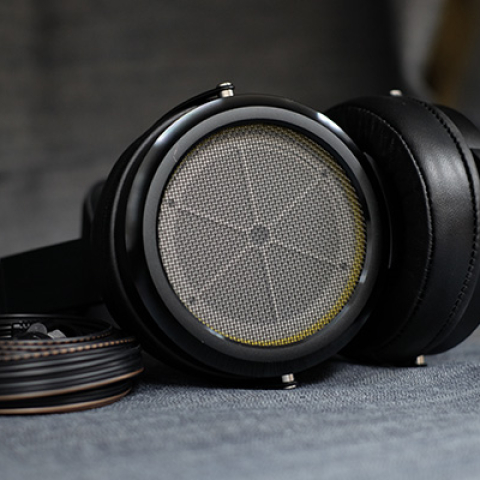
I still didn't feel I'd found all the Ideon's constant traits, so I decided to exchange the dynamics-challenged Falcon Gold Badges and see what I would hear from my most accurate in-house transducer, Audeze's laboratory-clean, nanodetailed, dynamic-to-the-max CRBN electrostatic headphones. The sound that resulted was perhaps the most tone-, tempo-, and transient-perfect I've ever encountered, completely awake and radically uncolored. Descriptive and dimensional in the extreme. No hi-fi chicanery, just audio vérité. This was my favorite "wow!" moment of this review.
My next curiosity was to see how Sparkler Audio's S515t "ballade II" CD transport, which I described in Gramophone Dreams #94, would sound feeding signal to the eos.
This transport swap turned out to be an important moment in my Ideon auditions. The only thing I changed in my system was the machine that spins the silver discs and reads the pits and lands, yet when I did that, the quality of the Ideon's sound changed. Quite noticeably, the eos's presence, immediacy, and raw transparency were now subordinated to an atmosphere of copious nuance and wide-spectrum tonal shading. With the Sparkler, Southern Journey Vol. 1 came through smooth and extra-rich without a hint of hi-fi spectacularism.
With what many readers would regard as an insignificant change in my reference system, I witnessed one DAC sounding two substantially different ways. Had I used only one of those transports, I would have believed the eos sounded either bright and clear (as it did with TEAC's 701T) or dark, dense, and atmospheric (as it did with the Sparkler S515t). I found this difference—the quantity of change—curious and wondered what was causing it, which motivated me to investigate further.
Remember that the eos played Qobuz from my Mac mini's USB output with extraordinary presence and unprecedented transparency—the same as it did via Kimber's D60 S/PDIF cable from the TEAC's VRDS 701T transport. Which means that both coax and USB inputs had produced the same levels of clarity, vigor, and immediacy. Now, via the same cable and input, a different transport resulted in a very different sound.
Still wondering why the Sparkler DAC sounded so different, I tried connecting the Sparkler transport to the eos DAC with an AudioQuest Cinnamon digital coax. That resulted in a Goldilocks moment for me and the Ideon. The eos's tone and contrast structure changed again, this time more drastically. This time, a simple cable swap yin-yang-ed the eos's (and my whole system's) sound into a just-right balance between hard and soft, thick and thin, sharp and dull. With the AudioQuest wire, presence and immediacy were back in full. Leading edges of tones sparkled and glimmered. And all I changed was a 1.5m cable!
I regard these shifting observations as proof that finding any component's true character—its persona if you will—depends on noticing which sonic traits remain constant no matter how iterations of ancillaries shift the sound around.
While comparing Ideon's eos to HoloAudio's May and Spring3 DACs, I was struck by how different each sounded. They sounded as different as magpies, woodpeckers, and doves.
The HoloAudio May held steadfast to its "this is the truth" testimony and beguiling Kodachrome color. The Spring3 stayed bright, lucid, and amped-up, like 10-year-old girls squealing while running in the park. The eos DAC gripped my attention with startling realism.
I still didn't feel I'd found all the Ideon's constant traits, so I decided to exchange the dynamics-challenged Falcon Gold Badges and see what I would hear from my most accurate in-house transducer, Audeze's laboratory-clean, nanodetailed, dynamic-to-the-max CRBN electrostatic headphones. The sound that resulted was perhaps the most tone-, tempo-, and transient-perfect I've ever encountered, completely awake and radically uncolored. Descriptive and dimensional in the extreme. No hi-fi chicanery, just audio vérité. This was my favorite "wow!" moment of this review.
 In my first sitting with the eos driving the Audeze electrostatics, I played that Channel Classics Beethoven and Alan Lomax's Southern Journey Vol. 1 all the way through, enjoying every second but pausing frequently to admire the beauty and stark vérité of what was unfolding in my head. What I heard sounded extremely real, like a good 78rpm record without the groove noise.
Weather permitting, I try every day to walk to Herbert Von King Park and read a book while waving at doggies on parade. I sit by the bleachers near the baseball field where a cohort of djembe drummers meet up daily and jam. Besides needing the exercise, I go to the park to tune up my mental health, and djembe drumming feels like the antidote for existential melancholy.
If you have never spaced out to djembe drumming, may I recommend starting with West African djembe master Mamady Keïta. Whenever I'm struggling with existential melancholia, I put on Keïta's album My Life for the Djembe, from 1999 (24/96 FLAC, Mamady Keita/Qobuz). What happens is—don't laugh—I get caught up in how tight the drumhead is stretched, trying to hear the drum's wood barrel and the flesh on the drummer's hands. No question, I am a "sounds first" audiophile. What's more exciting, the fact of a dragster breaking 300mph or the sound it makes doing that? With djembe, it's not just the hypnotic rhythms; it's the sound of the drums that triggers my trance and lucid dreaming.
With Ideon's eos, Mamady Keïta turned a whole afternoon into a spaced-out trance-out. The eos's faster-than-light transients and heavy-duty, in-the-room presence took mahogany wood, stretched goatskin, and African hand flesh to previously unknown levels of verisimilitude.
Conclusion
In my first sitting with the eos driving the Audeze electrostatics, I played that Channel Classics Beethoven and Alan Lomax's Southern Journey Vol. 1 all the way through, enjoying every second but pausing frequently to admire the beauty and stark vérité of what was unfolding in my head. What I heard sounded extremely real, like a good 78rpm record without the groove noise.
Weather permitting, I try every day to walk to Herbert Von King Park and read a book while waving at doggies on parade. I sit by the bleachers near the baseball field where a cohort of djembe drummers meet up daily and jam. Besides needing the exercise, I go to the park to tune up my mental health, and djembe drumming feels like the antidote for existential melancholy.
If you have never spaced out to djembe drumming, may I recommend starting with West African djembe master Mamady Keïta. Whenever I'm struggling with existential melancholia, I put on Keïta's album My Life for the Djembe, from 1999 (24/96 FLAC, Mamady Keita/Qobuz). What happens is—don't laugh—I get caught up in how tight the drumhead is stretched, trying to hear the drum's wood barrel and the flesh on the drummer's hands. No question, I am a "sounds first" audiophile. What's more exciting, the fact of a dragster breaking 300mph or the sound it makes doing that? With djembe, it's not just the hypnotic rhythms; it's the sound of the drums that triggers my trance and lucid dreaming.
With Ideon's eos, Mamady Keïta turned a whole afternoon into a spaced-out trance-out. The eos's faster-than-light transients and heavy-duty, in-the-room presence took mahogany wood, stretched goatskin, and African hand flesh to previously unknown levels of verisimilitude.
Conclusion
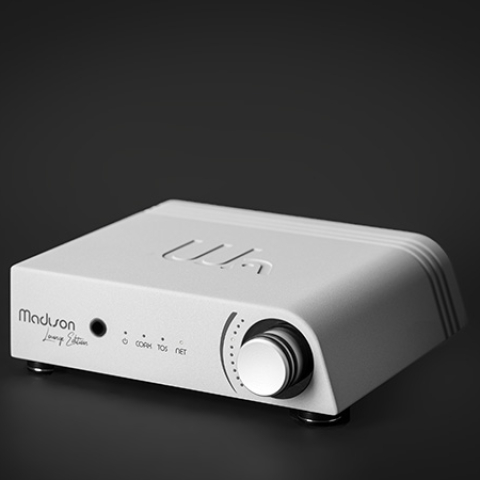
There is no point in nitpicking through any more detailed comparisons with my cohort of in-house DACs. The Ideon DAC is too different from all of them. Its sound character most closely resembles Wattson Audio's Madison DAC-server, which I reviewed recently. The eos has that same jet-engine, DAC-of-the-future presence and drive, to which it adds a lot of corporeal, tone-correct realism that I found extremely compelling.
My religion forbids me from using the word "truth," which I consider eternally weaponized and culture-dependent. But I swear on my grandma's bible, every time Ideon's eos played a recording, my brain muttered "Yep, that's how that's supposed to sound."
Under oath, I'd confess, I hate the display, but man-o-man, this thing can play!
My recommendation: Don't buy any DAC, at any price, until you've heard the eos. It's a tone setter.
Footnote 1: Customers have the option to replace this RCA connector with a BNC connector by indicating their preference at the time of purchase.
Footnote 2: World Wrestling Federation, not World Wildlife Fund.
DescriptionThe Ideon eos is a two-channel D/A converter. It is made in Greece. It's part of Ideon's three-piece eos stack, which also includes the eos Stream streamer and the eos Time, which Ideon describes as "a USB conditioning device." The eos stack is the first step down from the flagship "Absolute stack." It weighs 22lb. It is low-slung and modern-looking, 18" wide × 3" high. On the Ideon eos's back panel, I found one USB-B and two S/PDIF inputs (BNC and RCA), two sets of stereo analog outputs (balanced XLR and single-ended RCA), and a toggle switch for setting the display's brightness to High or Low—but not off. Ideon is cautious about revealing its secret sauce. The website announces, "What's inside the eos will remain undescribed." All that's revealed is a broad statement—"As with all Ideon offerings, the eos DAC is a fully proprietary design, with audio technologies developed in-house"—and a few bullet-point teasers:
"Cutting edge analog stage, with symmetrical ultra-low noise power supply." "Low-noise power through, more than 10 separate power regulators in each circuit." "Direct coupled output with no capacitors." "Fully balanced design throughout."That's not much to go on, but it suggests direct, clean, and well-regulated, which is just what I heard. Listening
Whenever I compare one DAC to another, the first thing I notice is the fundamental tone quality of each. How much do wood, metal, and flesh sound like themselves? After that, I notice how brightly or darkly their soundstages are lit: Under what form of illumination is this cabaret of wood, metal, and flesh being presented? This leads my mind into the darkness at the back of the soundspace, wherein I study how it feels, hoping to find power there, seeing if the darkness feels dead, as in switched-off, or alive and sparkling. Dark spaces and quiet moments in low-priced DACs sound empty and generic. Expensive, multichassis DACs with heavy metal power supplies identify themselves by putting vibrancy in the shadow spaces and latent force in the quiet moments. These subliminal energies make those quiet moments feel more continuous with the louder parts, which makes the musical content more accessible and interesting.
That's audio véritéI'm explaining my listening proclivities because after only a few tracks on the remastered Qobuz version of the glorious 1962 LP A Sound Spectacular, Music of Edgar Varèse Vol. 2: Arcana – Déserts – Offrandes (16/44.1 FLAC, Sony Classical/Qobuz), it was obvious, though surprising: Ideon's eos DAC was making streaming Qobuz from my Depression-era Mac mini sound fast, forceful, and grunge-free. It played files with punch and raw presence I never thought I'd get from Qobuz.
If everything went well, the ethnographer would capture a good performance, bring it home safely, and share it with cultural tourists like me. That's a huge undertaking. What's unique about field recordings is that the artist's sentiments feel mostly unspoiled. There are no celebrity egos. No "America's Most Talented" or TikTok clicks. Just small-town artists hoping to share their talents with strangers. Hobart Smith fiddling and tapping his foot on a wood floor playing "Katy Went Fishing with Her Hook and Line" is on the first Lomax disc (Vol. 1) and is one of the most vivid captures in the stunningly recorded 13-volume Alan Lomax collection Southern Journey: Voices from the American South (Rounder CD 1701-1713). With the Ideon, I listened in bare feet, tapping my wood floor in sync with Hobart. I repeated this song and my foot-tapping at least five more times without pausing. What the eos DAC was doing better than any DAC I've used is compel me to play songs over and over.
I know this recording from a thousand plays, and the eos played it more clearly, with better tone and greater vibratory presence, than any I can remember. This track's room sounds included Hobart tuning his violin, Hobart explaining the song he's about to play, and Hobart bumping into things. The wood floor Smith toe-tapped had a dark, oiled-wood tone. My polyurethane-coated oak floor sounded lighter and brighter.
Through the eos, all these Lomax tracks displayed a rawer, clearer, more-vibrant-than-ever presence that triggered "I am there" feelings that made each song feel newly fresh and automatically replayable.
Reproducing these Beethoven sonatas, etc., the eos's brilliance and immediacy were blanketed (in a positive way) in atmospheric nanodetail and rhythmic nuance. The eos's boldness and presence were out of the limelight but still operating, supporting a finely woven cloth of delicate harmonic energy.
My next curiosity was to see how Sparkler Audio's S515t "ballade II" CD transport, which I described in Gramophone Dreams #94, would sound feeding signal to the eos.
This transport swap turned out to be an important moment in my Ideon auditions. The only thing I changed in my system was the machine that spins the silver discs and reads the pits and lands, yet when I did that, the quality of the Ideon's sound changed. Quite noticeably, the eos's presence, immediacy, and raw transparency were now subordinated to an atmosphere of copious nuance and wide-spectrum tonal shading. With the Sparkler, Southern Journey Vol. 1 came through smooth and extra-rich without a hint of hi-fi spectacularism.
In my first sitting with the eos driving the Audeze electrostatics, I played that Channel Classics Beethoven and Alan Lomax's Southern Journey Vol. 1 all the way through, enjoying every second but pausing frequently to admire the beauty and stark vérité of what was unfolding in my head. What I heard sounded extremely real, like a good 78rpm record without the groove noise.
Weather permitting, I try every day to walk to Herbert Von King Park and read a book while waving at doggies on parade. I sit by the bleachers near the baseball field where a cohort of djembe drummers meet up daily and jam. Besides needing the exercise, I go to the park to tune up my mental health, and djembe drumming feels like the antidote for existential melancholy.
There is no point in nitpicking through any more detailed comparisons with my cohort of in-house DACs. The Ideon DAC is too different from all of them. Its sound character most closely resembles Wattson Audio's Madison DAC-server, which I reviewed recently. The eos has that same jet-engine, DAC-of-the-future presence and drive, to which it adds a lot of corporeal, tone-correct realism that I found extremely compelling.
Footnote 1: Customers have the option to replace this RCA connector with a BNC connector by indicating their preference at the time of purchase.