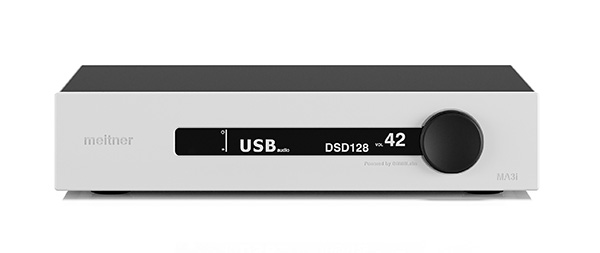
"Is the Meitner MA3i integrated DAC ($11,500, footnote 1) sufficiently different from its predecessor to warrant a full review?" That's the question Editor Jim Austin posed as he contemplated the alternative: a shorter follow-up to my 2022 review of the now discontinued MA3 ($10,500) that would omit an extensive interview and measurements.
After electrical engineer–in-training Amadeus "Deus" Meitner, son of digital pioneer and EMM Labs/Meitner Audio founder Ed Meitner, informed us that "almost everything in the MA3i is new," we opted for a full review. After spending many weeks with both old and new units, I agree with the pronouncement of Deus from his lofty perch on high (footnote 2).
Setting the stage
At the start of our extended Zoom interview, Deus tolerated a brief digression into bitch-face rant mode. "I'm so sick of the AI-generated content my 'Friends' repost on social media," I complained. "They seem compelled to share long dissertations from fictional websites because they find the content compelling. Each post begins with a seductive opening sentence designed to hook you with its drama. It's clickbait, crafted to feed you information that AI algorithms have determined will hook you into spending more time on the platform, scrolling through advertisements," etc.
I hadn't been ranting long when I noticed Deus fiddling with his computer. When I asked if I was boring him, he responded, "I just asked ChatGPT to compose a paean to the MA3i in the form of a soap opera. Want to hear what it came up with?"
Of course I did.
 Exploring the stage
It was a dark and dreary night. Of course it was. It was a dark and dreary day as well: I live in the Pacific Northwest. Eventually you either learn to appreciate infinite iterations of gray, turn to therapy and antidepressants, or go stark raving mad. What helped keep me sane during the Pacific Northwest winter's constant gray was the Meitner MA3i, which makes music that's not at all gray. I listened to it in different ways, sometimes utilizing its built-in streamer, sometimes streaming from the five-times-as-expensive Innuos Nazaré with its PhoenixNET reclocking Ethernet switch.
Visually, the main way to distinguish the MA3i from the discontinued MA3 is by the embossed logo in its lower right corner. Distinguishing it sonically is easier.
Manufactured in Canada by Meitner Audio, the lower-priced line of EMM Labs, the MA3i is a trickle-down version of EMM Labs' flagship DA2i/DV2iM. Equipped with all the customary outputs and all digital and analog inputs except I2S, it converts PCM up to 24/192, MQA, and DSD up to DSD128. Like many other DACs, it only supports DSD128, DXD, and MQA through its USB and Ethernet (RJ45) inputs.
The MA3i contains EMM Labs' proprietary discrete dual differential next-generation 16×DSD MDAC2 DACs, paired with their updated MDAT2 DSP and the latest generation VControl volume system trickled from the EMM Labs DV2i. VControl is claimed to ensure "no loss of resolution or transparency" as volume settings change. Can you tell that Meitner loves acronyms?
The unit also incorporates the company's updated frequency-acquisition protocol (MFAST) and new asynchronous clock (MCLK3). The Meitner website and literature claim that these new systems "reduce jitter to industry-defying levels." Updated input and power isolation systems "utilize advanced filtering and galvanic isolation" for noise reduction and input isolation. The network streaming system is also claimed to be more powerful and versatile than before.
Deus Meitner elaborated by Zoom. For even more, please consult my review of the original MA3.
"The purpose of the Meitner line is to take the advancements that we introduce first in the EMM Labs line, which is where we put all of our cards on the table and try to develop a product that encompasses the best that we can possibly do, and distill them down into a package that reduces our costs significantly enough," Deus said.
"By making some compromises that don't too greatly affect signal path process or what you hear, we can offer it as a 'welcome to the family' product at an entry-level price. We've discovered that a significant number of people who enter the room want to move their way up the line if they can. Think of it as a gateway drug into the Meitner family."
Deus explained that Ed Meitner, Mariusz Pawlicki, and other members of the engineering and design team had discovered how to upgrade their measurement capacity. "Ed actually designed his own measurement suite for a couple of things in the analog domain that previously were unknown to him," Deus said. "This research and development was essential to the sonic characteristics that we believe make the MA3i so great." As with all Meitner/EMM Labs digital products, the MA3i is a single-bit DAC whose clock upsamples and reclocks incoming data at 16×DSD (DSD1024) before sending it to the unit's single-bit converters. The converters also perform MDAT2, a proprietary DSP implementation of adaptive transient detection.
The differences between the MA3 and MA3i, in Deus's opinion, are a matter of bandwidth. "Our new analog stage has significantly improved bandwidth," he said. "A new folded-cascode analog output stage (footnote 3) provides the requisite speed and wide, very large, and very open bandwidth that, in our opinion, you need for really great music reproduction. In addition, the MA3i's streaming protocol now supports Qobuz Connect, Tidal Connect, and higher resolutions over RJ45."
The MA3i and flagship DA2i/DV2i implement the same streaming protocol. In the flagship, a proprietary switch-mode power supply provides isolated lines that separately serve its streamer, digital end, DAC, and analog output stage, keeping each sensitive stage on its own island. The MA3i uses a simplified implementation in which islands are to some extent shared.
Compared to the discontinued MA3, the MA3i's USB and RJ45 input isolation has been improved with an optocoupler that enhances galvanic isolation and prevents the passage of noise, ground currents, voltage spikes, and DC offset. The optocoupler is intended to ensure a clean, noise-free path from input to DAC.
"The MA3i shares the same goals as all Meitner and EMM Labs products," Deus said in summation. "They are transparency, neutrality, and musicality. If we get those three things right, we get great bandwidth, true bass response, a natural listening experience, and simplicity of use. Because the Meitner DAC is simple to use, the MA3 became the most successful product in our company's history. In the year since it was released, the MA3i has been following the same course."
 Setup and other considerations
Exactly four years ago, when my MA3 review appeared in the June 2022 issue of Stereophile, my reference system consisted of a dCS Rossini DAC and clock, EMM Labs DV2 Integrated DAC, Roon Nucleus+ music server, HDPlex linear power supplies, D'Agostino Momentum HD preamp and Progression M550 monoblocks, Wilson Audio Alexia 2 loudspeakers, AudioQuest and Stromtank power products, and room treatment from A/V RoomService, Resolution Acoustics, and Stillpoints. Since then, virtually everything has changed. I have the dCS Varèse five-piece music system, far more revealing than the Rossini; the Innuos Nazaré music server and PhoenixNET switch; Nordost and Sonore linear power supplies; D'Agostino Momentum M400 MxV and Audio Research 330M monoblocks; and Wilson Alexia V loudspeakers with Wilson LōKē subwoofers. The Stromtank power regenerator has been upgraded to the S-4000 MK II XT, and Edward DeVito of Audio-Ultra has completely redone my dedicated lines, breaker box, and filtering. Even my distance from the Alexia Vs and their driver-alignment settings (footnote 4) have changed. The acoustic these components interact with has also improved. Thanks to significant added diffusion and bass treatment from Artnovion and even more diffusion from Nihon Onkyo Engineering, the sound is now far more focused, well-defined, and nuanced. Everyone who has heard my room before and after acknowledges how much better it is now.
 Because there have been so many changes, I couldn't rely on memory to compare the MA3i to the earlier MA3. So I compared them directly, placing the two units on separate shelves of my Grand Prix rack. Because they're so light, installation was a snap. I used the same Nordost cabling and Wilson Audio Pedestals equipment supports for both.
During the review, I played music with apps from Innuos, Qobuz, Roon, and MConnect. (The MA3i online manual (footnote 5) includes eight pages on MConnect setup and use and another page on Roon setup.) The lightweight remote enabled me to control volume and switch between inputs; its buttons were rather stiff and sometimes slow to respond, but it did the trick. While the MA3i's narrow display only shows track and artist information in black and white—no album covers—I found its simplicity less distracting than vivid displays with moving letters. Some may desire more goodies, but others will appreciate the MA3i display's simplicity.
Because there have been so many changes, I couldn't rely on memory to compare the MA3i to the earlier MA3. So I compared them directly, placing the two units on separate shelves of my Grand Prix rack. Because they're so light, installation was a snap. I used the same Nordost cabling and Wilson Audio Pedestals equipment supports for both.
During the review, I played music with apps from Innuos, Qobuz, Roon, and MConnect. (The MA3i online manual (footnote 5) includes eight pages on MConnect setup and use and another page on Roon setup.) The lightweight remote enabled me to control volume and switch between inputs; its buttons were rather stiff and sometimes slow to respond, but it did the trick. While the MA3i's narrow display only shows track and artist information in black and white—no album covers—I found its simplicity less distracting than vivid displays with moving letters. Some may desire more goodies, but others will appreciate the MA3i display's simplicity.
 Oh boy, is it better
Throughout this review, Audio Research 330M monoblocks provided amplification and served up music from the Innuos Nazaré/PhoenixNET combo. I started light, with Yusef Lateef's fanciful "Plum Blossom" and magical "Blues for the Orient." Both are from his wonderful, well-remastered album Eastern Sounds (24/192 FLAC, Craft Recordings/Qobuz).
Through the MA3i, colors were warm, and tones were full and rounded. I've heard even more transparent presentations with more color variation and wider soundstages. Yet everything I played sounded musical and alive. Piano, tambourine, and drum timbres were very convincing, and the drum's resonant core sounded right. Images were fleshy and rounded.
Switching to the MA3, I was shocked to discover how plain everything sounded in comparison. Images were flatter and less involving; colors were less vivid and full. Transparency took a dip. When I returned to the MA3i, I heard it again: Music sounded fuller, richer, more like music. Images were convincingly round and 3D.
 With the MA3 comparison out of the way, the fun began. On soprano Véronique Gens's consistently captivating, prime-voice rendition of Guillaume Lekeu's gorgeous, rarely recorded "Nocturne," accompanied by I Giardini on the album Nuits (24/96 FLAC, Alpha/Qobuz), I was surprised by the strength of the cello's low notes and the smoothness of the strings. Then on to an unfamiliar recording: Edward Gardner and the Bergen Philharmonic Orchestra's new take on Brahms Symphonies Nos.2 and 4 (24/96 WAV, Chandos/download). As I began listening to the first movement of Symphony No.2, I immediately found myself floating blissfully on a sea of Brahmsian warmth. Given today's world, I'll take as much Brahmsian nostalgia, longing, and comfort as a recording and system can supply. Weeks after listening, I remain deeply impressed with how much goodness and grace Gardner coaxed from his musicians and how deeply they took the feelings conveyed by Brahms's music to heart.
I can't remember who was visiting at the time, but my next listening session began, rather uncharacteristically, with Grayson Capps's spare "Wake Up Little Maggie" (24/96 FLAC, Royal Potato Family/Tidal) from the album Heartbreak, Misery, and Death. After noting his warm, full, world-weary voice, I was led to the Tone of Voice Orchestra's "Heartless" (24/88.2 FLAC, Stunt Records/Qobuz).
With the MA3 comparison out of the way, the fun began. On soprano Véronique Gens's consistently captivating, prime-voice rendition of Guillaume Lekeu's gorgeous, rarely recorded "Nocturne," accompanied by I Giardini on the album Nuits (24/96 FLAC, Alpha/Qobuz), I was surprised by the strength of the cello's low notes and the smoothness of the strings. Then on to an unfamiliar recording: Edward Gardner and the Bergen Philharmonic Orchestra's new take on Brahms Symphonies Nos.2 and 4 (24/96 WAV, Chandos/download). As I began listening to the first movement of Symphony No.2, I immediately found myself floating blissfully on a sea of Brahmsian warmth. Given today's world, I'll take as much Brahmsian nostalgia, longing, and comfort as a recording and system can supply. Weeks after listening, I remain deeply impressed with how much goodness and grace Gardner coaxed from his musicians and how deeply they took the feelings conveyed by Brahms's music to heart.
I can't remember who was visiting at the time, but my next listening session began, rather uncharacteristically, with Grayson Capps's spare "Wake Up Little Maggie" (24/96 FLAC, Royal Potato Family/Tidal) from the album Heartbreak, Misery, and Death. After noting his warm, full, world-weary voice, I was led to the Tone of Voice Orchestra's "Heartless" (24/88.2 FLAC, Stunt Records/Qobuz).
 My response to all that heartbreak was to eradicate it with "Mars, the Bringer of War," the first movement on the London Symphony Orchestra and Tenebrae's new, less-than-supremely-colorful recording of Holst's The Planets, conducted by Sir Antonio Pappano (24/96 WAV download, LSO Records). Because this new release was stored on one of the Innuos server's SSDs, I could compare its sound with the Qobuz version streamed, first, through the Nazaré and then directly through the MA3i using Qobuz Connect. Is it any surprise to learn that the stored version was better than the streamed version? The MA3i's stream did not sound as full, colorful, airy, and warm as when the far-more-expensive Nazaré did the streaming.
Time for some bass tests. In my review of the MA3, I found its bass a poor second to the DV2's and its successor's, the DA2i/DV2i. At the start of Rafael Payare and Orchestre symphonique de Montreal's recording of Mahler Symphony No.5 (24/96 WAV, Pentatone/download), dynamics were muted, but the bass was quite good. Ditto for tracks from Aretha Franklin, Nils Lofgren, Yello, and The Rolling Stones streamed from Stereophile contributor Tom Fine's Bass Test playlist on Qobuz (footnote 6). Basswise, the MA3i has nothing to apologize for.
Quite the opposite in fact. I was taken with the profound low bass on "Royals," from Lorde's Pure Heroine (24/192 FLAC, Universal/Qobuz, footnote 7), which was well-balanced with the octaves above it. I didn't hear the infinite variations of color delivered by costlier DACs. Nor, on Rickie Lee Jones's version of "Sympathy for the Devil" (16/44.1 FLAC, Concord Records/Qobuz), did I hear as much of the texture of the guitar's wood as I do through the DV2i and even more expensive streaming DACs. But what I did hear was complete, musically satisfying, solid, and well-balanced from bottom to top. Instead of thinking about what was missing, I found myself drawn in deeper by what I was feeling.
My response to all that heartbreak was to eradicate it with "Mars, the Bringer of War," the first movement on the London Symphony Orchestra and Tenebrae's new, less-than-supremely-colorful recording of Holst's The Planets, conducted by Sir Antonio Pappano (24/96 WAV download, LSO Records). Because this new release was stored on one of the Innuos server's SSDs, I could compare its sound with the Qobuz version streamed, first, through the Nazaré and then directly through the MA3i using Qobuz Connect. Is it any surprise to learn that the stored version was better than the streamed version? The MA3i's stream did not sound as full, colorful, airy, and warm as when the far-more-expensive Nazaré did the streaming.
Time for some bass tests. In my review of the MA3, I found its bass a poor second to the DV2's and its successor's, the DA2i/DV2i. At the start of Rafael Payare and Orchestre symphonique de Montreal's recording of Mahler Symphony No.5 (24/96 WAV, Pentatone/download), dynamics were muted, but the bass was quite good. Ditto for tracks from Aretha Franklin, Nils Lofgren, Yello, and The Rolling Stones streamed from Stereophile contributor Tom Fine's Bass Test playlist on Qobuz (footnote 6). Basswise, the MA3i has nothing to apologize for.
Quite the opposite in fact. I was taken with the profound low bass on "Royals," from Lorde's Pure Heroine (24/192 FLAC, Universal/Qobuz, footnote 7), which was well-balanced with the octaves above it. I didn't hear the infinite variations of color delivered by costlier DACs. Nor, on Rickie Lee Jones's version of "Sympathy for the Devil" (16/44.1 FLAC, Concord Records/Qobuz), did I hear as much of the texture of the guitar's wood as I do through the DV2i and even more expensive streaming DACs. But what I did hear was complete, musically satisfying, solid, and well-balanced from bottom to top. Instead of thinking about what was missing, I found myself drawn in deeper by what I was feeling.
 One of the tracks I used to evaluate the various ways to play and stream music through the Meitner MA3i was the delightful first movement of Mozart's Piano Concerto No.23, performed on period instruments by Kristian Bezuidenhout and Freiburger Barockorchester (24/96 FLAC, Harmonia Mundi/download and Qobuz). Surprisingly, I couldn't decide which sounded better: streaming from Qobuz Connect or playing the file, stored on USB stick, using MConnect. As much as both beat out streaming with Roon, no streaming method could top Roon for ease of use, searchability, metadata, and more.
I listened to far more music than I have listed here. I especially treasure my time with friend Gary Forbes, who picked tracks he'd recently played on his weekly radio show on KPTZ, Radio Port Townsend. There have been times in years past when Gary's choices sounded too bright and edgy on my system. Now, thanks to room and system changes—with the Meitner MA3i performing conversion—tracks from Madison Cunningham, Rachael & Vilray, bassist Vulfpeck, and Big Thief, streamed directly through the MA3i using Qobuz Connect, were a delight to listen to.
One of the tracks I used to evaluate the various ways to play and stream music through the Meitner MA3i was the delightful first movement of Mozart's Piano Concerto No.23, performed on period instruments by Kristian Bezuidenhout and Freiburger Barockorchester (24/96 FLAC, Harmonia Mundi/download and Qobuz). Surprisingly, I couldn't decide which sounded better: streaming from Qobuz Connect or playing the file, stored on USB stick, using MConnect. As much as both beat out streaming with Roon, no streaming method could top Roon for ease of use, searchability, metadata, and more.
I listened to far more music than I have listed here. I especially treasure my time with friend Gary Forbes, who picked tracks he'd recently played on his weekly radio show on KPTZ, Radio Port Townsend. There have been times in years past when Gary's choices sounded too bright and edgy on my system. Now, thanks to room and system changes—with the Meitner MA3i performing conversion—tracks from Madison Cunningham, Rachael & Vilray, bassist Vulfpeck, and Big Thief, streamed directly through the MA3i using Qobuz Connect, were a delight to listen to.
 Putting it all together
Meitner's MA3i Integrated DAC brought everything together for me. It presented music with soaring and pleasing treble, a natural midrange, and solid bass. Far more than the sum of its parts, its sound was so complete and honest that I had no reservations using it to review recordings and share favorites with friends. Far too frequently, we audiophiles vacillate between "the glass is half-full" and "the glass is half-empty." Sitting in darkened listening rooms, we forget all about The 5th Dimension's call to "Let the Sunshine In." Once I turned off my audiophile mind, my time with the MA3i was filled with light. I remain grateful for how musical it sounded and for the considerable pleasure I derived from my time with it. In its price range, I doubt you'll find an equally up-to-date, well-built, reliable integrated streaming DAC manufactured in North America that sounds as good. It deserves a place in many an audiophile's system
Footnote 1: The "i" in MA3i stands for "improved." Footnote 2: Amadeus is nicknamed "Deus," after all, and he resides above me—in Canada. Footnote 3: In my March 2025 review of the EMM Labs DA2i, Deus described a folded cascode as "a really fast analog circuit that normally is used in high-frequency applications, including computer-controlled automobile engines. It yields greater bandwidth, can go up to the megahertz spectrum, and handles high-frequency clock signals without trouble." Footnote 4: My sincere thanks to John Giolas and Gary Bruestle for their assistance. Footnote 5: See tinyurl.com/ykh666yb. Footnote 6: See open.qobuz.com/playlist/21395182. Footnote 7: Thanks to Paul Rickert, Scott Campbell, and Gary Forbes for this one and so many others.
At the start of our extended Zoom interview, Deus tolerated a brief digression into bitch-face rant mode. "I'm so sick of the AI-generated content my 'Friends' repost on social media," I complained. "They seem compelled to share long dissertations from fictional websites because they find the content compelling. Each post begins with a seductive opening sentence designed to hook you with its drama. It's clickbait, crafted to feed you information that AI algorithms have determined will hook you into spending more time on the platform, scrolling through advertisements," etc.
Love, Loss, and Low Jitter Everyone thought it was just another component. Until it changed everything. The room was silent—too silent. A record waited on the platter, untouched, like a secret no one was ready to confess. The Meitner MA3i sat there calmly, unapologetically elegant, as if it already knew what was about to happen. They underestimated it. They always do. The MA3i didn't arrive with grand promises or flashy gestures. It didn't need to. It carried decades of obsession, sleepless nights, and hard decisions hidden beneath its surface. Timing refined to the point of obsession. Power disciplined like a vow never to falter. Every signal treated with respect—no shortcuts, no indulgence. When the music finally began, everything unraveled. Old arguments dissolved. Long-held assumptions collapsed. Listeners who once swore allegiance to complexity felt something unfamiliar tighten in their chests. This wasn't "digital sound." This was breath. Tension. Release. Regret. Desire.Aren't you glad you will never again read such dreck in Stereophile?People leaned forward. Then sat back. Then forgot why they ever stood up in the first place. The MA3i didn't try to seduce. It didn't raise its voice. It simply told the truth—and the truth was devastatingly beautiful. And in that moment, everyone understood: The drama was never in the system. It was always in the music. The MA3i just had the courage to let it speak.
Exploring the stageIt was a dark and dreary night. Of course it was. It was a dark and dreary day as well: I live in the Pacific Northwest. Eventually you either learn to appreciate infinite iterations of gray, turn to therapy and antidepressants, or go stark raving mad. What helped keep me sane during the Pacific Northwest winter's constant gray was the Meitner MA3i, which makes music that's not at all gray. I listened to it in different ways, sometimes utilizing its built-in streamer, sometimes streaming from the five-times-as-expensive Innuos Nazaré with its PhoenixNET reclocking Ethernet switch.
Setup and other considerationsExactly four years ago, when my MA3 review appeared in the June 2022 issue of Stereophile, my reference system consisted of a dCS Rossini DAC and clock, EMM Labs DV2 Integrated DAC, Roon Nucleus+ music server, HDPlex linear power supplies, D'Agostino Momentum HD preamp and Progression M550 monoblocks, Wilson Audio Alexia 2 loudspeakers, AudioQuest and Stromtank power products, and room treatment from A/V RoomService, Resolution Acoustics, and Stillpoints. Since then, virtually everything has changed. I have the dCS Varèse five-piece music system, far more revealing than the Rossini; the Innuos Nazaré music server and PhoenixNET switch; Nordost and Sonore linear power supplies; D'Agostino Momentum M400 MxV and Audio Research 330M monoblocks; and Wilson Alexia V loudspeakers with Wilson LōKē subwoofers. The Stromtank power regenerator has been upgraded to the S-4000 MK II XT, and Edward DeVito of Audio-Ultra has completely redone my dedicated lines, breaker box, and filtering. Even my distance from the Alexia Vs and their driver-alignment settings (footnote 4) have changed. The acoustic these components interact with has also improved. Thanks to significant added diffusion and bass treatment from Artnovion and even more diffusion from Nihon Onkyo Engineering, the sound is now far more focused, well-defined, and nuanced. Everyone who has heard my room before and after acknowledges how much better it is now.
Because there have been so many changes, I couldn't rely on memory to compare the MA3i to the earlier MA3. So I compared them directly, placing the two units on separate shelves of my Grand Prix rack. Because they're so light, installation was a snap. I used the same Nordost cabling and Wilson Audio Pedestals equipment supports for both.
During the review, I played music with apps from Innuos, Qobuz, Roon, and MConnect. (The MA3i online manual (footnote 5) includes eight pages on MConnect setup and use and another page on Roon setup.) The lightweight remote enabled me to control volume and switch between inputs; its buttons were rather stiff and sometimes slow to respond, but it did the trick. While the MA3i's narrow display only shows track and artist information in black and white—no album covers—I found its simplicity less distracting than vivid displays with moving letters. Some may desire more goodies, but others will appreciate the MA3i display's simplicity.
Oh boy, is it betterThroughout this review, Audio Research 330M monoblocks provided amplification and served up music from the Innuos Nazaré/PhoenixNET combo. I started light, with Yusef Lateef's fanciful "Plum Blossom" and magical "Blues for the Orient." Both are from his wonderful, well-remastered album Eastern Sounds (24/192 FLAC, Craft Recordings/Qobuz).
With the MA3 comparison out of the way, the fun began. On soprano Véronique Gens's consistently captivating, prime-voice rendition of Guillaume Lekeu's gorgeous, rarely recorded "Nocturne," accompanied by I Giardini on the album Nuits (24/96 FLAC, Alpha/Qobuz), I was surprised by the strength of the cello's low notes and the smoothness of the strings. Then on to an unfamiliar recording: Edward Gardner and the Bergen Philharmonic Orchestra's new take on Brahms Symphonies Nos.2 and 4 (24/96 WAV, Chandos/download). As I began listening to the first movement of Symphony No.2, I immediately found myself floating blissfully on a sea of Brahmsian warmth. Given today's world, I'll take as much Brahmsian nostalgia, longing, and comfort as a recording and system can supply. Weeks after listening, I remain deeply impressed with how much goodness and grace Gardner coaxed from his musicians and how deeply they took the feelings conveyed by Brahms's music to heart.
My response to all that heartbreak was to eradicate it with "Mars, the Bringer of War," the first movement on the London Symphony Orchestra and Tenebrae's new, less-than-supremely-colorful recording of Holst's The Planets, conducted by Sir Antonio Pappano (24/96 WAV download, LSO Records). Because this new release was stored on one of the Innuos server's SSDs, I could compare its sound with the Qobuz version streamed, first, through the Nazaré and then directly through the MA3i using Qobuz Connect. Is it any surprise to learn that the stored version was better than the streamed version? The MA3i's stream did not sound as full, colorful, airy, and warm as when the far-more-expensive Nazaré did the streaming.
Time for some bass tests. In my review of the MA3, I found its bass a poor second to the DV2's and its successor's, the DA2i/DV2i. At the start of Rafael Payare and Orchestre symphonique de Montreal's recording of Mahler Symphony No.5 (24/96 WAV, Pentatone/download), dynamics were muted, but the bass was quite good. Ditto for tracks from Aretha Franklin, Nils Lofgren, Yello, and The Rolling Stones streamed from Stereophile contributor Tom Fine's Bass Test playlist on Qobuz (footnote 6). Basswise, the MA3i has nothing to apologize for.
One of the tracks I used to evaluate the various ways to play and stream music through the Meitner MA3i was the delightful first movement of Mozart's Piano Concerto No.23, performed on period instruments by Kristian Bezuidenhout and Freiburger Barockorchester (24/96 FLAC, Harmonia Mundi/download and Qobuz). Surprisingly, I couldn't decide which sounded better: streaming from Qobuz Connect or playing the file, stored on USB stick, using MConnect. As much as both beat out streaming with Roon, no streaming method could top Roon for ease of use, searchability, metadata, and more.
I listened to far more music than I have listed here. I especially treasure my time with friend Gary Forbes, who picked tracks he'd recently played on his weekly radio show on KPTZ, Radio Port Townsend. There have been times in years past when Gary's choices sounded too bright and edgy on my system. Now, thanks to room and system changes—with the Meitner MA3i performing conversion—tracks from Madison Cunningham, Rachael & Vilray, bassist Vulfpeck, and Big Thief, streamed directly through the MA3i using Qobuz Connect, were a delight to listen to.
Putting it all togetherMeitner's MA3i Integrated DAC brought everything together for me. It presented music with soaring and pleasing treble, a natural midrange, and solid bass. Far more than the sum of its parts, its sound was so complete and honest that I had no reservations using it to review recordings and share favorites with friends. Far too frequently, we audiophiles vacillate between "the glass is half-full" and "the glass is half-empty." Sitting in darkened listening rooms, we forget all about The 5th Dimension's call to "Let the Sunshine In." Once I turned off my audiophile mind, my time with the MA3i was filled with light. I remain grateful for how musical it sounded and for the considerable pleasure I derived from my time with it. In its price range, I doubt you'll find an equally up-to-date, well-built, reliable integrated streaming DAC manufactured in North America that sounds as good. It deserves a place in many an audiophile's system
Footnote 1: The "i" in MA3i stands for "improved." Footnote 2: Amadeus is nicknamed "Deus," after all, and he resides above me—in Canada. Footnote 3: In my March 2025 review of the EMM Labs DA2i, Deus described a folded cascode as "a really fast analog circuit that normally is used in high-frequency applications, including computer-controlled automobile engines. It yields greater bandwidth, can go up to the megahertz spectrum, and handles high-frequency clock signals without trouble." Footnote 4: My sincere thanks to John Giolas and Gary Bruestle for their assistance. Footnote 5: See tinyurl.com/ykh666yb. Footnote 6: See open.qobuz.com/playlist/21395182. Footnote 7: Thanks to Paul Rickert, Scott Campbell, and Gary Forbes for this one and so many others.