I was heading back home to New York in my old Mercedes diesel on a Sunday evening, having just attended the annual Capital Audiofest near Washington, DC. Riding shotgun was fellow Stereophile scribbler Ken Micallef, and as we puttered along the straight, featureless lower half of the New Jersey Turnpike, we started to reminisce about our audio show experiences.
My first audio event was the 1973 hi-fi show in Brussels, Belgium, held at the massive Brussels Exhibition Centre, near the famous Atomium landmark. Today, it's hard to imagine a hi-fi show big enough to fill a huge convention center, but back then, audio was big business. My dad had pretty much zero interest in audio equipment, but he recognized my passion and indulged my 11-year-old self by taking me to the show. Standouts I remember to this day include the Nakamichi 1000 cassette deck, which proved that cassette decks were more than just repurposed dictation machines, and a Dual display that had a playing turntable mounted in a rotating jig that flipped the turntable on its side and even upside down without causing it to skip a groove. This taught me the benefits of a dynamically balanced tonearm.
Fast forward about 15 years. After moving back to New York from London, I was just getting my start in the audio business, working at Andy Singer's high-end store in Manhattan. Back then, there was only one American hi-fi show that really mattered, the Consumer Electronics Show (CES). To be a bit more accurate, it was two shows, because back then there were two Consumer Electronics Shows each year, the Summer CES in June in Chicago, and the Winter CES in January in Las Vegas. The main event for what the CES people liked to call "specialty audio" was the summer show in Chicago. High-end audio exhibitors were spread out among classic old hotels like The Americana Congress, The Palmer House, and The Blackstone, all on or close to Michigan Avenue, while the big mainstream companies—Sony, Panasonic—took over the nearby McCormick Place Convention Center.
My first CES was the 1986 Chicago event. That was a truly memorable time for me, with my first sightings of landmark products like the MBL 101 and Infinity IRS V speakers and the first CD player to use vacuum tubes, the California Audio Labs Tempest. The inimitable Harvey Rosenberg was using a Tempest along with his tasty New York Audio Labs tube electronics driving a pair of Quad ESL-63 electrostatic speakers, all to great effect. I even got a secret sneak peek of the mythical vaporware Finial LT-1 laser turntable, which eventually developed into the ELP LT-Master, which is still being made.
Over at the WCES in Las Vegas, the focus was more on home-video software. This meant that one massive exhibition hall was taken over by adult video vendors and their stars, signing autographs. It was a giant four-day party. Back in the '90s, when I was writing for Listener, Art Dudley gave me an assignment to go over and interview porn stars about their hi-fi systems, but that's a story for another day.
One big problem with CES is that, as a trade-only show, it has never been open to the public. Only those who work in the consumer electronics field can participate. At that time, there was a glaring dearth of audio shows for consumers. Stereophile addressed that problem by launching the highly successful Stereophile shows for people who actually buy audio gear. The first show was in Santa Monica in early 1987. A few months later, in October of the same year, the Stereophile Show circuit came to the Omni Park Central on 7th Avenue in in Manhattan, marking my first show as an exhibitor. I was still working at Sound by Singer, and we had five rooms with systems at the show. Andy had me working in the big flagship room. I remember the system we showed. A.J. Conti was there for the public launch of his Basis Debut turntable, which we used along with Leif Haggmark's gorgeous AirTangent air-bearing linear tonearm and a Koetsu Rosewood Signature cartridge. Electronics were the latest Krell KRS Balanced six-chassis preamp and the humongous KRS-200 pure class-A mono power amplifiers driving Apogee Diva ribbon loudspeakers. From the show's start to finish, we had a line of people down the hallway waiting to hear the system as we presented a 15-minute timed demo.
The success of the show was short lived. The day after it ended, the stock market plunged in what became known as Black Monday. Buyers with deep pockets got nervous about opening their wallets, and the post-show sales bounce never materialized.
 Doshi Audio Evolution Phono
Whenever I see a particular brand of gear or an individual component popping up in good-sounding systems put together by people whose opinions I respect, it gets my attention, especially when that person has no connection to the component in question or its maker—no reason to be loyal. They're using the component not because it's what they make or sell but because they like what it does. A few years ago, I started to notice this with Nick Doshi's electronics. At first it was his tape recorder replay preamplifier, which I kept seeing in place of stock electronics on fancy Studer and Technics reel-to-reel tape machines. I started to see (and hear) systems using Doshi electronics at some of my turntable setup clients, at audio shows, that sounded exceptional. Clearly something special was going on.
Nick Doshi was born in India but moved to the United States as a teenager to study recording technology at the Institute of Audio Research in New York City. He followed that with a physics degree before moving into broadcast engineering at radio stations in New York City. During that time, he started to build audio gear, first just for himself, later for friends who heard it and wanted their own. What started as a hobby turned into a business. For Doshi, the big change came in the mid-2000s, when he quit his broadcast engineering job and moved to Virginia. Doshi Audio was launched in 2006.
With 20 years of success behind him, Nick has launched the Evolution series, codifying all he has learned. The Doshi lineup is simple, with a stereo amplifier, a mono amplifier, line and phono preamplifiers, and the tape-head preamplifier that first captured my attention. I'm the Spin Doctor, so it was the phono preamplifier I was most interested in.
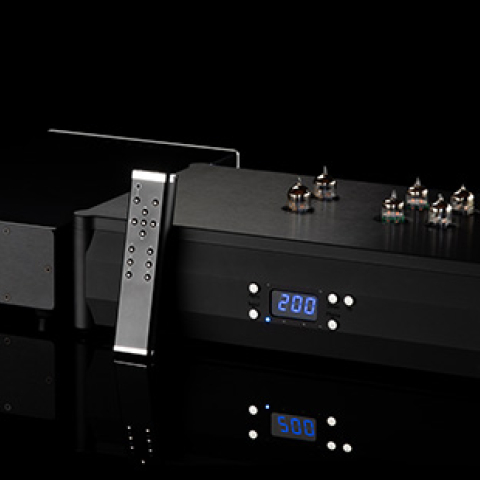
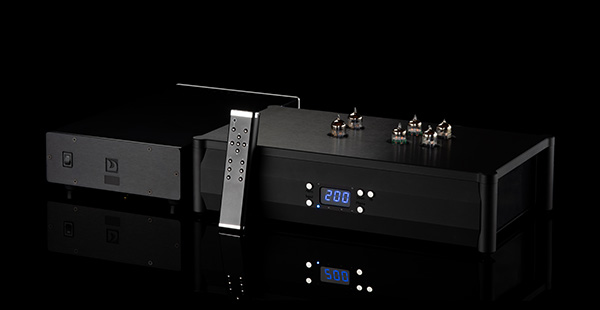
 I have seen the Doshi phono preamplifier ($23,995) many times, with its low-slung chassis that allows only the top half of its six vacuum tubes to peek out from holes in the top surface. When I was setting it up for this review, I noticed that two umbilical cables connect the power supply to the main chassis. Nick says this allows him to use separate, independent power supply circuits for the moving coil headamp and the rest of the circuit, each with completely separate grounding schemes to keep noise in check. That type of obsessive approach reminds me of my John Curl-designed Vendetta Research SCP-2B phono stage, which has entirely separate left and right channel circuits, right down to its two power cables. Speaking of power plugs, Doshi does not supply a power cable with the unit, as he feels this is an individual choice the owner should make with his audio dealer. I pressed a Cardas Audio Clear Cygnus into service.
On the Doshi's rear panel are three phono inputs, each with its own characteristics. Input 1 connects to the JFET head amplifier for a total gain of 72dB but with an option to lower that to 66dB with a simple factory or dealer modification. Both XLR and RCA inputs are provided, though even the RCA uses a floating balanced connection. Resistive loading is adjustable from 10 ohms to 10k ohms with more than 500 steps (!) in between. The loading can be adjusted from the front panel or from the listening position using the supplied remote.
I have seen the Doshi phono preamplifier ($23,995) many times, with its low-slung chassis that allows only the top half of its six vacuum tubes to peek out from holes in the top surface. When I was setting it up for this review, I noticed that two umbilical cables connect the power supply to the main chassis. Nick says this allows him to use separate, independent power supply circuits for the moving coil headamp and the rest of the circuit, each with completely separate grounding schemes to keep noise in check. That type of obsessive approach reminds me of my John Curl-designed Vendetta Research SCP-2B phono stage, which has entirely separate left and right channel circuits, right down to its two power cables. Speaking of power plugs, Doshi does not supply a power cable with the unit, as he feels this is an individual choice the owner should make with his audio dealer. I pressed a Cardas Audio Clear Cygnus into service.
On the Doshi's rear panel are three phono inputs, each with its own characteristics. Input 1 connects to the JFET head amplifier for a total gain of 72dB but with an option to lower that to 66dB with a simple factory or dealer modification. Both XLR and RCA inputs are provided, though even the RCA uses a floating balanced connection. Resistive loading is adjustable from 10 ohms to 10k ohms with more than 500 steps (!) in between. The loading can be adjusted from the front panel or from the listening position using the supplied remote.
 Input 2 also has both RCA and XLR inputs. It is tailored for moving coil use with a separate step-up transformer. It bypasses the headamp, providing a fixed 10k ohm load and 52dB of gain. Input 3 is for moving magnet cartridges, with only an RCA input, 52dB of gain, and a fixed, 47k ohm load.
Doshi's circuit is unique in my experience in using a step-down transformer between the differential JFET moving coil headamp and the first gain section. This lowers the impedance so the signal can drive the tube more effectively. It also galvanically isolates the MC stage from the rest of the circuit.
Nick Doshi says he was careful to avoid using exotic tubes in the circuit because he wanted to ensure that tube availability would never become an issue. There are three pairs of tubes: two 12AX7s in the first gain stage, two 12AU7s in the second stage as a parallel follower to drive the EQ section, and two 12DW7s for the final gain section and output driver. Because the circuit has no feedback, tube matching is important to maintain tight channel balance.
Input 2 also has both RCA and XLR inputs. It is tailored for moving coil use with a separate step-up transformer. It bypasses the headamp, providing a fixed 10k ohm load and 52dB of gain. Input 3 is for moving magnet cartridges, with only an RCA input, 52dB of gain, and a fixed, 47k ohm load.
Doshi's circuit is unique in my experience in using a step-down transformer between the differential JFET moving coil headamp and the first gain section. This lowers the impedance so the signal can drive the tube more effectively. It also galvanically isolates the MC stage from the rest of the circuit.
Nick Doshi says he was careful to avoid using exotic tubes in the circuit because he wanted to ensure that tube availability would never become an issue. There are three pairs of tubes: two 12AX7s in the first gain stage, two 12AU7s in the second stage as a parallel follower to drive the EQ section, and two 12DW7s for the final gain section and output driver. Because the circuit has no feedback, tube matching is important to maintain tight channel balance.
 The review sample was set to the full 72dB of gain, so I used the Ortofon MC 90X for most of my listening. Its 0.25 mV output proved to be a good gain match, and while the 0.56mV Lyra Atlas sounded good with no apparent overloading, the linestage volume setting had to be kept quite low. Thinking about Doshi's origins in India, I also tried the EBI Audio Khumar I reviewed recently, and this too proved to be a good synergistic match with the Doshi. Finally, to check out the direct moving magnet input, I used an Ortofon 2M Black.
Even before I lowered the stylus onto the first record, I noticed how quiet the Doshi is. Nick said it should be quieter than my vintage Vendetta Research SCP-2B, which was legendary for its silence, and while I did not have an opportunity to make a direct comparison, it wouldn't surprise me if it is.
Opening with the title track from Heart and Soul (Contemporary S7606) by tenor sax man Teddy Edwards, I was presented with a massive soundstage, with Milt Turner's big drum sound set back in the room on the right and Gerry Wiggins sitting down at what sounds like a Wurlitzer organ rather than his usual piano on the left. This session is straight ahead and swinging, with Teddy's smooth-as-silk sax front and center. The presentation had a clear-as-glass quality that made little details easy to follow, like the way Wiggins made the organ swell and ebb.
The track "Opening," from Philip Glass's soundtrack for the movie Mishima (Nonesuch 9 79113-1), is a brutal test of dynamics, changing in the space of two minutes from the quietest possible wind chimes to pounding timpani and clanging tubular bells, then back to almost nothing again. The Doshi made the tonal richness of each wind chime and drum crystal clear and rode the dynamic contrasts perfectly. It presented the violins with a sweetness and clarity that sometimes get lost on this digital recording.
To rock out a bit, I put on "Words of Wonder" from Keith Richards's 1992 album Main Offender (Virgin America VUSLP 59). This reggae-inspired track features Keef imself testing the system's low-frequency punch and power with his bass, and Charlie Drayton thwacking the crap out of his drum kit. I normally think of Drayton as a bass player, but he played drums on "Love Shack" by the B-52's, so clearly he's a man of many talents. Using the Doshi with the MC 90X, the sound jumped from the speakers with spectacular weight and drive.
I love the sound of tubes. I have mostly used tube amplifiers in my system for the last 40 years—but I have mainly used solid state phono stages to avoid the gain-vs-noise problems tubes can bring with them. The Doshi phono preamplifier is the perfect antidote, with a very clever hybrid circuit that manages to combine the vivid tonal color and lucidity of tubes, with the silence and dynamics of the quietest transistor-based phono stages.
The review sample was set to the full 72dB of gain, so I used the Ortofon MC 90X for most of my listening. Its 0.25 mV output proved to be a good gain match, and while the 0.56mV Lyra Atlas sounded good with no apparent overloading, the linestage volume setting had to be kept quite low. Thinking about Doshi's origins in India, I also tried the EBI Audio Khumar I reviewed recently, and this too proved to be a good synergistic match with the Doshi. Finally, to check out the direct moving magnet input, I used an Ortofon 2M Black.
Even before I lowered the stylus onto the first record, I noticed how quiet the Doshi is. Nick said it should be quieter than my vintage Vendetta Research SCP-2B, which was legendary for its silence, and while I did not have an opportunity to make a direct comparison, it wouldn't surprise me if it is.
Opening with the title track from Heart and Soul (Contemporary S7606) by tenor sax man Teddy Edwards, I was presented with a massive soundstage, with Milt Turner's big drum sound set back in the room on the right and Gerry Wiggins sitting down at what sounds like a Wurlitzer organ rather than his usual piano on the left. This session is straight ahead and swinging, with Teddy's smooth-as-silk sax front and center. The presentation had a clear-as-glass quality that made little details easy to follow, like the way Wiggins made the organ swell and ebb.
The track "Opening," from Philip Glass's soundtrack for the movie Mishima (Nonesuch 9 79113-1), is a brutal test of dynamics, changing in the space of two minutes from the quietest possible wind chimes to pounding timpani and clanging tubular bells, then back to almost nothing again. The Doshi made the tonal richness of each wind chime and drum crystal clear and rode the dynamic contrasts perfectly. It presented the violins with a sweetness and clarity that sometimes get lost on this digital recording.
To rock out a bit, I put on "Words of Wonder" from Keith Richards's 1992 album Main Offender (Virgin America VUSLP 59). This reggae-inspired track features Keef imself testing the system's low-frequency punch and power with his bass, and Charlie Drayton thwacking the crap out of his drum kit. I normally think of Drayton as a bass player, but he played drums on "Love Shack" by the B-52's, so clearly he's a man of many talents. Using the Doshi with the MC 90X, the sound jumped from the speakers with spectacular weight and drive.
I love the sound of tubes. I have mostly used tube amplifiers in my system for the last 40 years—but I have mainly used solid state phono stages to avoid the gain-vs-noise problems tubes can bring with them. The Doshi phono preamplifier is the perfect antidote, with a very clever hybrid circuit that manages to combine the vivid tonal color and lucidity of tubes, with the silence and dynamics of the quietest transistor-based phono stages.
Footnote 1: Rockville is also the place, famously, that R.E.M. bassist Mike Mills pleaded with his girlfriend, one Ingrid Schorr, not to go back to on Reckoning, so as not to "waste another year."—Jim Austin Footnote 2: Doshi Audio, Manassas, Virginia. Tel: (917) 952-2758. Email: info@doshiaudio.com. Web: doshiaudio.com.
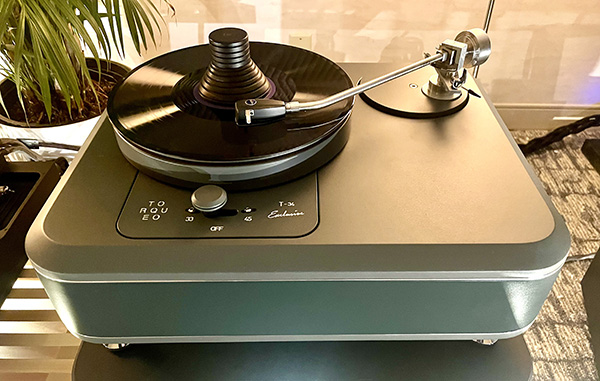
The Torqueo Audio T-34 at CAF 2025.
Those Stereophile shows opened the door for many other direct-to-consumer audio events, and now, nearly 40 years later, we have more good hi-fi shows each year than you could count. I typically attend four shows each year. First, there's AXPONA, the big show outside Chicago in April, which until this year was quickly followed by the Munich High End Show in May. That show has been moved to Vienna, in June, though I still plan to be there. Then we have the New York Show in October, which last year was under new ownership and greatly improved after years of poor management and lousy attendance. My only gripe is that just like the New York Giants and New York Jets of the NFL, the New York show was held across the Hudson River in New Jersey, at the Hasbrouck Heights Hilton. It may be a Hilton, but it is a long way, in distance and prestige, from the 6th Avenue Manhattan Hilton, where Stereophile held its shows in the early 2000s.
Wrapping up my audio show year is the Capital Audiofest, which I mentioned at the start of this missive. CAF has been held for years at yet another Hilton, the Hilton Rockville in Rockville, Maryland (footnote 1), outside Washington DC. Every year, this show gets a little larger, and in 2025 it burst out of the Hilton's walls, expanding across Rockville Pike into the Even Hotel with a couple of exhibits. You could sit sipping a coffee outside the Hilton's Starbucks, watching show attendees playing Frogger with traffic on the busy six-lane road, trying to get to the Even Hotel's exhibits. This year was also a bonus for me, because show organizer Gary Gill asked J.R. Boisclair from WAM Engineering and me to present an hour-long discussion on turntable setup topics, along with a Q&A. My friend Mark Block recorded the discussion, which you can watch on the WAM Engineering/WallyTools YouTube channel.
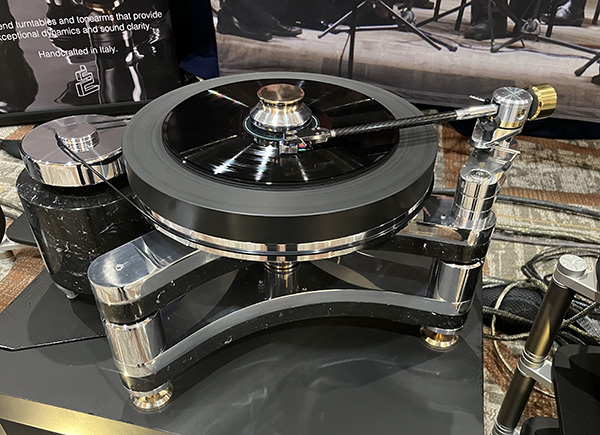
The Thuono Audio TH400 at CAF 2025.
After attending so many shows, I have learned that it's best to go in with few epectations about the sonic presentations—to consider it a bonus when you hear great sound. Think for a minute about how the odds are stacked against an exhibitor.
You enter a hotel room you have probably never seen before and have about 24 hours to transform it into a high-performance listening space. Most audiophiles will spend years tweaking the little details in their system and room, but at a show you have just a few hours. Now consider that you may be putting together a system from components you have never tried together before, with noisy neighbors all around and a hundred systems all sucking on the hotel's electrical system. It's amazing that any system is listenable.
For all these reasons, I tend to think of shows mostly as an opportunity for what Herb Reichert likes to call shaking hands and kissing babies. I want to meet people and see their new stuff up close and in person. No press release can match that.
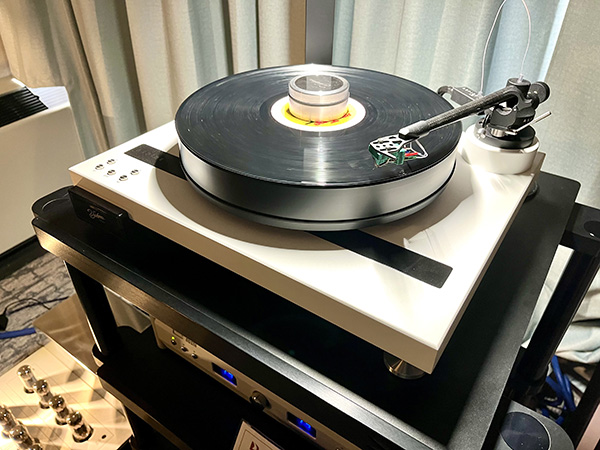
The new J.Sikora Aspire.
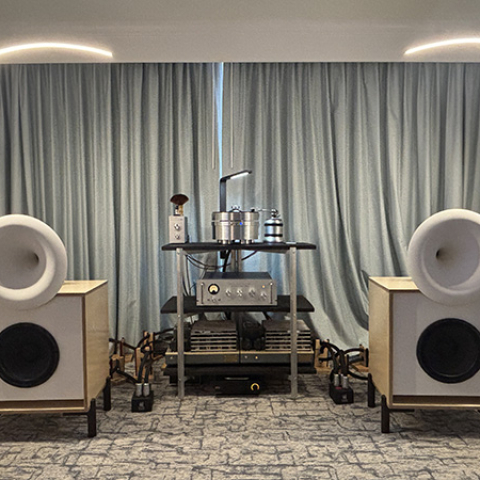
One room that never fails to impress with great analog sound, whether it's at CAF or some other show, is the room featuring J.Sikora turntables, Doshi Audio electronics, and Joseph Audio loudspeakers, connected using cables from Cardas Audio. At this year's CAF it was the smaller room put together by Virginia-based dealer Command Performance AV. Using J.Sikora's much anticipated Aspire turntable, an Aidas cartridge, and Doshi Audio electronics, this system played Jeff Joseph's standmount Pulsar2 Graphene speakers with a level of authority and impact that belied their compact size. Part of that system was the Doshi Audio Evolution Phono Preamplifier—the very same unit I took home for a listen.
Doshi Audio Evolution PhonoWhenever I see a particular brand of gear or an individual component popping up in good-sounding systems put together by people whose opinions I respect, it gets my attention, especially when that person has no connection to the component in question or its maker—no reason to be loyal. They're using the component not because it's what they make or sell but because they like what it does. A few years ago, I started to notice this with Nick Doshi's electronics. At first it was his tape recorder replay preamplifier, which I kept seeing in place of stock electronics on fancy Studer and Technics reel-to-reel tape machines. I started to see (and hear) systems using Doshi electronics at some of my turntable setup clients, at audio shows, that sounded exceptional. Clearly something special was going on.
I have seen the Doshi phono preamplifier ($23,995) many times, with its low-slung chassis that allows only the top half of its six vacuum tubes to peek out from holes in the top surface. When I was setting it up for this review, I noticed that two umbilical cables connect the power supply to the main chassis. Nick says this allows him to use separate, independent power supply circuits for the moving coil headamp and the rest of the circuit, each with completely separate grounding schemes to keep noise in check. That type of obsessive approach reminds me of my John Curl-designed Vendetta Research SCP-2B phono stage, which has entirely separate left and right channel circuits, right down to its two power cables. Speaking of power plugs, Doshi does not supply a power cable with the unit, as he feels this is an individual choice the owner should make with his audio dealer. I pressed a Cardas Audio Clear Cygnus into service.
Input 2 also has both RCA and XLR inputs. It is tailored for moving coil use with a separate step-up transformer. It bypasses the headamp, providing a fixed 10k ohm load and 52dB of gain. Input 3 is for moving magnet cartridges, with only an RCA input, 52dB of gain, and a fixed, 47k ohm load.
Doshi's circuit is unique in my experience in using a step-down transformer between the differential JFET moving coil headamp and the first gain section. This lowers the impedance so the signal can drive the tube more effectively. It also galvanically isolates the MC stage from the rest of the circuit.
The review sample was set to the full 72dB of gain, so I used the Ortofon MC 90X for most of my listening. Its 0.25 mV output proved to be a good gain match, and while the 0.56mV Lyra Atlas sounded good with no apparent overloading, the linestage volume setting had to be kept quite low. Thinking about Doshi's origins in India, I also tried the EBI Audio Khumar I reviewed recently, and this too proved to be a good synergistic match with the Doshi. Finally, to check out the direct moving magnet input, I used an Ortofon 2M Black.
Even before I lowered the stylus onto the first record, I noticed how quiet the Doshi is. Nick said it should be quieter than my vintage Vendetta Research SCP-2B, which was legendary for its silence, and while I did not have an opportunity to make a direct comparison, it wouldn't surprise me if it is.
Footnote 1: Rockville is also the place, famously, that R.E.M. bassist Mike Mills pleaded with his girlfriend, one Ingrid Schorr, not to go back to on Reckoning, so as not to "waste another year."—Jim Austin Footnote 2: Doshi Audio, Manassas, Virginia. Tel: (917) 952-2758. Email: info@doshiaudio.com. Web: doshiaudio.com.