I view preamplifiers the way my dog views vacuum cleaners: warily and a bit mystified by their existence. The less-is-more, straight-wire-with-gain approach has always seemed the correct one to me. The preamps I own (footnote 1) often sit forlornly in my gear closet until I am in temporary need of their services.
To me, a preamp is like a traffic cop. It routes signals and keeps everything moving smoothly. When source components began offering their own volume controls, it felt not just reasonable but principled to plug them directly into the power amplifier. By the mid-2010s, this was commonplace. Streamers, DACs, even CD players were marketed with "digital preamps." The traditional active preamp began to look like a legacy component: a switchboard operator in the age of smartphones.
So I got nervous when Stereophile Editor Jim Austin proposed I review a preamp. I begged off. I suggested a different writer. I pointed out that I had half a dozen other reviews in the works. When that failed, my excuses got fanciful. I may have claimed that a preamp would ruin my room's feng shui, and that any hum from the transformer was sure to interfere with my circadian rhythm.
Jim didn't buy it. Maybe he saw a blind spot I didn't or reasoned that comfort is the enemy of good copy. Or perhaps he figured that a review from a nonbeliever carries extra weight: If a guy who dislikes middlemen likes this middleman, it probably matters.
In any case, PS Audio's latest preamplifier, the PMG Signature, soon showed up on my doorstep. I eyed the shipping box with all the enthusiasm of a vegetarian coming to terms with a bloody steak. Nevertheless, I knew that this thing deserved more than a modicum of respect: It's the company's flagship preamp, part of a product line that also includes an SACD transport, a DAC/streamer, and a phono stage. Each costs $8999 (footnote 2).
PMG is short for Paul McGowan, the company's cofounder and longtime CEO, though McGowan will graciously point out that the preamp's design was mostly the work of engineer Darren Myers, formerly of PS Audio, now at Parasound.
No knobs, no bueno?
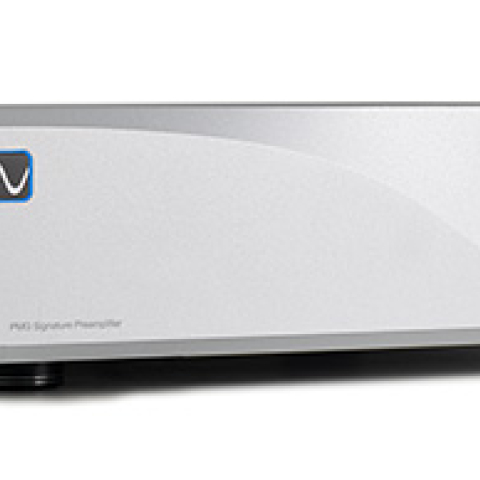
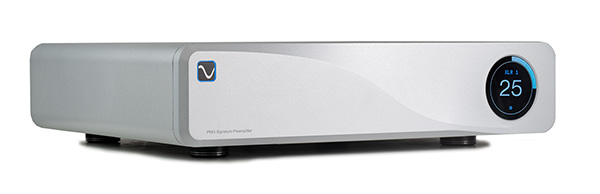
A few months later, PS Audio also shipped me the PMG DAC and SACD player for evaluation, with the mutual understanding that my review would focus on the preamp. Together they make a classy-looking trio. The fascia of each PMG product has a handsome circular touchscreen on the right and a swooping, lengthwise "crease" down the middle. After listening to all three products separately and then with everything connected, I realized they work together in a way that exceeds each product's individual strengths. But as every reviewer must, I spent most of the evaluation period listening with source components I am already familiar with: my Sony S9000ES SACD player and a Grimm MU2 streamer/DAC. I got a small jolt of pleasure every time I flicked the master switch on my AudioQuest Niagara 5000 power conditioner and watched the PMG products spring to life. Each ring-shaped touchscreen blinks awake with a cool animation that forms the eponymous initials. On the DAC and the preamp, a meaty blue circle hugs each display's circumference and shows the relative volume setting. On the CD transport, the circle—much thinner here—indicates the track time that has passed. A swipe of the finger around the edge of the DAC's or preamp's screen increases or decreases the volume. McGowan told me that if you use both components, it's best to turn the DAC almost all the way up—he prefers a setting of 97 out of 100 (footnote 3)—and make further volume adjustments via the preamp. The PMG stack, with its blue-and-white displays, nicely complemented the big azure meters of my McIntosh MC462 power amplifier. Everything lined up well visually. Tactility was a different story. Other than the square power button on the left, rimmed in blue light, all the PMG Signature controls exist only on the 3" glass screen. This looks clean and modern, which I like, but I sometimes missed physical switches and buttons. Having to work through a selection menu reminded me that the product is substantially software driven. It relies on technology whose long-term serviceability is harder to predict than that of plain old analog tech. PS Audio opted for touchscreen-only controls at a time when car manufacturers, from Hyundai to Ferrari, are steering away from displays and bringing back knobs and buttons.
The PMG preamp's touchscreen is thoughtfully designed, but it does have quirks. The balance control, for example, requires you to place your finger in the middle of a small horizontal bar and drag left or right. No problem, except that your fingertip obscures the exact position of the virtual slider. A number appears above the bar—there's a scale of 0 to 50 for each channel, 0 being center—but it isn't always much help because after the briefest moment of inattention, you can lose track of which side of that midpoint you're on. It would be helpful if, instead of "3" or "8," the display said "R3" or "L8." Perhaps PS Audio can address this in a future firmware update.
The remote control helps, of course. It adds genuine flexibility and keeps you from having to tap the screen for every adjustment. But not all touchscreen functions are replicated on the remote. For instance, there's no "open/close the CD tray" command for the transport. If its screen were to fail, the player would be unusable until repaired.
All four current PMG products have the same dimensions, and the company packs each in boxes that are interchangeable. Smart. Only a small stick-on label on the cardboard identifies what's inside. The backlit remotes are agnostic as well. I received three identical ones, one with each component—a model of consistency, if not restraint. Older users may need reading glasses to decipher the text on the remotes' 44 small buttons, at least until familiarity and muscle memory kick in.
Unfortunately, the early-production PMG preamplifier PS Audio sent me barely responded to any of the remote controls. A replacement unit with a stronger RF receiver fixed that, though the newer sample stopped responding at one point during the seven weeks I spent with it. A quick factory reset solved that issue.
The PMG stack, with its blue-and-white displays, nicely complemented the big azure meters of my McIntosh MC462 power amplifier. Everything lined up well visually. Tactility was a different story. Other than the square power button on the left, rimmed in blue light, all the PMG Signature controls exist only on the 3" glass screen. This looks clean and modern, which I like, but I sometimes missed physical switches and buttons. Having to work through a selection menu reminded me that the product is substantially software driven. It relies on technology whose long-term serviceability is harder to predict than that of plain old analog tech. PS Audio opted for touchscreen-only controls at a time when car manufacturers, from Hyundai to Ferrari, are steering away from displays and bringing back knobs and buttons.
The PMG preamp's touchscreen is thoughtfully designed, but it does have quirks. The balance control, for example, requires you to place your finger in the middle of a small horizontal bar and drag left or right. No problem, except that your fingertip obscures the exact position of the virtual slider. A number appears above the bar—there's a scale of 0 to 50 for each channel, 0 being center—but it isn't always much help because after the briefest moment of inattention, you can lose track of which side of that midpoint you're on. It would be helpful if, instead of "3" or "8," the display said "R3" or "L8." Perhaps PS Audio can address this in a future firmware update.
The remote control helps, of course. It adds genuine flexibility and keeps you from having to tap the screen for every adjustment. But not all touchscreen functions are replicated on the remote. For instance, there's no "open/close the CD tray" command for the transport. If its screen were to fail, the player would be unusable until repaired.
All four current PMG products have the same dimensions, and the company packs each in boxes that are interchangeable. Smart. Only a small stick-on label on the cardboard identifies what's inside. The backlit remotes are agnostic as well. I received three identical ones, one with each component—a model of consistency, if not restraint. Older users may need reading glasses to decipher the text on the remotes' 44 small buttons, at least until familiarity and muscle memory kick in.
Unfortunately, the early-production PMG preamplifier PS Audio sent me barely responded to any of the remote controls. A replacement unit with a stronger RF receiver fixed that, though the newer sample stopped responding at one point during the seven weeks I spent with it. A quick factory reset solved that issue.
 Tech and topology
The preamplifier's rear panel is an entirely analog affair. It has two pairs of single-ended RCA inputs and four pairs of balanced XLRs. Biampers and subwoofer fans will find outputs aplenty: there are two pairs of RCAs and two pairs of XLRs. (There's a USB-A port, but it's for firmware updates only.) The internal architecture is a departure from traditional power supply and gain stage design. The power supply eschews electrolytic capacitors in favor of a large array of long-life film capacitors—a design choice intended to provide faster transient power and a lower noisefloor, specified at a vanishingly low –145dB, by avoiding the slower, more inductive characteristics of standard electrolytic storage. The electronics are housed in a 16-gauge double-chassis structure with a 1.5"-thick, CNC-machined aluminum front panel, choices that seek to isolate the delicate analog signals from electromagnetic interference.
The signal path itself is fully balanced, pure class-A. It uses a "folded cascode" topology. Traditional cascodes stack transistors to increase bandwidth; the folded version "bends" the signal path to allow for high voltage swings and a bandwidth extending to 500kHz without the instability that team McGowan says they encounter in some high-gain solid state designs. This stage is direct-coupled and servo-controlled, so there are no capacitors in the signal path. PS Audio says this increases the purity of the signal. Volume is handled by a high-resolution stepped attenuator offering 0.1dB channel accuracy, while the preamplifier employs zero-feedback diamond-buffer output stages for current drive.
Digital volume controls attenuate level by reducing numerical precision, which means as you get farther from full output, low-level information is quietly sacrificed. Passive analog controls avoid that problem but introduce another: rising output impedance as the volume drops, which can interact unfavorably with cable capacitance and amplifier inputs. In both cases, the system's behavior changes with level. The PMG preamp was designed to remove those variables, isolating the source from the load. The source sees a stable, high-impedance input; the power amp sees a low, consistent-output impedance, regardless of listening level or cable length. Nothing about this is glamorous, and little of it shows up neatly on a spec sheet, but it has consequences for bass control, dynamics, and the way a system holds together as music becomes denser or quieter.
 Flat-out wrong
When I confessed to Paul McGowan that I'd long had reservations about preamplifiers, he understood only too well. "Your position was exactly mine: One more piece of equipment in the signal path can't be better," he said. "For years, that's what I preached, too. Then one fateful day, Arnie Nudell and Bascom King (footnote 4) cornered me and said flat-out, 'You're wrong.' 'Okay,' I told them. 'Show me.' And they did. Turns out that beyond a certain level, a preamp is better in the path than no preamp."
At the time, McGowan wasn't pleased. "It really sucked for me because PS Audio's preamplifier wasn't better. When you pitted it against the DAC and its lossless volume control going straight [into the amp], it was a wash. Bascom and Arnie had a wonderful tube preamplifier they used. It was better, and not just by a little. That revelation led to our BHK preamplifier (footnote 5), and the PMG Signature takes that to a whole new level."
What will source-to-amp audiophiles hear when they put a high-quality preamp in the chain? "Simply put, an entirely new sense of space and depth," McGowan told me. "A cleaning of the two-dimensional window that all of a sudden feels far more open and three-dimensional. There's more space around instruments and voices. You hear a real versus a cardboardish presentation of every instrument."
The reason for that improvement is probably something like this: The minimalist source-to-amplifier approach assumes perfect conditions—an ideal impedance match, infinite current delivery, zero cable effects, flawless digital attenuation. Real-world systems may not be so pristine. A DAC's output stage must drive the amplifier's input impedance and the interconnects in between, all while maintaining linearity and low noise at any listening level. Not every output stage is equally happy doing that.
A well-designed active preamplifier can optimize the electrical relationship between components. With its high input impedance, low output impedance, and robust current drive, the PMG preamp appears to act as a kind of stabilizer. It lets the source operate comfortably while feeding the amplifier a signal it can accept with minimal strain. The result, in my system at least, was increased ease. I got cleaner leading edges and slightly firmer image outlines.
Or did I? It's both gratifying and faintly unnerving when a new component arrives for review and sounds really good. Over the years, I've learned to be self-skeptical, and doubly so when someone tells me what I ought to hear. Am I being primed? Am I genuinely hearing superior performance, or could I be responding to subtle conditioning? Might I be receiving those dopamine hits because I'm hearing something that's merely different instead of better?
I aimed to find out by listening to music with all this in mind.
 Does it sing?
Via Roon Radio, I recently came across Knochenmann by the Zuzana Leharová Quartet (24/96 FLAC, Qobuz/Double Moon). Leharová, a Slovakia-born avant-garde violinist and composer who's no stranger to the New York jazz scene, plays with almost no vibrato. On the violin, that's a high-wire act. Intonation has to be dead-on. Through the PS Audio preamp, her sustained notes were unflinching and pure, the pitch center unwavering. The presentation emphasized clarity over gloss, aligning with the group's chamber-jazz aesthetic. The quartet's music is often angular and brusque, with influences from Eastern European folklore and the work of American minimalists. "Intro Pokúšenie," the eerie second track, flirts with chaos and atonality but is exceptionally well-recorded. Via the PMG preamplifier, the piano's lower notes had true-to-life weight. The system brilliantly rendered piano performances across genres, from Glenn Gould's version of Bach's Chromatic Fantasy in D Minor (16/44.1 FLAC, Qobuz/Sony Classical) to Fleetwood Mac's "Songbird" (24/96 FLAC, Qobuz/Rhino-Warner) to Stephanie Nilles's The Off-White Album (16/44.1 FLAC, Qobuz/Attention Spaniel).
I've listened to Martial Solal's "Et si c'était vrai" from Martial Solal Big Band (Dreyfus Jazz, 16/44.1 FLAC, Red Book CD) dozens of times since discovering that pulsing-with-energy album six or seven years ago. Through the PS Audio preamp, it took on extra authority. The trumpets had subtly more body, and the lyricism of the piano and violin seemed fuller, with less constraint. The music came across as more holistic: Individual notes, sounds, and phrases, while still perfectly delineable, meshed a bit better, emphasizing the whole instead of the parts. It's the difference between hearing drums and bass and piano and horns vs listening to a performance where all those elements lock into place as a single musical statement. In the end, the puzzle pieces fit together so well that I stopped noticing the joints. The full-orchestra crescendo that slams to silence 14 seconds into the track is followed by a few seconds of reverb tails blooming and dissolving into the room—long enough to register the studio's dimensions before the music starts up again.
"Chalaba," the title track from a lovely 2011 album by Ramón López, Joachim Kühn, and Majid Bekkas (16/44.1 FLAC, Qobuz/ACT Music), is rooted in the Gnawa trance tradition of Morocco. Every second of the 10-minute piece holds interest, but the first goose bumps arrive at 1:05 when Bekkas's plaintive chanting casts a potent spell. He also excels on the guembri, the three-string bass lute central to Gnawa music; its woody thrum anchors the piece. On paper, next to López's flamenco influences and Kühn's light-footed, harmonically agile piano, all these elements are unlikely bedfellows, but here they complement each other with perfect ease. This is how world fusion is done.
 After my meeting with Magico founder Alon Wolf (see the April 2026 issue), I got my hands on a copy of the CD he named his company after. Mágico (CD, ECM 1151) is a 1979 album by Charlie Haden on double bass, Jan Garbarek on sax, and Egberto Gismonti on guitar and piano. Haden is in fine form, and I love the solo-bass title track, but the highlight of the album, captured live in an Oslo recording studio in front of a small audience, is a composition called Silence. It nods beautifully to gypsy jazz and North African folk music. Gismonti is the star of the show. His dexterity and tonal variation are such that he sometimes seems to play two instruments at the same time. What sounds at first like an oud soon drifts into archtop-acoustic-guitar territory, then morphs into something closer to a tamburitza, a string instrument from the Balkans. Remarkably, these different characters are mostly due to playing technique, not instrument changes. Part of the reason it sounds so unusual is that Gismonti developed his own trademark eight-string guitar, which is likely the instrument we hear on this recording (though I haven't been able to confirm). The track is so energetic and propulsive that I was startled to realize, when it had almost ended, that there are no drums on the recording. The PMG Signature preamp presented it all with top-tier composure.
I've often found the American songbook classic "There's a Lull in My Life" hard to listen to, because in my native Dutch, the title suggests something crudely sexual (footnote 6), and who wants a foul-mouthed Ella Fitzgerald? But I easily ignored the unfortunate homonyms as I listened to Cécile McLorin Salvant's languid, gently aching interpretation of the song (from WomanChild, 24/96 FLAC, Tidal/Mack Avenue). The PS Audio preamp was often like that: straight to the heart, bypassing the conscious brain.
After my meeting with Magico founder Alon Wolf (see the April 2026 issue), I got my hands on a copy of the CD he named his company after. Mágico (CD, ECM 1151) is a 1979 album by Charlie Haden on double bass, Jan Garbarek on sax, and Egberto Gismonti on guitar and piano. Haden is in fine form, and I love the solo-bass title track, but the highlight of the album, captured live in an Oslo recording studio in front of a small audience, is a composition called Silence. It nods beautifully to gypsy jazz and North African folk music. Gismonti is the star of the show. His dexterity and tonal variation are such that he sometimes seems to play two instruments at the same time. What sounds at first like an oud soon drifts into archtop-acoustic-guitar territory, then morphs into something closer to a tamburitza, a string instrument from the Balkans. Remarkably, these different characters are mostly due to playing technique, not instrument changes. Part of the reason it sounds so unusual is that Gismonti developed his own trademark eight-string guitar, which is likely the instrument we hear on this recording (though I haven't been able to confirm). The track is so energetic and propulsive that I was startled to realize, when it had almost ended, that there are no drums on the recording. The PMG Signature preamp presented it all with top-tier composure.
I've often found the American songbook classic "There's a Lull in My Life" hard to listen to, because in my native Dutch, the title suggests something crudely sexual (footnote 6), and who wants a foul-mouthed Ella Fitzgerald? But I easily ignored the unfortunate homonyms as I listened to Cécile McLorin Salvant's languid, gently aching interpretation of the song (from WomanChild, 24/96 FLAC, Tidal/Mack Avenue). The PS Audio preamp was often like that: straight to the heart, bypassing the conscious brain.
 Truth and consequences
You may have experienced the disappointment of your system sounding magical one evening, pedestrian the next. I suspect our mood and state of mind greatly influence how we ultimately perceive sonic performance. With the PS Audio in the chain, the excitement was there on day two, three, and 30—before noontime, after dinner, and into the wee hours. In a field crowded with embellishers and sweet talkers, PS Audio's PMG Signature preamplifier speaks plain truths. I'd have no reservations about installing it as a reference.
Footnote 1: A Benchmark HP4A line stage, a 2024-edition Quad 33, and a vintage Apt Holman. Footnote 2: PS Audio is set to launch two PMG stereo amplifiers this spring, priced at $7999 and $9999, along with two monoblock models at $17,999/pair and $29,999/pair. All are solid state, high-slew-rate class-AB designs.
Footnote 3: "We've always found that running the DAC at 31 bit sounds and measures slightly better than the full 32 bit (which one rarely ever gets)," McGowan emailed.
Footnote 4: Industry luminaries both, Nudell co-founded both Infinity Systems and Genesis Technologies; King was Infinity's chief engineer and went on to design pre- and power amps for Marantz, Conrad-Johnson, PS Audio, Audeze, and others.
Footnote 5: Not coincidentally, those are Bascom H. King's initials.
Footnote 6: If you're curious, "lul" is slang for the male anatomy, and "life" sounds like "lijf," meaning body. The title sounds to the Dutch ear like something that lyricist Mack Gordon surely never intended.
A few months later, PS Audio also shipped me the PMG DAC and SACD player for evaluation, with the mutual understanding that my review would focus on the preamp. Together they make a classy-looking trio. The fascia of each PMG product has a handsome circular touchscreen on the right and a swooping, lengthwise "crease" down the middle. After listening to all three products separately and then with everything connected, I realized they work together in a way that exceeds each product's individual strengths. But as every reviewer must, I spent most of the evaluation period listening with source components I am already familiar with: my Sony S9000ES SACD player and a Grimm MU2 streamer/DAC. I got a small jolt of pleasure every time I flicked the master switch on my AudioQuest Niagara 5000 power conditioner and watched the PMG products spring to life. Each ring-shaped touchscreen blinks awake with a cool animation that forms the eponymous initials. On the DAC and the preamp, a meaty blue circle hugs each display's circumference and shows the relative volume setting. On the CD transport, the circle—much thinner here—indicates the track time that has passed. A swipe of the finger around the edge of the DAC's or preamp's screen increases or decreases the volume. McGowan told me that if you use both components, it's best to turn the DAC almost all the way up—he prefers a setting of 97 out of 100 (footnote 3)—and make further volume adjustments via the preamp.
The PMG stack, with its blue-and-white displays, nicely complemented the big azure meters of my McIntosh MC462 power amplifier. Everything lined up well visually. Tactility was a different story. Other than the square power button on the left, rimmed in blue light, all the PMG Signature controls exist only on the 3" glass screen. This looks clean and modern, which I like, but I sometimes missed physical switches and buttons. Having to work through a selection menu reminded me that the product is substantially software driven. It relies on technology whose long-term serviceability is harder to predict than that of plain old analog tech. PS Audio opted for touchscreen-only controls at a time when car manufacturers, from Hyundai to Ferrari, are steering away from displays and bringing back knobs and buttons.
Tech and topologyThe preamplifier's rear panel is an entirely analog affair. It has two pairs of single-ended RCA inputs and four pairs of balanced XLRs. Biampers and subwoofer fans will find outputs aplenty: there are two pairs of RCAs and two pairs of XLRs. (There's a USB-A port, but it's for firmware updates only.) The internal architecture is a departure from traditional power supply and gain stage design. The power supply eschews electrolytic capacitors in favor of a large array of long-life film capacitors—a design choice intended to provide faster transient power and a lower noisefloor, specified at a vanishingly low –145dB, by avoiding the slower, more inductive characteristics of standard electrolytic storage. The electronics are housed in a 16-gauge double-chassis structure with a 1.5"-thick, CNC-machined aluminum front panel, choices that seek to isolate the delicate analog signals from electromagnetic interference.
Flat-out wrongWhen I confessed to Paul McGowan that I'd long had reservations about preamplifiers, he understood only too well. "Your position was exactly mine: One more piece of equipment in the signal path can't be better," he said. "For years, that's what I preached, too. Then one fateful day, Arnie Nudell and Bascom King (footnote 4) cornered me and said flat-out, 'You're wrong.' 'Okay,' I told them. 'Show me.' And they did. Turns out that beyond a certain level, a preamp is better in the path than no preamp."
Does it sing?Via Roon Radio, I recently came across Knochenmann by the Zuzana Leharová Quartet (24/96 FLAC, Qobuz/Double Moon). Leharová, a Slovakia-born avant-garde violinist and composer who's no stranger to the New York jazz scene, plays with almost no vibrato. On the violin, that's a high-wire act. Intonation has to be dead-on. Through the PS Audio preamp, her sustained notes were unflinching and pure, the pitch center unwavering. The presentation emphasized clarity over gloss, aligning with the group's chamber-jazz aesthetic. The quartet's music is often angular and brusque, with influences from Eastern European folklore and the work of American minimalists. "Intro Pokúšenie," the eerie second track, flirts with chaos and atonality but is exceptionally well-recorded. Via the PMG preamplifier, the piano's lower notes had true-to-life weight. The system brilliantly rendered piano performances across genres, from Glenn Gould's version of Bach's Chromatic Fantasy in D Minor (16/44.1 FLAC, Qobuz/Sony Classical) to Fleetwood Mac's "Songbird" (24/96 FLAC, Qobuz/Rhino-Warner) to Stephanie Nilles's The Off-White Album (16/44.1 FLAC, Qobuz/Attention Spaniel).
After my meeting with Magico founder Alon Wolf (see the April 2026 issue), I got my hands on a copy of the CD he named his company after. Mágico (CD, ECM 1151) is a 1979 album by Charlie Haden on double bass, Jan Garbarek on sax, and Egberto Gismonti on guitar and piano. Haden is in fine form, and I love the solo-bass title track, but the highlight of the album, captured live in an Oslo recording studio in front of a small audience, is a composition called Silence. It nods beautifully to gypsy jazz and North African folk music. Gismonti is the star of the show. His dexterity and tonal variation are such that he sometimes seems to play two instruments at the same time. What sounds at first like an oud soon drifts into archtop-acoustic-guitar territory, then morphs into something closer to a tamburitza, a string instrument from the Balkans. Remarkably, these different characters are mostly due to playing technique, not instrument changes. Part of the reason it sounds so unusual is that Gismonti developed his own trademark eight-string guitar, which is likely the instrument we hear on this recording (though I haven't been able to confirm). The track is so energetic and propulsive that I was startled to realize, when it had almost ended, that there are no drums on the recording. The PMG Signature preamp presented it all with top-tier composure.
Truth and consequencesYou may have experienced the disappointment of your system sounding magical one evening, pedestrian the next. I suspect our mood and state of mind greatly influence how we ultimately perceive sonic performance. With the PS Audio in the chain, the excitement was there on day two, three, and 30—before noontime, after dinner, and into the wee hours. In a field crowded with embellishers and sweet talkers, PS Audio's PMG Signature preamplifier speaks plain truths. I'd have no reservations about installing it as a reference.
Footnote 1: A Benchmark HP4A line stage, a 2024-edition Quad 33, and a vintage Apt Holman. Footnote 2: PS Audio is set to launch two PMG stereo amplifiers this spring, priced at $7999 and $9999, along with two monoblock models at $17,999/pair and $29,999/pair. All are solid state, high-slew-rate class-AB designs.