Sidebar 3: Measurements
I measured the Pass Laboratories XP-30's electrical performance with Stereophile's loan sample of the top-of-the-line Audio Precision SYS2722 system (see www.ap.com and the January 2008 "As We See It"). The maximum gain for both balanced input/balanced output and single-ended input/single-ended output, with the volume control set to "99," was slightly less than the specified 10dB, at 9.45dB. The volume control operated in accurate 1dB steps, meaning that the unity-gain setting was "89." The balanced input impedance was slightly but inconsequentially lower than specified, at 39k ohms at low and middle frequencies, and 35k ohms at the top of the audioband. The single-ended input impedances were half these values, as expected. The balanced output impedance was close to the specification at 20 and 1kHz, at 117 ohms, but rose to 1127 ohms at 20Hz. The single-ended output impedance was 65 ohms across the band.
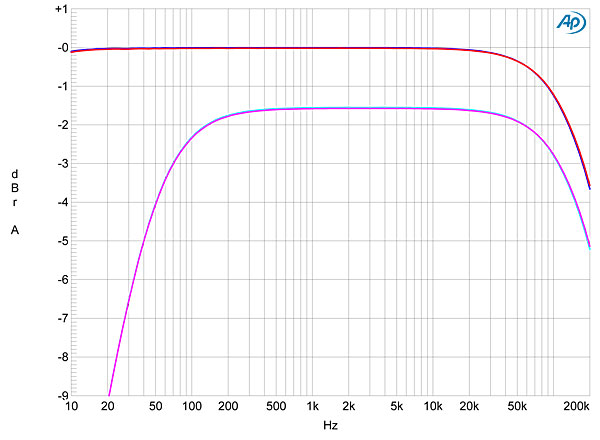
The XP-30's frequency response into high impedances was flat in the audioband, with the channels superbly matched (fig.1, blue and red traces), and down by 3dB at a very high 170kHz. The frequency bandwidth was independent of the volume-control setting, but into the very low 600 ohms impedance the low frequencies rolled off prematurely (fig.1, cyan and magenta traces). However, as long as the power amplifier with which the XP-30 is used has an input impedance of 10k ohms or more, the Pass will offer extended bass response.
 As expected from its dual-mono topology, the XP-30's channel separation was outstanding, at 130dB below 2kHz (not shown). I measure a preamplifier's signal/noise ratio with the input short-circuited but with the volume control set to its maximum, which is very much the worst case. Even so, the XP-30's unweighted, wideband S/N (ref. 1V) was superb, at 96.5dB in both channels. With A-weighting, the ratio increased to 109.1dB. Fig.2 shows the spectrum of the noise floor while the XP-30 drove a 1kHz tone into 100k ohms. Other than tiny blips at the supply-related frequencies of 180 and 300Hz in the right channel (red trace), the noise is free from spuriae of any kind.
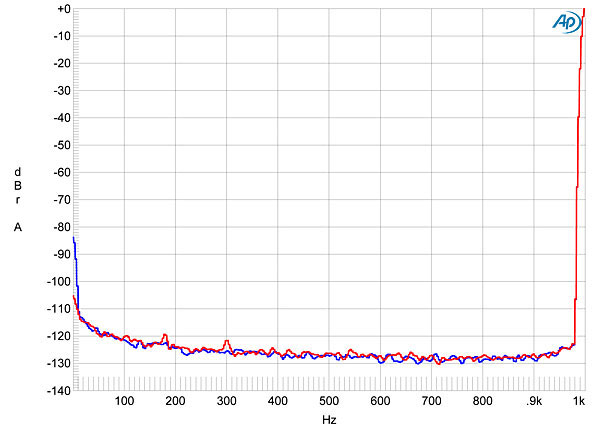
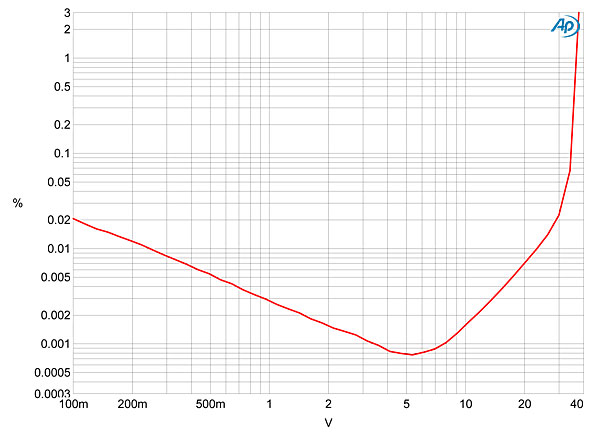
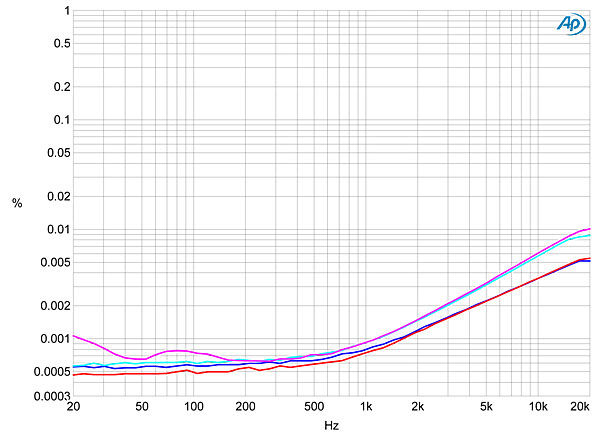
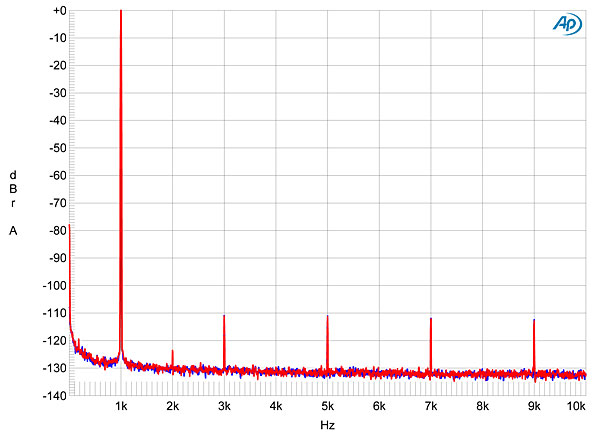
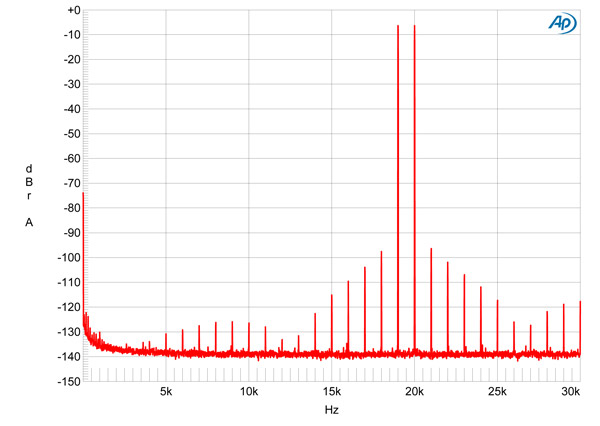
Fig.1 Pass Labs XP-30, balanced frequency response with volume control set to "99" at 1V, into: 100k ohms (left channel blue, right red), 600 ohms (left cyan, magenta right) (1dB/vertical div.).
Fig.2 Pass Labs XP-30, balanced spectrum of 1kHz sinewave, DC–1kHz, at 2V into 100k ohms (left channel blue, right red; linear frequency scale).
Even with this very low level of noise, distortion was even lower, as can be seen in fig.3, which plots the THD+noise percentage against the balanced output level at 1kHz. The downward slope of the trace below 5V output is due to the reading being dominated by a low but constant level of noise, which steadily becomes a smaller percentage of the output voltage as the latter rises. The distortion begins to rise above 6V, which is above the level the preamp will be required to deliver in practice, but the XP-30 doesn't clip (defined as when THD+N reaches 1%) until around 36V!
Fig.3 Pass Labs XP-30, balanced distortion (%) vs 1kHz output voltage into 100k ohms.
I plotted how the THD+N changed with frequency at a level, 6V, where I could be sure that I was looking at actual distortion rather than noise (fig.4). Even into 600 ohms (cyan and magenta traces), the THD is very low in the midrange and below. And though it rises in the treble, it is still just 0.01% at the top of the audioband. Fig.5, taken with the volume control at unity gain, reveals that the distortion spectrum comprises odd-order harmonics, though these all lie at –110dB (0.0003%) or below. At low frequencies (not shown), there was just a trace of third harmonic. And despite the rise in THD at the top of the audioband, an equal mix of 19 and 20kHz tones was reproduced with very little intermodulation, even into 600 ohms (fig.6), with no difference product visible at 1kHz, and all the higher-order products lying at or below –100dB (0.001%).
Fig.4 Pass Labs XP-30, balanced THD+N (%)vs frequency at 6V into: 100k ohms (left channel blue, right red), 600 ohms (left cyan, right magenta).
Fig.5 Pass Labs XP-30, volume control at unity gain, balanced spectrum of 1kHz sinewave, DC–10kHz, at 1V into 100k ohms (left channel blue, right red; linear frequency scale).
Fig.6 Pass Labs XP-30, balanced HF intermodulation spectrum, DC–30kHz, 19+20kHz at 2V into 600 ohms (left channel blue, right red; linear frequency scale).
This is a superbly well-measuring, bombproof preamplifier.—John Atkinson