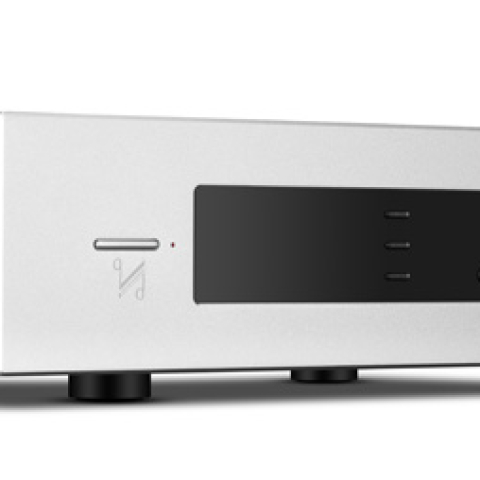
The Kitsuné HiFi KTE LCR-1 MK5 phono stage
Last month, when I was at Richard Cirulnick's place, I noticed he was running a Valab LCR phono stage with his ELAC EMC-1 moving coil. The Valab LCR was the phono stage that became Kitsuné HiFi's $1498 KTE LCR-1 MK5, which I raved about in Gramophone Dreams #50 (footnote 5). Hearing how transparent and vital the Valab sounded in Richard's system made me run home and re-install the KTE LCR-1 MK5 in my system. I wanted to remind myself what low-impedance RIAA sounds like. I'm embarrassed to admit it, but despite its conspicuously natural sonics, the KTE LCR-1 had fallen out of my system because I did not enjoy removing it from my rack every time I changed cartridge loading with the DIP switches on the chassis bottom. I was lured by the convenience of setting gain and loading with knobs and buttons on the front panels of the fancy phono stages I've been reviewing: PrimaLuna's $4495 EVO 100 and MoFi's $5995 MasterPhono made switching cartridges twice a day as easy as smiling. With Schitt Audio's $1699 Stjarna, I was changing loading from my chair with a remote! But I only tried that once, because when I did it, Art Dudley's ghost appeared, scolding me, preaching that remote controls were "Satan's playthings." Today I remembered that those front panel buttons and knobs add cost and engineering complexity that at the very least do not improve the sound. I also remembered that most phonophiles do not change cartridges twice a day like I do.
 In that spirit, the twin-chassis KTE LCR-1 is a minimalist device. It forgoes all unnecessary complexity and all front-panel features and puts the money on the stuff inside its two sturdy chassis, one with a substantial power transformer and beefy energy storage. The other chassis holds four large inductors, top-quality capacitors, and premium resistors for the RIAA. (That's what "LCR" stands for.)
Both the Valab and KTE LCR stages were designed by Korean engineer Kuo-Wei Tsai, also known as Kevin Valab. Kuo-Wei's original design was inspired by the totally passive and extremely expensive Japanese-made Tango EQ-600P LCR RIAA module, which itself was a recreation of the original Pultec/Western Electric phono-equalizer circuit.
Beethoven's piano and chamber compositions are the music I use to escape quotidian anxieties, focus my mind, and elevate my consciousness. Beethoven's piano trios on German EMI 1C 163-02 046/050 (five LPs; footnote 6), played by Pinchas Zukerman (violin), Jacqueline du Pré (cello), and Daniel Barenboim (piano), are among my first-choice discs for observing the workings of Beethoven's mind—and assessing the performance of phonographic components.
In that spirit, the twin-chassis KTE LCR-1 is a minimalist device. It forgoes all unnecessary complexity and all front-panel features and puts the money on the stuff inside its two sturdy chassis, one with a substantial power transformer and beefy energy storage. The other chassis holds four large inductors, top-quality capacitors, and premium resistors for the RIAA. (That's what "LCR" stands for.)
Both the Valab and KTE LCR stages were designed by Korean engineer Kuo-Wei Tsai, also known as Kevin Valab. Kuo-Wei's original design was inspired by the totally passive and extremely expensive Japanese-made Tango EQ-600P LCR RIAA module, which itself was a recreation of the original Pultec/Western Electric phono-equalizer circuit.
Beethoven's piano and chamber compositions are the music I use to escape quotidian anxieties, focus my mind, and elevate my consciousness. Beethoven's piano trios on German EMI 1C 163-02 046/050 (five LPs; footnote 6), played by Pinchas Zukerman (violin), Jacqueline du Pré (cello), and Daniel Barenboim (piano), are among my first-choice discs for observing the workings of Beethoven's mind—and assessing the performance of phonographic components.
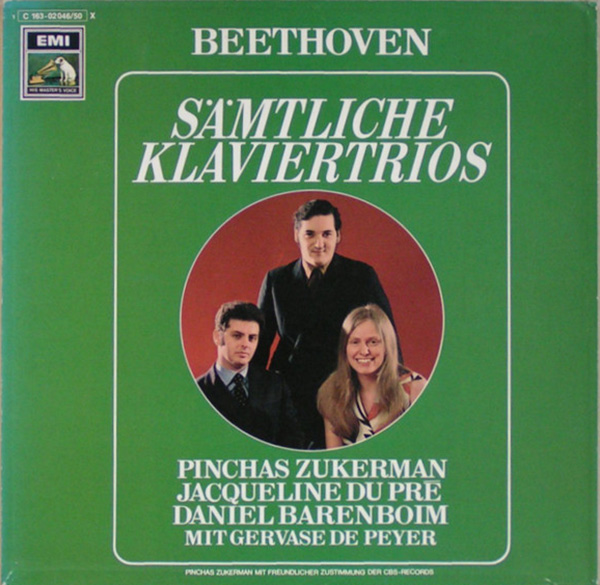 What I heard when I played these high-falutin German discs with the blue-collar LCR-1 and a retipped Shure M3D moving magnet cartridge made me feel certain I'd seriously underestimated both products. Together, these affordable phonobits presented sounds with incredible transparency that felt très moderne. If you've only used conventional RC-type RIAA circuits and never tried an LCR RIAA like the one in the KTE LCR-1, you should prepare for the sound of your sound system to feel subliminally different, texture- and vibrancy-wise. With every cartridge I tried, the LCR-1 presented recordings with a fluid, Ektachrome-like transparency that made other solid state RC stages sound dull and staid.
The LCR-1 did a star turn while playing a five-star mono Lyrita (RCS.19) from 1960. This physically beautiful, joy-to-hold 220gm disc features German-born British composer Franz Reizenstein (1911–1968) playing his own compositions. Simply putting this heavy, green-label record on the platter was a pleasurable experience. Playing both sides got me smirking in awe at one of the most lifelike close-miked piano recordings in my collection. This Lyrita represents a masterful melding of composer, piano artistry, and Lyrita's incomparable sound, which let Nagaoka's MP-200 and KTE's LCR-1 strut their superior liquidity and nuanced dynamics.
What I heard when I played these high-falutin German discs with the blue-collar LCR-1 and a retipped Shure M3D moving magnet cartridge made me feel certain I'd seriously underestimated both products. Together, these affordable phonobits presented sounds with incredible transparency that felt très moderne. If you've only used conventional RC-type RIAA circuits and never tried an LCR RIAA like the one in the KTE LCR-1, you should prepare for the sound of your sound system to feel subliminally different, texture- and vibrancy-wise. With every cartridge I tried, the LCR-1 presented recordings with a fluid, Ektachrome-like transparency that made other solid state RC stages sound dull and staid.
The LCR-1 did a star turn while playing a five-star mono Lyrita (RCS.19) from 1960. This physically beautiful, joy-to-hold 220gm disc features German-born British composer Franz Reizenstein (1911–1968) playing his own compositions. Simply putting this heavy, green-label record on the platter was a pleasurable experience. Playing both sides got me smirking in awe at one of the most lifelike close-miked piano recordings in my collection. This Lyrita represents a masterful melding of composer, piano artistry, and Lyrita's incomparable sound, which let Nagaoka's MP-200 and KTE's LCR-1 strut their superior liquidity and nuanced dynamics.
 One more record
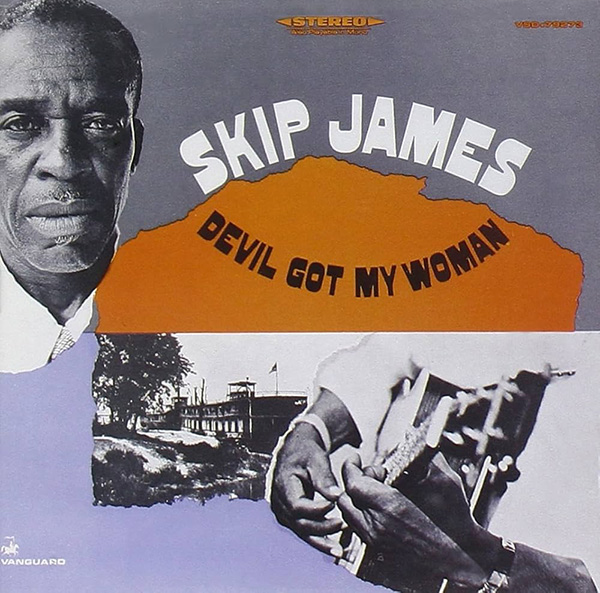
Skip James was a preternaturally talented American blues artist that I might have, could have, but didn't see perform after John Fahey lifted him from obscurity in 1964. For me, it was a major event when his LP, Devil Got My Woman (Vanguard VSD 79273), was released in 1968, one year before he died in 1969. Before that, James made two microgrooves, one in '64 and the other in '66. Before that he recorded 18 78rpm sides on Paramount, in 1931. Maybe someday I'll get lucky and hear one at the Hot Club of New York.
I borrowed a 681EEE high-compliance moving iron cartridge because I've never owned a Stanton cartridge and I was curious how its character would suit my system and my temperament. I set the 681 to a Stevenson alignment and verified its Level Five tracking with Shure's Era IV test record. My initial impressions suggested this: Stevenson + Shibata = quiet and detailed. Stevenson + Elliptical = alive and dancing. There is wisdom in choosing a stylus profile to match your personality type, or your mood. I didn't know it in advance, but my borrowed sample of the Stanton 681EEE came with a Jico D6800EEE-S Shibata stylus ($256)—a disappointment because most of the broadcast-quality cartridges I've tried used either spherical or elliptical diamonds, and my reason for auditioning these vintage nail-draggers was to play vintage recordings with period-correct broadcast-quality transducers.
 Before they ran out, LP Gear had new old stock 681EEEs (with Stanton's original 0.3 × 0.7mil elliptical stylus) for $598. But you can buy a used 681EEE for under $200 on eBay and a newly manufactured 0.3 × 0.7 elliptical stylus from LP Gear for $108. Which I did. To start, I wanted to see which stylus profile gave me the biggest dose of that Channel One Records vibe with a particular recording: a big-hole 45 pressed in Kingston, Jamaica, in 1977, with vocalist Tinga Stewart backed by the Mighty Diamonds. I first heard it on the only station in the nation with a Caribbean education: WLIB (footnote 7). The disc has no catalog number, but I remember playing it at a loft party in DUMBO where everyone got up and waved their hands while singing along with the chorus.
Sing and danceMy copy is scruffy, but with the 681, its well-organized clarity drew me right in. The extreme intelligibility of Tinga Stewart's voice was such that repeating the words "sing and dance" became redemptive spell-breakers. The disc's ability to convey that song's I-shall-be-released messaging is the Channel One vibe I was hoping to reproduce. I thought the elliptical stylus did a better job eliciting those gospel feelings than the Shibata-equipped version. This is music with a social message I wanted to feel, not an audiophile recording where I needed to perv on its inner detail. I have not streamed a Qobuz file in 12 weeks. Playing old records with vintage moving magnet pickups has made my sound system a fun new place to hang out.
Sing and dance
Sing and dance
Sing
 Speaking of fun: In the Technics room at the T.H.E. Show NYC, Bill Voss played Sonny & Cher's original 1968 recording of "I Got You Babe" from a Greatest Hits album on Atco Records. With the new Technics SL-1210 Master Edition turntable and a Nagaoka MP-700 moving magnet cartridge, these swinging pop-culture icons sounded so "as I remember it" right that I told Bill I was going home to buy an original 45 of that song. Which I did. My VG+ copy (Atco 45-6359) cost $11.98 including free shipping and a crisp mint-minus outer sleeve. With the Stanton 681, Sorane SA-1.2 tonearm, Dr. Feickert Blackbird turntable, and Luxman E-07 phono stage, I laughed out loud at how fresh, timeless, and tone-balanced this music sounded—not to mention how close its vocal tones matched my memories of Sonny & Cher coming out of the dashboards of people's cars.
Most interesting was how after hearing the Sonny & Cher duo a million times on TV and radio, I could hear how my brain had completed their vocal gestalt. That what I thought they should sound like was likely an extrapolation from countless media inputs. In other words, my brain knew, better than mine or Bill Voss's reproduction system, what these artists really sounded like.
And here's the funny part of the story: It's a week later, and all day long, everywhere I go, even lying in bed at night, all I hear is snippets of "I Got You Babe" playing over and over in my head.
Speaking of fun: In the Technics room at the T.H.E. Show NYC, Bill Voss played Sonny & Cher's original 1968 recording of "I Got You Babe" from a Greatest Hits album on Atco Records. With the new Technics SL-1210 Master Edition turntable and a Nagaoka MP-700 moving magnet cartridge, these swinging pop-culture icons sounded so "as I remember it" right that I told Bill I was going home to buy an original 45 of that song. Which I did. My VG+ copy (Atco 45-6359) cost $11.98 including free shipping and a crisp mint-minus outer sleeve. With the Stanton 681, Sorane SA-1.2 tonearm, Dr. Feickert Blackbird turntable, and Luxman E-07 phono stage, I laughed out loud at how fresh, timeless, and tone-balanced this music sounded—not to mention how close its vocal tones matched my memories of Sonny & Cher coming out of the dashboards of people's cars.
Most interesting was how after hearing the Sonny & Cher duo a million times on TV and radio, I could hear how my brain had completed their vocal gestalt. That what I thought they should sound like was likely an extrapolation from countless media inputs. In other words, my brain knew, better than mine or Bill Voss's reproduction system, what these artists really sounded like.
And here's the funny part of the story: It's a week later, and all day long, everywhere I go, even lying in bed at night, all I hear is snippets of "I Got You Babe" playing over and over in my head.
Footnote 5: Kitsuné HiFi, 19410 Highway 99, Suite A #366, Lynnwood, WA 98036. Web: kitsunehifi.com. Footnote 6: Side 2 of the last disc includes Beethoven's Clarinet Trio, Op.11, with Gervase de Peyer on the wind instrument. Footnote 7: Still broadcasting in NYC, 1190 on the AM dial, though it is far less interesting these days: Since January 2025, it has been rebroadcasting the Spanish language/Adult Contemporary music from "La Exitosa, 98.7 FM." As I write this, the most recently played songs were by Phil Collins, Wilson Phillips, and Heart.—Jim Austin