The Glimmer Twins were right: If you can't always get what you want, sometimes, you just might find, you get what you need. Take Ayre's K-1 preamplifier, for instance. I'd been trying to get Ayre to send me their $3750 V-3 power amplifier since the moment I started writing for Stereophile; after approximately a year and a half, I finally got a phone call from then Marketing Director Bruce Van Allen.  "So when are you going to send me that verklempt amplifier?" I demanded. "Actually, we're more excited about our new K-1 preamplifier. Let us send you that instead." Smelling a stronger bargaining position than I'd had since the start of negotiations, I held firm. "Love to look at the preamp, Bruce—after the amplifier review." "[sigh] You win." Not long after that, Bruce and Charles Hansen, Ayre's Research Director, arrived in Santa Fe with a V-3 for me to review (footnote 1). "What's that?" I asked, pointing to a bulky, unmarked box they were unloading from their car.
"It's the first production K-1 preamplifier. We haven't even shipped any to our dealers yet. We figured that as long as we were here, we'd show it to you." Just what I needed—another preamp to review. I only had five waiting in line before it. "[sigh] You win." They'd arrived fully prepared. They had extra volume controls and circuit boards to serve as visual aids, and we popped the top off SN#0001 and rooted around for several hours. By the time they were through, I was whimpering. "So, you're leaving it—right?"
"Sorry, Wes, we have to take it back with us." "But I want it, I want it, I WANT it!" "YOU CAN'T HAVE IT!" It's hard to maintain your professional dignity once you start singing choruses of "The Magic Bus" with manufacturers. Sensing I no longer had the upper hand, I did what I could—I groveled shamelessly. I was put in the queue to receive a K-1, when available. After a small eternity, I finally received one. One man"s "Simple!" is another man's "Huh?"
"So when are you going to send me that verklempt amplifier?" I demanded. "Actually, we're more excited about our new K-1 preamplifier. Let us send you that instead." Smelling a stronger bargaining position than I'd had since the start of negotiations, I held firm. "Love to look at the preamp, Bruce—after the amplifier review." "[sigh] You win." Not long after that, Bruce and Charles Hansen, Ayre's Research Director, arrived in Santa Fe with a V-3 for me to review (footnote 1). "What's that?" I asked, pointing to a bulky, unmarked box they were unloading from their car.
"It's the first production K-1 preamplifier. We haven't even shipped any to our dealers yet. We figured that as long as we were here, we'd show it to you." Just what I needed—another preamp to review. I only had five waiting in line before it. "[sigh] You win." They'd arrived fully prepared. They had extra volume controls and circuit boards to serve as visual aids, and we popped the top off SN#0001 and rooted around for several hours. By the time they were through, I was whimpering. "So, you're leaving it—right?"
"Sorry, Wes, we have to take it back with us." "But I want it, I want it, I WANT it!" "YOU CAN'T HAVE IT!" It's hard to maintain your professional dignity once you start singing choruses of "The Magic Bus" with manufacturers. Sensing I no longer had the upper hand, I did what I could—I groveled shamelessly. I was put in the queue to receive a K-1, when available. After a small eternity, I finally received one. One man"s "Simple!" is another man's "Huh?"
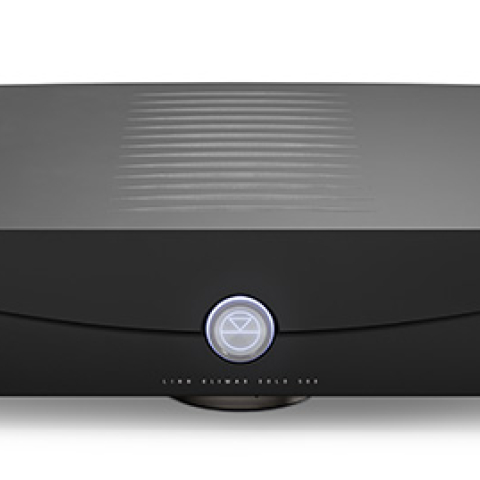
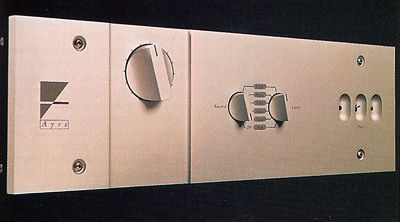
Costing $5250 in its basic form, $7100 with remote control and phono stage, the K-1 has a ½" aluminum front panel, with a decorative dado carved out for the massive volume control on the left side. In the center of the panel are two rotary knobs; one selects input, the other selects a recording source. Although the name plaques between these knobs are labeled B1, Phono, B3, S1, S2, and S3, the metalized adhesive labels that come with the unit allow the user to relabel the plaques more specifically. On the fascia's right, three ovoid dimples are carved into the aluminum: One houses the IR sensor for the remote; one has the touch-activated Mute/Play knife switch set into it; and the last houses a three-color LED. During power-up, this shines red; counterintuitively, green means "mute" and blue means "play." I asked Charlie Hansen about this. "If you're at a stoplight and the light turns green, what does that mean?" "Green means 'go,' sure. But on this preamp, green means 'ready to go'." "And what does blue stand for?" "Blue means 'bliss.' We could have made blue mean 'mute' and green mean 'play,' but I don't think the green in LEDs is particularly attractive—it's sort of yellowish and ugly—whereas the blue is rich and inviting. I figured that most people would have the amp in play mode most of the time, and I'd personally rather look at the blue.
"But you do expect green to mean 'play.' It's even happened to me—I'd be turning it up and up and then realize that I wasn't getting any sound because the preamp was muted. We didn't do it to fool people. But the green LED is brighter and more attention-getting, and we figured it made more sense to call attention to the fact that the unit was in mute by using the brightest light for it."
Footnote 1: The V-3 review appeared in the August 1996 issue of Stereophile (Vol.19 No.8).
"So when are you going to send me that verklempt amplifier?" I demanded. "Actually, we're more excited about our new K-1 preamplifier. Let us send you that instead." Smelling a stronger bargaining position than I'd had since the start of negotiations, I held firm. "Love to look at the preamp, Bruce—after the amplifier review." "[sigh] You win." Not long after that, Bruce and Charles Hansen, Ayre's Research Director, arrived in Santa Fe with a V-3 for me to review (footnote 1). "What's that?" I asked, pointing to a bulky, unmarked box they were unloading from their car. Costing $5250 in its basic form, $7100 with remote control and phono stage, the K-1 has a ½" aluminum front panel, with a decorative dado carved out for the massive volume control on the left side. In the center of the panel are two rotary knobs; one selects input, the other selects a recording source. Although the name plaques between these knobs are labeled B1, Phono, B3, S1, S2, and S3, the metalized adhesive labels that come with the unit allow the user to relabel the plaques more specifically. On the fascia's right, three ovoid dimples are carved into the aluminum: One houses the IR sensor for the remote; one has the touch-activated Mute/Play knife switch set into it; and the last houses a three-color LED. During power-up, this shines red; counterintuitively, green means "mute" and blue means "play." I asked Charlie Hansen about this. "If you're at a stoplight and the light turns green, what does that mean?" "Green means 'go,' sure. But on this preamp, green means 'ready to go'." "And what does blue stand for?" "Blue means 'bliss.' We could have made blue mean 'mute' and green mean 'play,' but I don't think the green in LEDs is particularly attractive—it's sort of yellowish and ugly—whereas the blue is rich and inviting. I figured that most people would have the amp in play mode most of the time, and I'd personally rather look at the blue.
Footnote 1: The V-3 review appeared in the August 1996 issue of Stereophile (Vol.19 No.8).