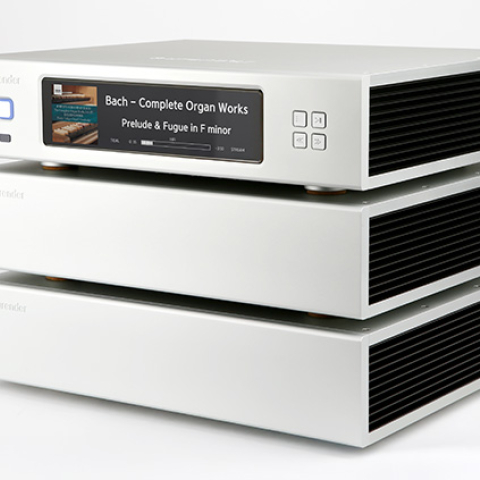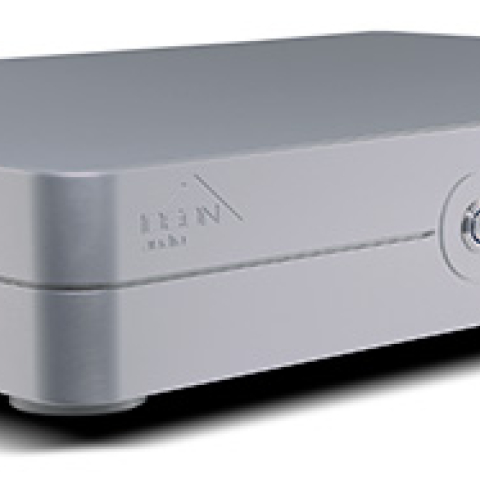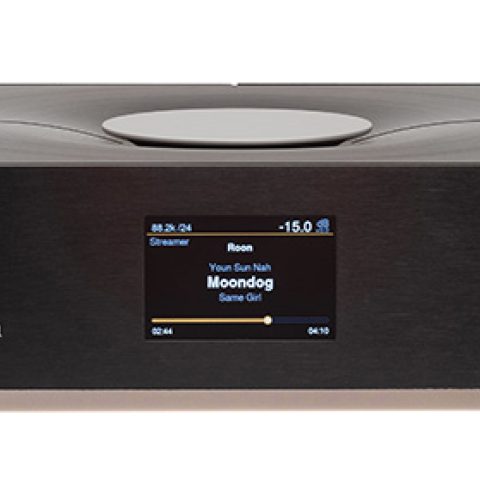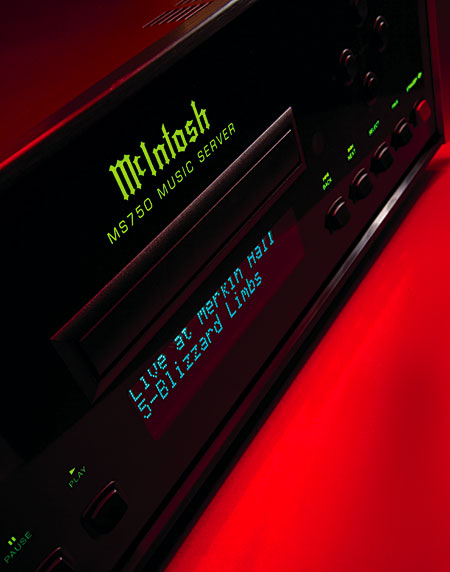
It has a fan, it won't work without a monitor, and it contains a 750GB hard drive—for some audiophiles, that's a trifecta of reasons not to buy the McIntosh MS750 music server ($6000).
There are cheaper ways to incorporate a music server into your hi-fi—hello, Slim Devices Squeezebox. And there are whole-system approaches—the Sonos ZP80-ZP100 combo, for example. The MS750 is aimed somewhere between the two. It doesn't require as much computer savvy as the Squeezebox does, nor does it require you to buy an entire system. It's perhaps the easiest way to add digital storage to an existing hi-fi or a whole-house integrated system.
 Also, the MS750 is a McIntosh. For McIntosh owners—some would say believers—that would be enough in itself. They buy into the corporate philosophy, which goes deeper than the black-glass front panel and the blue lights. Mac gear retains its resale value, lasts for years, and is supported by the mothership in Binghamton, New York, many decades after it was manufactured.
If you'd invested in an all-Mac system rather than a mortgage in the last five years, you might have come out ahead in equity.
Built like a Mack truck
Also, the MS750 is a McIntosh. For McIntosh owners—some would say believers—that would be enough in itself. They buy into the corporate philosophy, which goes deeper than the black-glass front panel and the blue lights. Mac gear retains its resale value, lasts for years, and is supported by the mothership in Binghamton, New York, many decades after it was manufactured.
If you'd invested in an all-Mac system rather than a mortgage in the last five years, you might have come out ahead in equity.
Built like a Mack truck
The MS750 is built on an Escient platform (the $4000 FireBall MX752, near as I can figure), but with a few crucial differences, primarily the software interface, CD burner, front-panel display, and the 750GB hard drive, which McIntosh's product manager, Ron Cornelius, described as a "mission-critical Seagate." Huh? "It's an industry term that describes the rate of failure over years," Cornelius said. "Essentially, we had to use something that would stand up for decades of heavy use, because that's what McIntosh is about."
However, because McIntosh and Escient are both part of D&M Holdings, Escient's help line also provides support to MS750 owners—which is a good thing.
The MS750 has a huge amount of connectivity, including RS-232C connectors, video outputs (composite, S-video, and component), analog inputs and outputs (single-ended), digital inputs and outputs (coaxial and TosLink), and Ethernet. The MS750 connects to a modem or WiFi network with the Ethernet cable to automatically download Gracenote metadata for its files. Transferring a CD to the server takes about five minutes; you can choose MP3 at various rates, or lossless FLAC for full resolution "CD quality." I chose FLAC for my auditioning.
The MS750 is ready to be incorporated into any sophisticated system. It can be controlled by just about any external touchscreen remote-control panel—consumers such as I who don't have one handy will need a monitor to set up the system and use some of the more complicated features, such as inputting metadata on discs that aren't in the Gracenote database. Of the 500 or so discs I loaded into the MS750, I had to manually enter only four. (This can be done—laboriously—with the remote, or much more easily with a computer.)
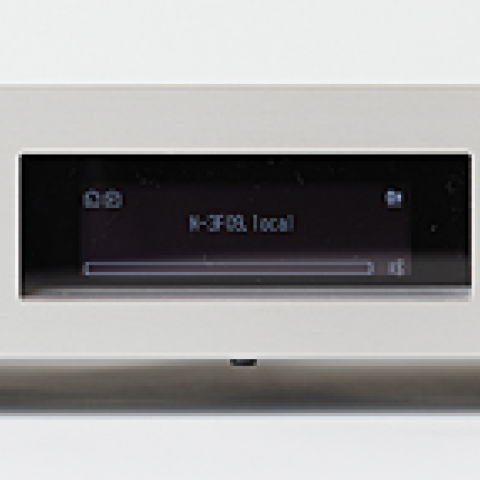
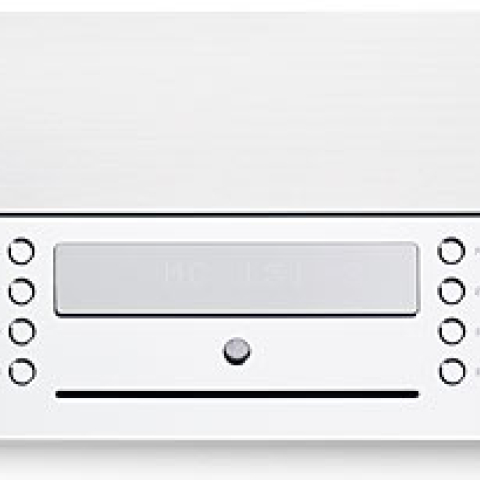
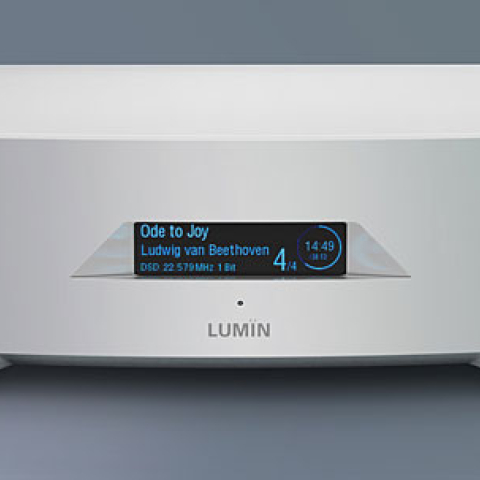
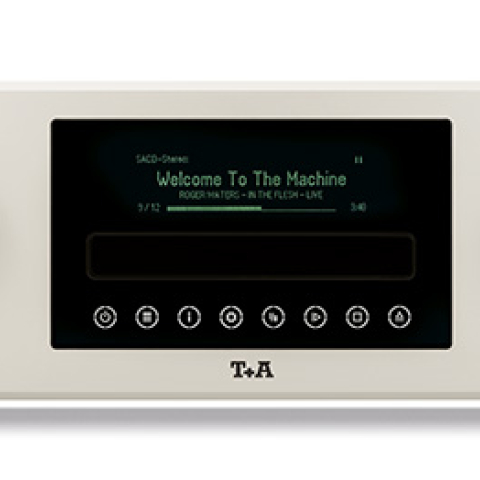
The MS750's front panel has an alphanumeric display that will tell you the song title and musical category of the song playing, but for more information, such as finding a specific track or creating a playlist, you'll need that monitor or touchscreen controller.
The MS750 has analog inputs that allow you to record external analog sources, such as, say, LPs. I'm sure this is a selling point for some, but it's one that I doubt will be used by most Mac owners. It's a bit of a pain in the keister, and you're going to have to really want to rip that analog source in real time, then edit the recording into individual tracks and enter the metadata yourself. And if you want to use the CD burner, you're going to have to feed it royalty-paid CD blanks (not cheap "data" discs).
The MS750 will let you transfer digital files from your computer via your WiFi interface, from either PCs or Apple computers (I almost said Macs, but that would get confusing). It also lets you surf Web radio, which can allow you to sample new music, albeit generally at disappointing data rates.
What's the setup, Mac?
Setting up the MS750 was fairly simple, even if it requires an Ethernet connection and a monitor or touchscreen panel. That requirement wasn't immediately apparent until the MS750 helpfully prompted me by displaying the message "CONNECT MONITOR." Once I'd done that, the server guided me through several screens of preliminary settings, shaking hands with my WiFi network, asking how I wanted to rip files, and whether or not it should automatically rip CDs upon insertion—basic housekeeping.
Also, the MS750 is a McIntosh. For McIntosh owners—some would say believers—that would be enough in itself. They buy into the corporate philosophy, which goes deeper than the black-glass front panel and the blue lights. Mac gear retains its resale value, lasts for years, and is supported by the mothership in Binghamton, New York, many decades after it was manufactured.
The MS750 is built on an Escient platform (the $4000 FireBall MX752, near as I can figure), but with a few crucial differences, primarily the software interface, CD burner, front-panel display, and the 750GB hard drive, which McIntosh's product manager, Ron Cornelius, described as a "mission-critical Seagate." Huh? "It's an industry term that describes the rate of failure over years," Cornelius said. "Essentially, we had to use something that would stand up for decades of heavy use, because that's what McIntosh is about."
Setting up the MS750 was fairly simple, even if it requires an Ethernet connection and a monitor or touchscreen panel. That requirement wasn't immediately apparent until the MS750 helpfully prompted me by displaying the message "CONNECT MONITOR." Once I'd done that, the server guided me through several screens of preliminary settings, shaking hands with my WiFi network, asking how I wanted to rip files, and whether or not it should automatically rip CDs upon insertion—basic housekeeping.